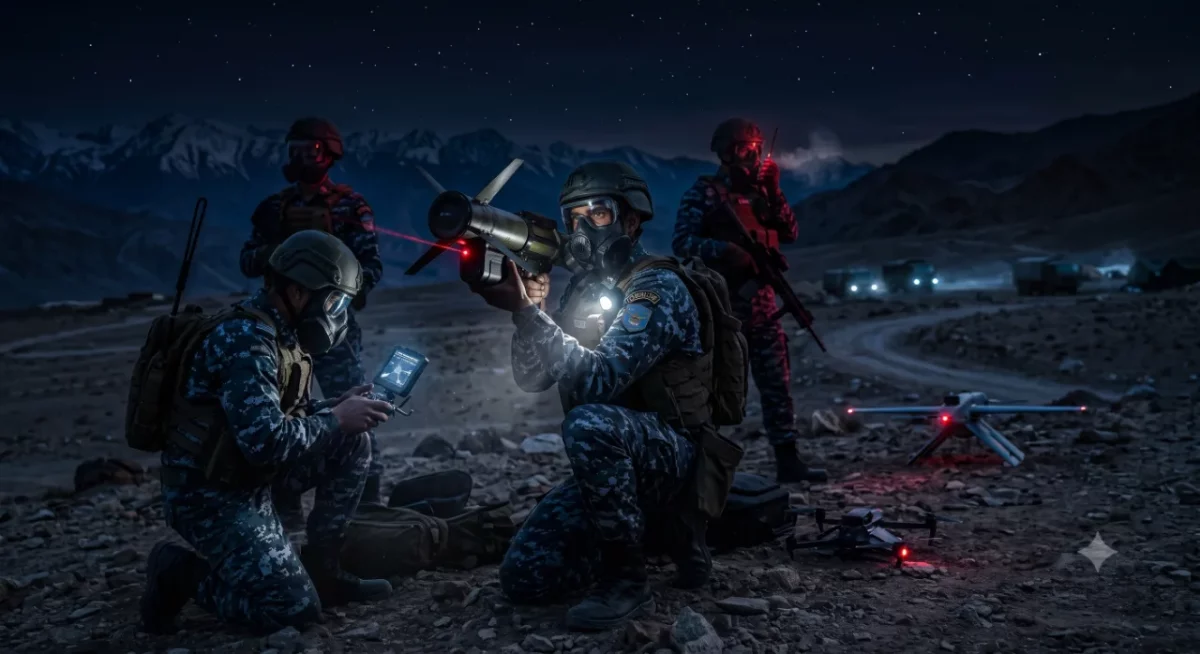
The Indian Air Force (IAF) has initiated plans to significantly enhance the combat capabilities of its elite Garud Commando Force by issuing a Request for Information (RFI) for indigenous man-portable loitering munitions. The proposed acquisition is aimed at providing Garud commandos with an organic precision-strike capability that combines real-time surveillance, target acquisition and lethal engagement, enabling them to operate more effectively in complex and contested operational environments.





Issued under the Government’s Make in India initiative, the RFI seeks indigenous solutions capable of meeting the operational requirements of the Air Force’s special operations units. The move reflects the growing importance of loitering munitions in modern warfare and underscores the Indian military’s continued emphasis on indigenous defence technology and advanced battlefield capabilities.
According to the RFI, the proposed loitering munition must be lightweight and man-portable, allowing small special forces teams to carry and deploy the system without requiring heavy launch platforms or specialised logistical support. The weapon is expected to have a minimum operational range of 40 kilometres, an endurance of more than two hours and the ability to carry both High Explosive (HE) and High Explosive Anti-Tank (HEAT) warheads, enabling it to engage a wide variety of targets, including enemy personnel, fortified positions and armoured vehicles.
Loitering munitions, often referred to as “kamikaze drones,” combine the capabilities of an unmanned aerial surveillance platform and a precision-guided weapon. Once launched, the system can remain airborne over a designated area for an extended period, transmitting real-time video and intelligence to operators. Upon identifying a suitable target, the operator can direct the munition to strike with high precision. If operational conditions change or the target is no longer valid, the mission can be aborted, providing commanders with greater tactical flexibility and reducing the risk of collateral damage.
For the Garud Commando Force, the induction of such systems would represent a substantial leap in operational capability. Unlike conventional infantry weapons or anti-tank guided missiles, which typically have an effective range of around four to five kilometres, the proposed loitering munition would enable commandos to detect, monitor and engage targets at distances exceeding 40 kilometres. This would allow special operations teams to conduct long-range precision strikes independently without relying immediately on artillery, aircraft or other supporting fire assets.
In addition to its strike capability, the loitering munition would provide Garud teams with valuable Intelligence, Surveillance and Reconnaissance (ISR) capabilities. Real-time aerial imagery would enhance situational awareness during missions conducted deep behind enemy lines, allowing commanders to assess enemy movements, identify potential threats and modify operational plans based on live battlefield information.
Such capabilities are expected to prove particularly valuable during operations in mountainous terrain, dense forests, urban environments and other areas where conventional surveillance and fire support may be difficult to employ. The combination of extended range, precision engagement and organic reconnaissance is expected to significantly improve the effectiveness of special operations while minimising risks to personnel and reducing collateral damage.
The Indian Air Force has also placed considerable emphasis on survivability in contested electromagnetic environments. The RFI specifies that the system should be capable of operating effectively in GPS-denied conditions and demonstrate resilience against electronic warfare measures employed by technologically advanced adversaries. These requirements reflect the growing importance of electronic warfare protection as modern battlefields become increasingly contested in both the physical and electromagnetic domains.
The Garud Commando Force, raised in 2004, serves as the Indian Air Force’s specialised special operations unit. Its responsibilities include protecting critical air force installations, conducting counter-terrorism and counter-insurgency operations, executing combat search and rescue missions, undertaking special reconnaissance and supporting strategic military operations. Over the years, the force has evolved into one of India’s premier special operations units, trained to operate across diverse operational environments.
Globally, loitering munitions have emerged as one of the defining technologies of contemporary warfare. Recent conflicts, particularly the Russia-Ukraine war, have demonstrated their effectiveness in destroying armoured vehicles, artillery positions, command posts and fortified defensive positions while providing commanders with unprecedented battlefield flexibility. Systems such as the United States’ Switchblade, Poland’s Warmate, Türkiye’s Kargu and Israel’s Harop have highlighted the growing role of loitering munitions in modern military operations.
The Indian Armed Forces have also increasingly embraced loitering munition technology in recent years, recognising its value as a force multiplier across conventional and special operations. The latest IAF initiative aligns with the broader military modernisation programme focused on integrating unmanned systems, artificial intelligence, autonomous platforms and precision-guided weapons into future battlefield operations.
By seeking indigenous man-portable loitering munitions, the Indian Air Force is not only strengthening the operational capabilities of the Garud Commando Force but also supporting the domestic defence manufacturing ecosystem. Once inducted, these advanced systems are expected to significantly enhance the Garuds’ ability to conduct precision stand-off strikes, gather actionable intelligence and execute high-risk missions with greater autonomy, flexibility and effectiveness, further reinforcing India’s special operations capabilities in an increasingly technology-driven security environment.