

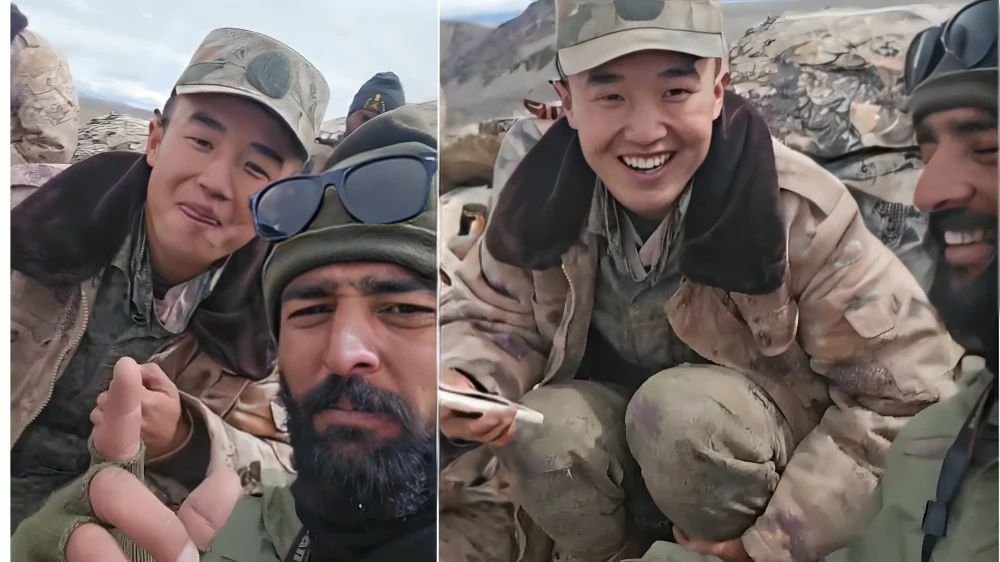
In a heartwarming scene from the Line of Actual Control (LAC), soldiers of the Indian Army and China’s People’s Liberation Army (PLA) were seen sharing friendly moments during a border interaction, highlighting the gradual improvement in relations along one of the world’s most sensitive frontiers. A video from the interaction has attracted widespread attention after Chinese soldiers were heard singing the popular Bollywood song Aankhein Khuli from Shah Rukh Khan’s blockbuster film Mohabbatein, drawing smiles from the Indian troops and social media users alike. Reports and viral videos indicate the interaction took place during a routine border personnel meeting or ceremonial engagement along the LAC.

The choice of the iconic Bollywood song underscored the enduring popularity of Indian cinema in China and demonstrated how cultural connections can occasionally transcend geopolitical differences. Bollywood films, particularly those featuring Shah Rukh Khan, continue to enjoy a dedicated following among Chinese audiences, making the moment symbolic of the softer side of India-China relations even amid a complex strategic environment.
Such cordial exchanges are not entirely new. Troops deployed along certain sectors of the Line of Actual Control have traditionally participated in Border Personnel Meetings (BPMs) on occasions such as national days and military anniversaries. These interactions often include greetings, exchange of souvenirs, cultural performances and informal conversations aimed at maintaining communication between the two militaries and reducing the risk of misunderstandings along the disputed frontier.
The friendly atmosphere, however, stands in sharp contrast to the tensions that have characterised India-China relations over the past several years. Bilateral ties deteriorated significantly following the violent Galwan Valley clash in June 2020, in which soldiers from both sides lost their lives during the deadliest confrontation along the border in decades. The incident fundamentally altered the security environment along the LAC and prompted both countries to undertake large-scale military deployments across eastern Ladakh.
Since then, India and China have maintained thousands of troops, armoured vehicles, artillery systems and air defence assets along the frontier while simultaneously engaging in multiple rounds of military commander-level and diplomatic talks aimed at reducing tensions. Several friction points have witnessed phased disengagement, accompanied by the creation of temporary buffer zones designed to prevent direct confrontations and restore stability along the border.
In recent months, both sides have continued efforts to stabilise the situation through sustained military dialogue and confidence-building measures. While differences over the unresolved boundary dispute remain, there has been a noticeable increase in structured engagement between the two militaries to maintain peace and avoid unintended escalation.
Against this backdrop, the latest interaction between Indian Army personnel and PLA soldiers serves as a reminder that professionalism and communication remain essential elements of border management. Friendly exchanges during officially sanctioned interactions help build familiarity between troops deployed in close proximity and contribute to reducing tensions on the ground without altering either country’s respective strategic positions.
For the Indian Army, maintaining vigilance along the Line of Actual Control continues to remain the foremost priority. At the same time, confidence-building measures and established communication mechanisms are regarded as important tools for preserving stability until a broader resolution of the boundary dispute is achieved.
Although strategic competition between India and China continues across multiple domains—including border security, regional influence and infrastructure development—the sight of soldiers sharing smiles over a Bollywood classic demonstrates that even along one of the world’s most heavily militarised frontiers, moments of goodwill and mutual respect can still emerge. Such interactions do not diminish the seriousness of the unresolved border issues, but they do reinforce the importance of dialogue, restraint and professional military engagement in maintaining peace along the Line of Actual Control.