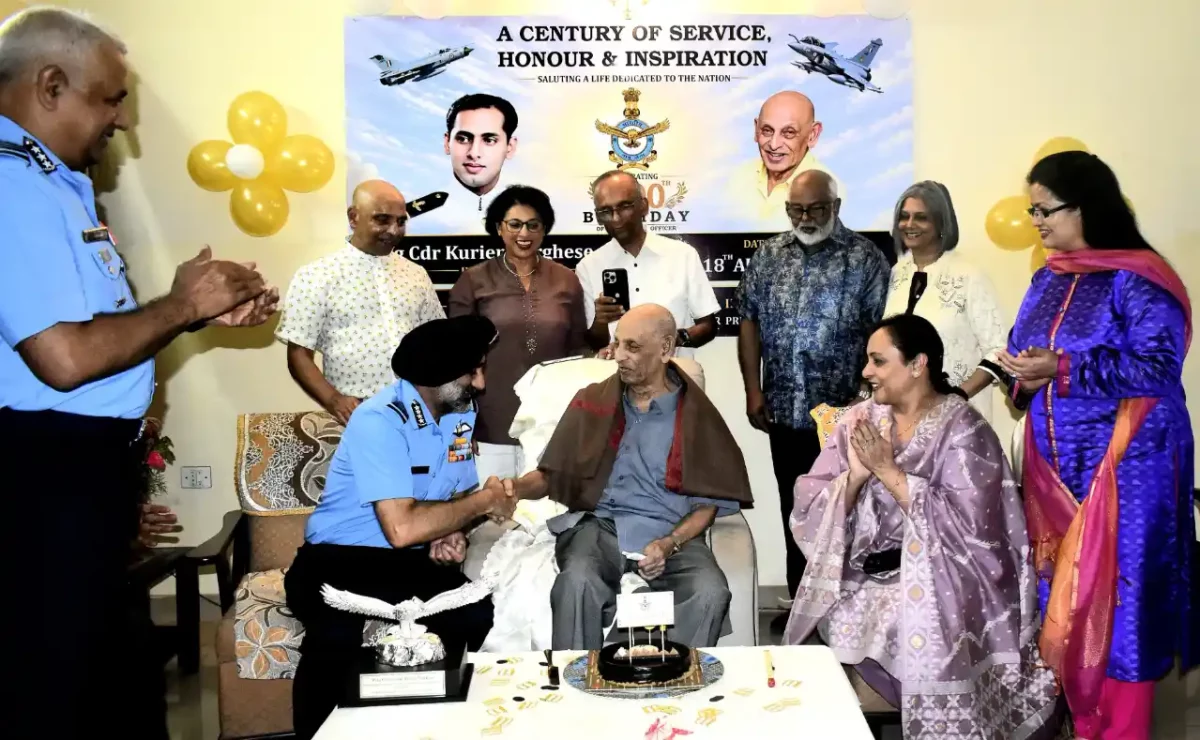
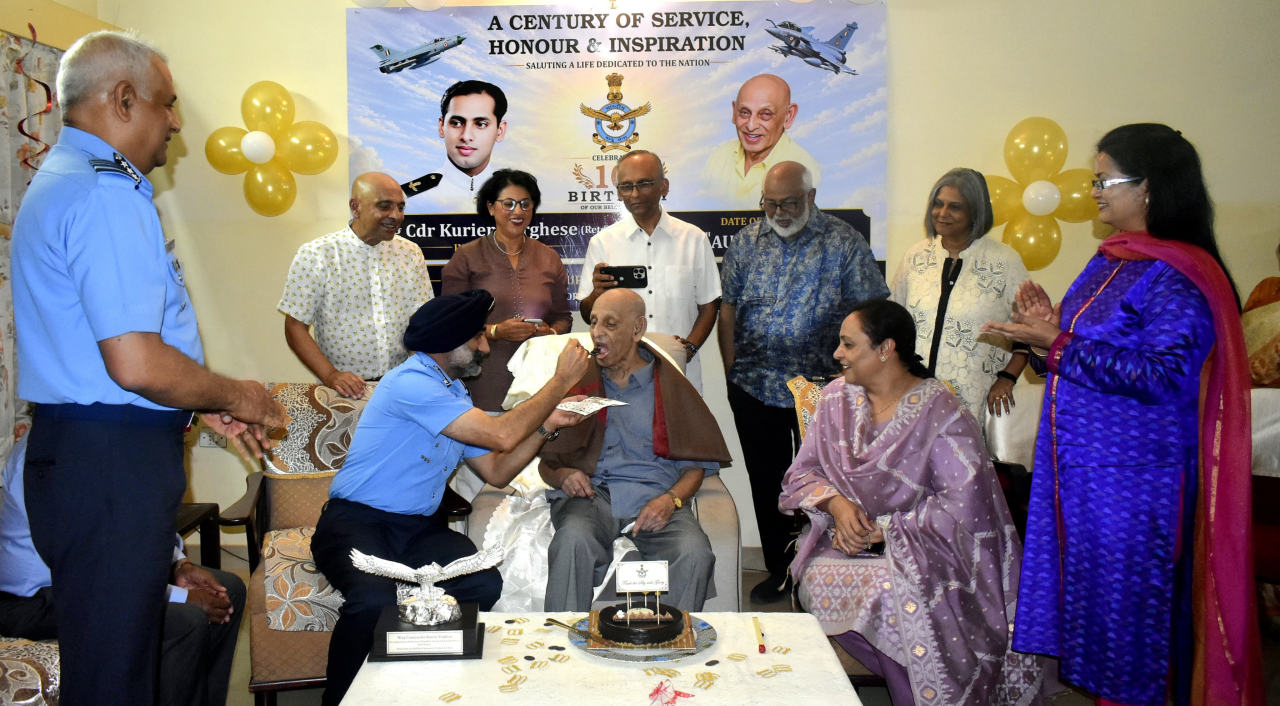
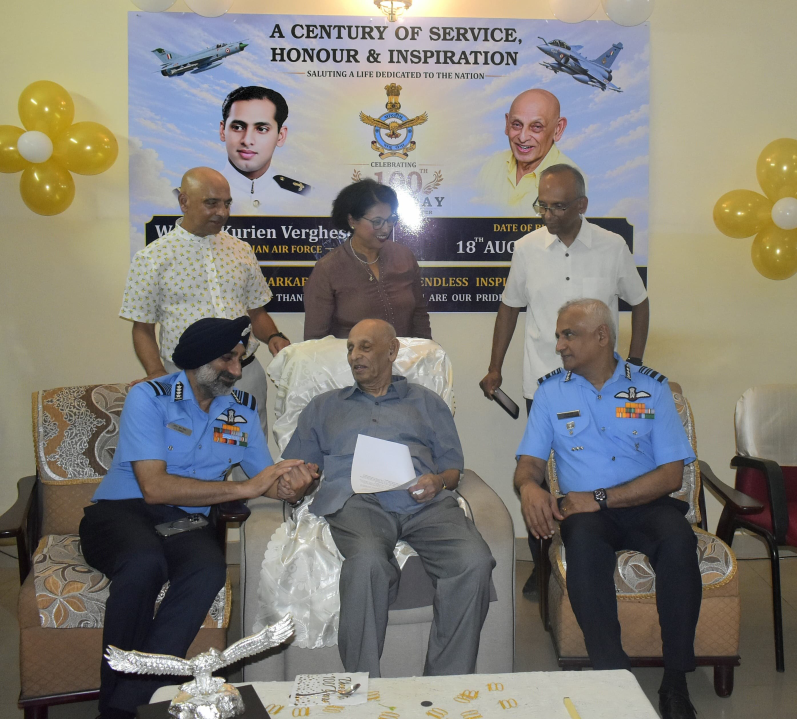
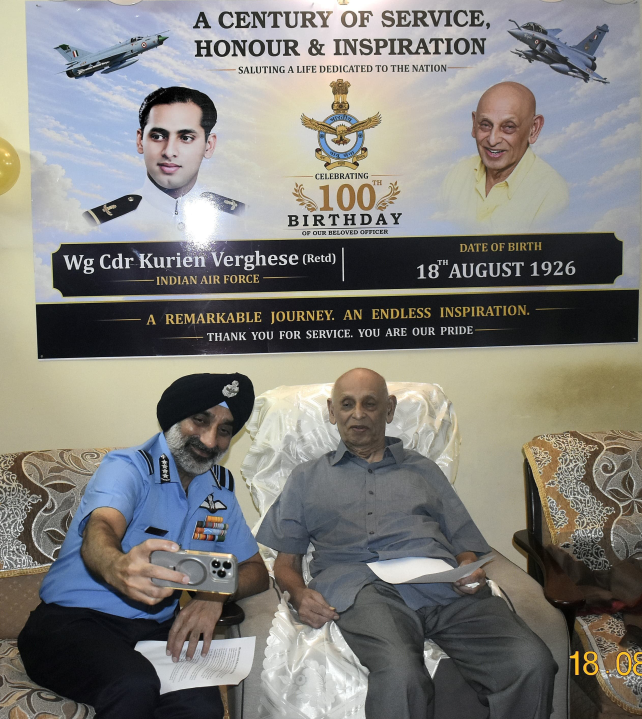
The Indian Air Force (IAF) has celebrated the remarkable life and service of Wing Commander Kurien Verghese (Retd), honouring the distinguished veteran on the occasion of his 100th birthday. Chief of the Air Staff Air Chief Marshal AP Singh personally felicitated the centenarian at his residence in Bengaluru on 18 August 2026, marking a rare and memorable occasion that brought together generations of the Air Force fraternity.





The centenary celebrations were attended by Mrs Sarita Singh, President of the Air Force Family Welfare Association (AFFWA); Air Marshal S Shrinivas, Air Officer Commanding-in-Chief, Training Command; Mrs Sunita Shrinivas, President AFFWA (Regional); and several Air Force veterans. The gathering paid tribute to a veteran whose association with the Indian Air Force stretches back to the formative years of the Republic.
Wing Commander Kurien Verghese occupies a special place in the history of the IAF. He was commissioned on 26 January 1950—the very day the Constitution of India came into effect and India formally became a Republic. He was consequently among the first batch of Air Force officers commissioned in the newly established Indian Republic.
Historical records corroborate that Kurien Verghese was commissioned on 26 January 1950 and served in the Administration branch of the Indian Air Force. Records list him as Service Number 3742 and show that he eventually attained the rank of Wing Commander before retiring from the service on 31 August 1978.
His military career therefore spanned almost three decades and covered an extraordinary period in India’s history, during which the country and its armed forces underwent major transformations. He joined when the Republic itself was being born and served through decades in which the Indian Air Force expanded from a relatively small post-Independence force into a modern military air arm.
Before joining the Air Force, Verghese had pursued higher education in law. In an interview published ahead of Republic Day in 2025, he recalled completing an MA and LLB in Bombay, now Mumbai, and approaching an Air Force recruiting officer even before his law examination results had arrived. Following the selection process, he was sent to Dehradun for the selection board and subsequently proceeded to Delhi after being selected for the Air Force. He recalled the immense pride he felt at being able to wear the Air Force uniform.
His early career was spent at Air Force Headquarters in New Delhi. According to a previously published account of his service, he served at Air Headquarters from around 1949-50 until 1961. He subsequently moved to Bengaluru, serving at Training Command in Hebbal between 1961 and 1964.
In 1965, Verghese attended the Staff College at Coonoor for additional officers’ training. From 1966 to 1969, he served with Eastern Air Command in Shillong before moving to Central Air Command headquarters in Allahabad, now Prayagraj, where he served between 1969 and 1972.
He returned to Bengaluru in 1972 and served there until his retirement in 1978. During this period, he held the rank of Wing Commander and served as Command Judge Advocate, the senior legal appointment at Training Command. His background in law thus became an important part of his contribution to the Air Force during the latter years of his career.
One particularly significant episode from his years in uniform came following the death of India’s first Prime Minister, Jawaharlal Nehru, in May 1964. Verghese was reportedly selected during his service to collect Nehru’s ashes, which were subsequently scattered in accordance with the former Prime Minister’s wishes.
His career also reflects the development of Bengaluru into one of India’s most important aerospace and military aviation centres. Verghese first arrived in the city during the 1960s and eventually made Bengaluru his home. Recalling those years decades later, he spoke warmly about the city and how circumstances ultimately led him to settle there after his long association with Training Command.
His daughter, Susana Kurien, has previously described how the veteran carried the values of his Air Force years into family life. She recalled that he encouraged equal opportunities within the family and maintained a keen interest in current affairs even in advanced age. Despite hearing difficulties, he continued communicating through email and keeping himself informed about developments around him.
The timing of his commissioning makes his story particularly significant. On 26 January 1950, India transitioned from a Dominion to a sovereign democratic Republic as the Constitution came into force. For a young officer to receive his commission on that historic day meant that his military career began simultaneously with a defining chapter in independent India’s constitutional history.
More than 76 years later, the presence of the serving Chief of the Air Staff at the veteran’s Bengaluru residence offered a powerful link between the earliest generation of officers of the Indian Republic and today’s Indian Air Force.
Air Chief Marshal AP Singh’s felicitation of the veteran also reflected the IAF’s tradition of maintaining bonds with its retired personnel and recognising the contributions of those who helped build the institution over successive generations. The participation of senior Training Command leadership, AFFWA representatives and Air veterans added to the significance of the centenary celebration.
For Wing Commander Kurien Verghese, the milestone represents far more than a personal birthday. His century-long life encompasses India’s transition from the final years of colonial rule through Independence, the birth of the Republic and more than seven decades of the country’s subsequent development.
When he entered the Air Force, India’s military aviation establishment was still in its early post-Independence phase. By the time he retired on 31 August 1978, the IAF had experienced enormous institutional and operational change. His nearly three decades in uniform placed him within an important generation of officers who helped guide the service during its formative decades.
The Indian Air Force, while sharing the centenary milestone, described his journey as one that continues to inspire generations. The tribute is particularly fitting for an officer whose commission bears one of the most historically significant dates in modern Indian history—26 January 1950.
At 100, Wing Commander Kurien Verghese (Retd) stands as a living connection to the first generation of officers of the Republic. From receiving his commission on India’s first Republic Day to serving at major Air Force commands and eventually retiring as a Wing Commander, his career represents a remarkable chapter in the institutional history of the Indian Air Force.
The centenary celebration in Bengaluru on 18 August 2026 was therefore not merely an occasion to wish a veteran on his 100th birthday. It was a salute from today’s Indian Air Force to one of the men who wore its uniform at the dawn of the Republic—a veteran whose century of life and decades of service remain part of the enduring legacy of the IAF.