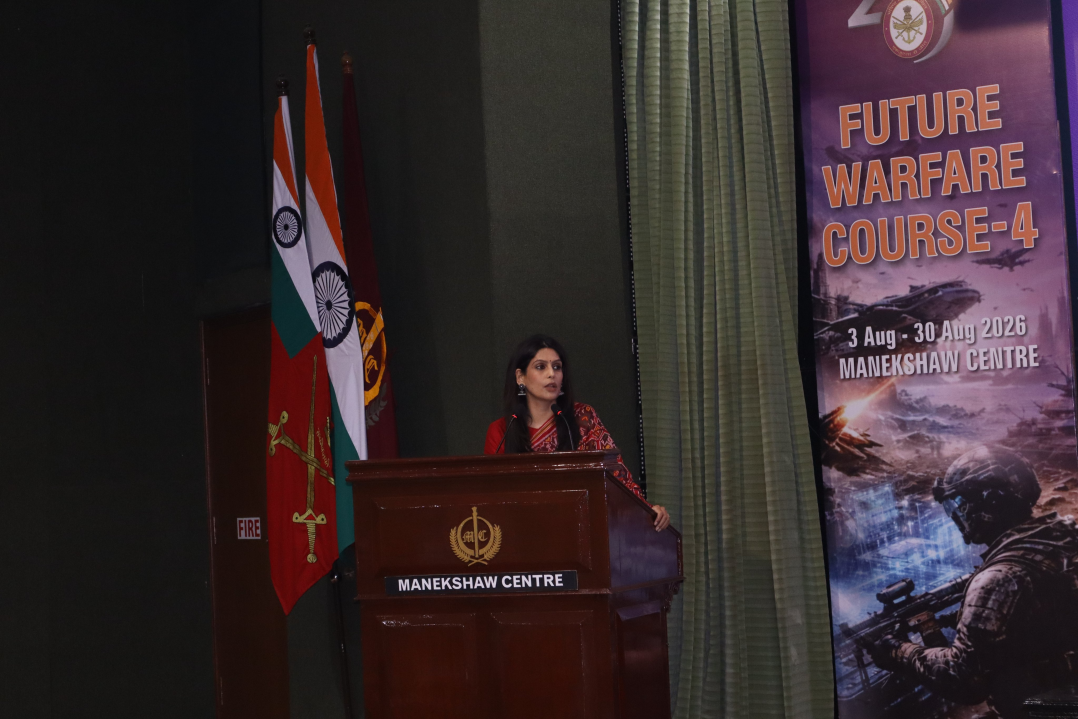
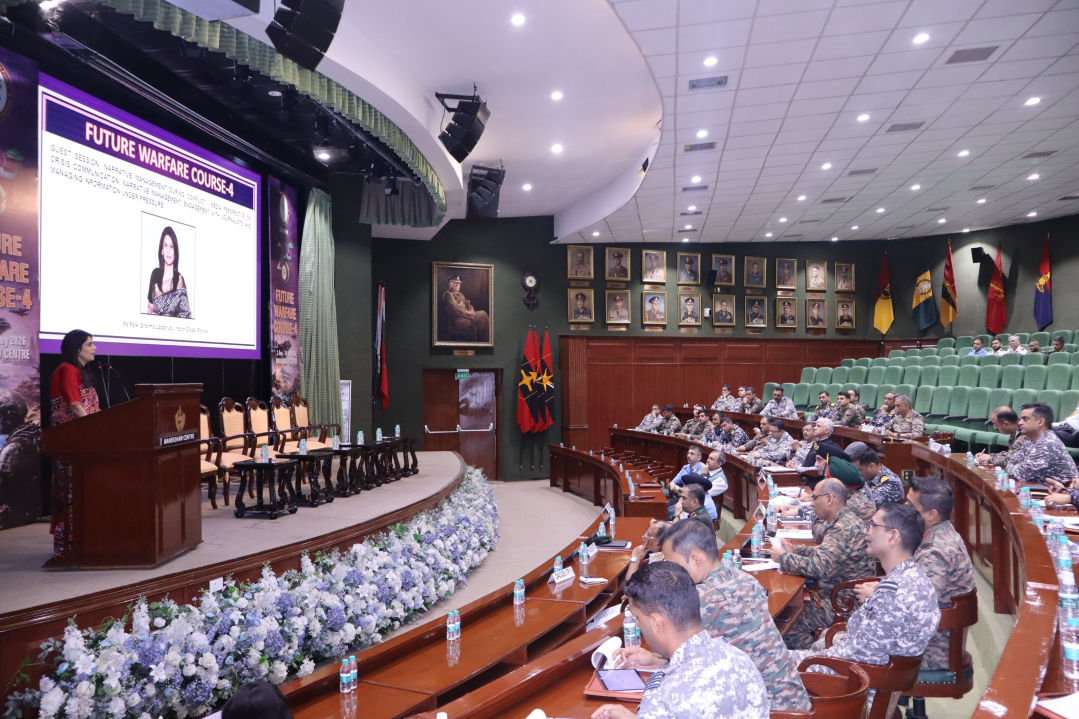
New Delhi, 19 August 2026: The ongoing fourth edition of the Future Warfare Course (FWC-4) has turned its focus towards the increasingly important cognitive dimension of conflict, with a two-day specialised module on Cognitive Warfare being conducted at the Manekshaw Centre in New Delhi. The module brings together eminent journalists, strategic thinkers and domain experts to examine how information, perception and narratives are emerging as potent instruments in modern warfare.





The Future Warfare Course is being organised by Headquarters Integrated Defence Staff (HQ IDS) in collaboration with the Centre for Joint Warfare Studies (CENJOWS). FWC-4 is being held at the Manekshaw Centre from 3 August to 30 August 2026 and forms part of the broader effort to prepare military leaders for rapidly evolving technology-driven and multi-domain security challenges.
Air Marshal Tejinder Singh, PVSM, AVSM, VM, Chief of Integrated Defence Staff to the Chairman Chiefs of Staff Committee (CISC), witnessed the Cognitive Warfare module and interacted with the speakers as well as officers participating in FWC-4. His presence underscored the growing importance being attached by India’s higher defence leadership to understanding the non-kinetic dimensions of contemporary and future conflicts.
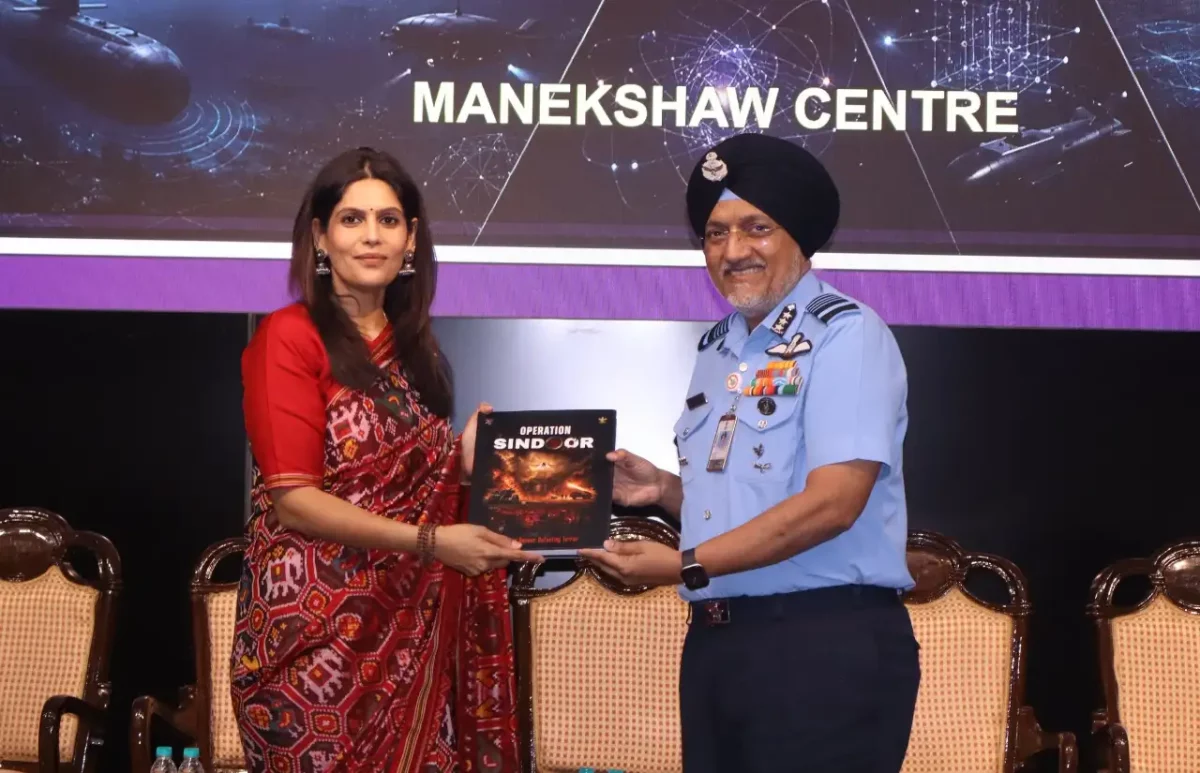
During the programme, Air Marshal Tejinder Singh also presented a book on Operation Sindoor to prominent journalist and television anchor Palki Sharma Upadhyay. The interaction at the Manekshaw Centre highlighted the relevance of bringing military professionals and experienced media practitioners onto a common platform while examining the battle for narratives, perceptions and public opinion.
Modern warfare is no longer confined to engagements between conventional military forces across land, sea and air. Cyber, space, electromagnetic and information environments have become deeply integrated with traditional military operations. Within this expanding battlespace, the cognitive domain is particularly significant because it concerns the perceptions, beliefs, emotions, decision-making processes and behaviour of individuals, military organisations and entire populations.
Cognitive warfare seeks to influence how an adversary understands a situation and consequently how it acts. Unlike a conventional attack aimed primarily at destroying physical targets, cognitive operations can attempt to create confusion, undermine confidence in institutions, manipulate public discourse, amplify social divisions or influence the decisions of commanders and political leaders. Digital platforms, artificial intelligence, deepfakes, disinformation and rapidly circulating narratives have substantially increased the speed and potential reach of such operations.
CENJOWS has itself highlighted cognitive warfare as an increasingly important national-security challenge. Recent work associated with the think tank has examined threats ranging from deepfakes to narrative manipulation and their potential impact on institutional trust, while stressing the need for coordinated responses involving both military and civilian stakeholders.
The inclusion of journalists and domain experts in the FWC-4 module is particularly relevant because the information environment has become inseparable from military operations. Events on the battlefield can now be recorded, interpreted and distributed globally within minutes. Competing narratives surrounding an operation can consequently develop even while military action is still underway.
This creates challenges that go beyond traditional military communication. Commanders and national-security planners increasingly need to understand how adversaries may employ manipulated images, fabricated videos, coordinated social-media campaigns, selective disclosure of information and artificial-intelligence-generated content to shape perceptions of military events.
The cognitive dimension also has implications for operational security and decision-making. A sophisticated influence campaign may be designed not simply to convince the general public of a particular narrative but to overwhelm analysts with contradictory information, create uncertainty about an adversary’s intentions or induce military and political decision-makers to act on misleading assessments.
The module therefore fits into the larger philosophy behind the Future Warfare Course, which is exposing participating officers to technologies and concepts that are transforming military operations. Other sessions associated with FWC-4 have examined artificial intelligence and automation in naval operations, network-centric warfare, robotics, Multi-Domain Operations, unmanned underwater vehicles, maritime and underwater domain awareness, autonomous systems and emerging naval warfare concepts.
Such subjects reflect the increasingly interconnected nature of future warfare. A military operation may simultaneously involve conventional forces, satellites, cyber capabilities, unmanned platforms, artificial intelligence-enabled command systems, electronic warfare and information operations. Success in one domain can influence outcomes in another, making integration and rapid decision-making increasingly important.
The cognitive domain, however, remains a constant layer across all of them. Whether an operation takes place in the mountains, at sea, in cyberspace or through unmanned systems, military actions generate information and perceptions. Understanding how those perceptions can be influenced, protected or exploited is therefore becoming an important component of preparing commanders for future conflicts.
FWC-4 also reflects the growing emphasis on interaction between the Armed Forces, strategic community, academia, technology specialists and industry. CENJOWS, established at the initiative of the Ministry of Defence in 2007, is mandated to examine joint warfare and promote interaction among stakeholders including government, the armed forces, academia, industry and the wider strategic community.
The two-day Cognitive Warfare module at the Manekshaw Centre consequently represents more than an examination of information warfare. It highlights a broader shift in military thinking in which controlling physical terrain alone may not be sufficient to achieve strategic objectives. The ability to understand and contest narratives, maintain institutional credibility, protect decision-making and communicate effectively during crises could increasingly influence the outcome of military operations.
As technologies capable of generating and distributing convincing information continue to evolve, the distinction between the physical and informational battlespaces is likely to become even less pronounced. For India’s Armed Forces, preparing leaders to recognise and respond to such challenges will therefore remain an important element of readiness for multi-domain warfare.
Through FWC-4 and specialised modules such as the one on Cognitive Warfare, HQ IDS and CENJOWS are seeking to expose participants to precisely this changing character of conflict — where military strength continues to matter, but where information, perception, technology and the ability to influence human decision-making can also become decisive instruments of national power.