

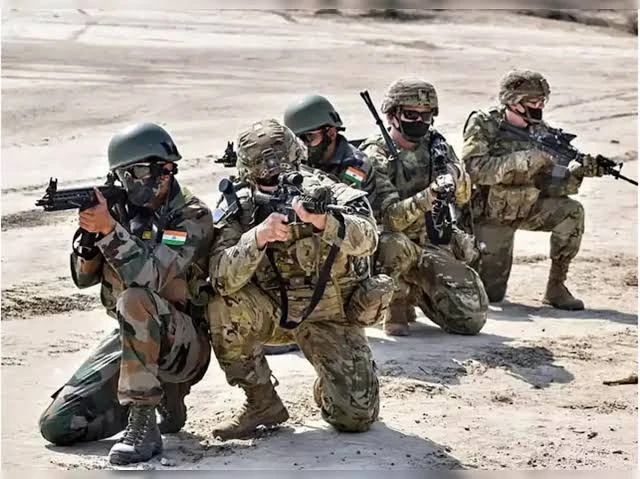
The Indian and US armies are set to conduct the 22nd edition of their annual Yudh Abhyas exercise in a two-theatre format, with participating troops scheduled to train first in the desert terrain of Rajasthan and subsequently in the high-altitude mountains of Uttarakhand.





The exercise is scheduled to commence in the first week of September at the Mahajan Field Firing Ranges near Bikaner before moving to Auli in Uttarakhand, located around 95 kilometres from the Line of Actual Control with China.
The two-phase format will expose the participating troops to significantly different operational environments. The desert phase is expected to focus on open manoeuvre operations, long-range fires and precision strike capabilities, while the Himalayan phase will emphasise high-altitude warfare, infantry manoeuvres, air mobility and logistics.
During the Mahajan phase, the Indian Army is expected to deploy Pinaka multi-barrel rocket launchers and K9 Vajra tracked self-propelled howitzers. The US Army is also expected to bring its High Mobility Artillery Rocket System, or HIMARS, to the exercise.
AH-64E Apache attack helicopters are also slated to participate, adding an air support dimension to the exercise. The helicopters are expected to demonstrate their fire-support capabilities, including the employment of Hellfire missiles, 70 mm rockets and 30 mm cannon systems.
The exercise will subsequently shift to Auli, where the participating forces will operate in mountainous terrain at an altitude of approximately 2,500 metres. The mountain phase will provide an opportunity to train in conditions involving difficult terrain, altitude-related challenges and demanding logistical requirements.
The Indian Army is expected to employ M777 ultra-light howitzers during the high-altitude phase. The lightweight artillery systems can be transported by heavy-lift helicopters, including Chinooks, allowing them to be deployed in areas where conventional tracked artillery systems face mobility constraints.
A major focus across both phases is expected to be counter-unmanned aerial system operations. The training will cover detection and classification of small drones, electronic warfare measures such as jamming and spoofing, as well as hard-kill interception capabilities.
The exercise is also expected to incorporate offensive employment of loitering munitions and intelligence, surveillance and reconnaissance platforms, reflecting the growing importance of unmanned and networked capabilities in contemporary warfare.
At Auli, the participating forces will also undertake training related to acclimatisation, high-altitude logistics and infantry manoeuvres. The terrain will provide a realistic environment for examining operational challenges associated with sustained military activity in mountainous regions.
Yudh Abhyas, which began in 2004 as a platoon-level exercise focused primarily on peacekeeping operations, has evolved significantly over the years. Its scope has expanded to include counter-insurgency and counter-terrorism operations, mountain warfare, electronic warfare, unmanned systems and humanitarian assistance and disaster relief.
The exercise has become an important platform for strengthening interoperability and exchanging operational experiences between the two armies. Training across two distinct theatres in a single edition is expected to provide additional opportunities to develop flexibility, adaptability and joint operational understanding.
The India-US defence relationship also includes several other major bilateral and multilateral exercises across the land, maritime and air domains. These include Vajra Prahar between the two Special Forces, Malabar involving the two navies along with Japan and Australia, and Cope India between the Indian Air Force and US Air Force.
Yudh Abhyas 2026 is therefore expected to further strengthen military cooperation between India and the United States while providing both armies with valuable experience in operating together across diverse and challenging battlefields.