
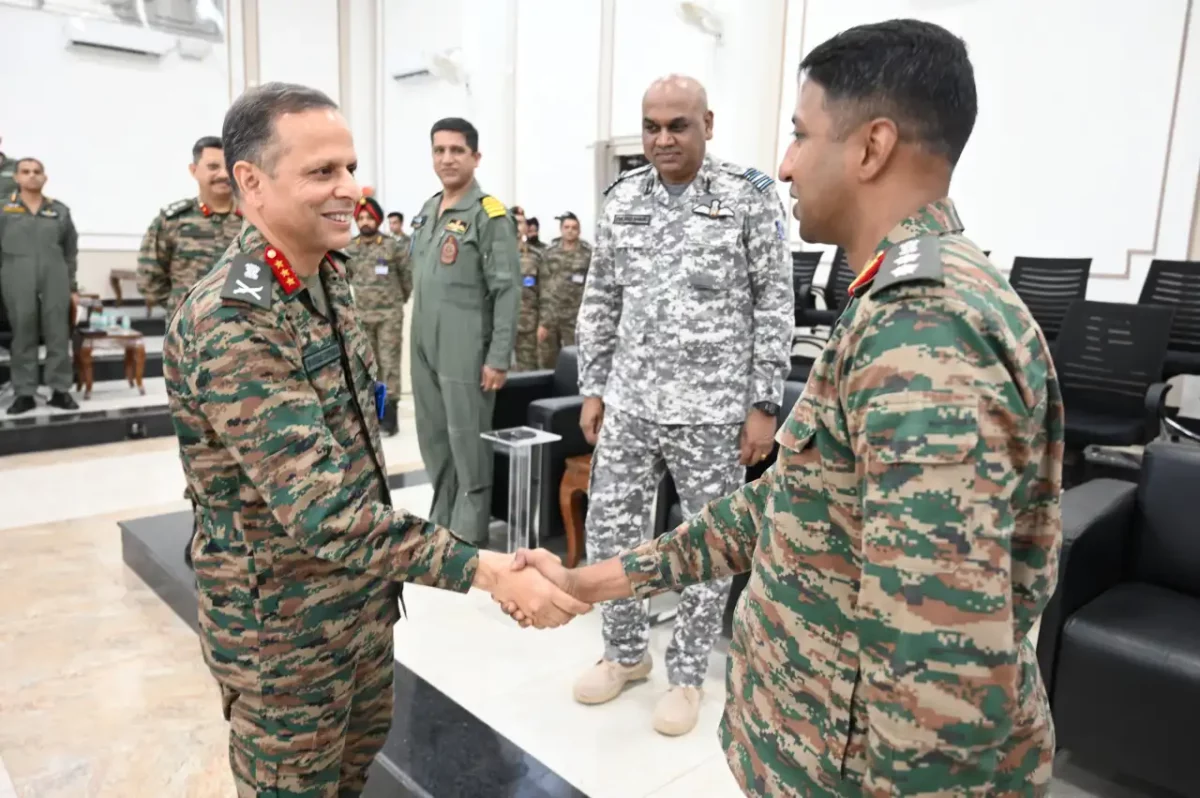
Officers undergoing the prestigious Higher Air Command Course (HACC), Serial 50, visited the Indian Army’s Kharga Corps as part of a focused professional military engagement aimed at strengthening joint understanding of the contemporary battlespace and the integrated employment of land and air power.

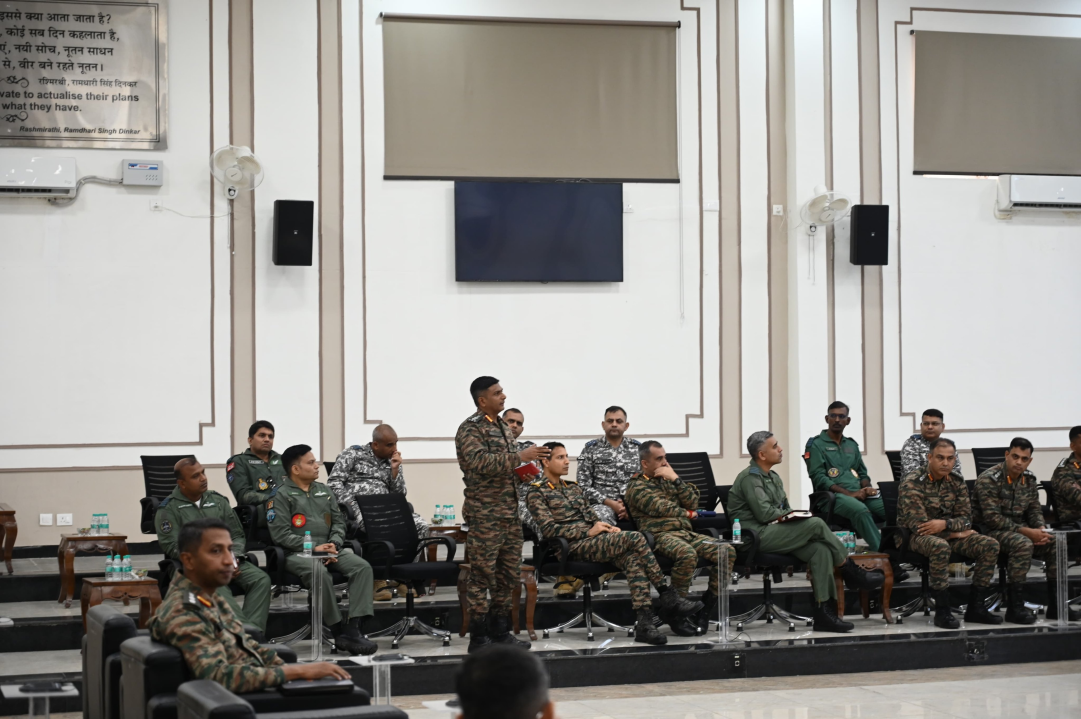
During the visit, Lieutenant General Manish Luthra, AVSM, General Officer Commanding (GOC), Kharga Corps, interacted with the participating officers and provided them with an overview of the evolving operational environment along India’s Western Front.
The engagement focused on contemporary operational imperatives, the changing character of warfare and the evolving role of Strike Corps formations in conducting operations in an increasingly complex, technology-intensive and multidomain battlespace.
Understanding the Evolving Western Front
The Western Front remains one of the most important operational theatres for the Indian Armed Forces, requiring close coordination between the Indian Army and Indian Air Force for the effective conduct of military operations.
During his interaction with the HACC participants, Lt Gen Manish Luthra discussed the changing operational environment and the factors influencing the employment of military formations in the theatre.
Modern military operations increasingly require commanders to account for developments in surveillance, precision weapons, unmanned systems, electronic warfare, information warfare and increasingly transparent battlefields. These developments are influencing how large formations plan, manoeuvre, concentrate combat power and sustain operations.
The interaction therefore provided the officers with an opportunity to understand the operational environment from the perspective of a major field formation and examine how traditional concepts of warfare continue to evolve in response to emerging capabilities and threats.
Changing Contours of Strike Corps Operations
A major focus of the professional engagement was the changing contours of Strike Corps operations.
Strike Corps have traditionally represented an important offensive component of the Indian Army’s conventional war-fighting capability. Such formations are designed to generate significant combat power and undertake offensive operations when required.
However, the modern battlespace is increasingly characterised by persistent surveillance, long-range precision fires, drones, electronic warfare systems and rapid information flows. Consequently, mobility, dispersion, deception, survivability, operational tempo and the ability to rapidly concentrate effects have assumed greater significance.
The discussions at Kharga Corps offered HACC officers an Army perspective on how these developments are shaping contemporary operational planning and the employment of large formations.
Rather than viewing land operations in isolation, the engagement emphasised the importance of understanding the battlespace as an interconnected environment in which capabilities from different services must complement one another.
Integrated Employment of Land and Air Power
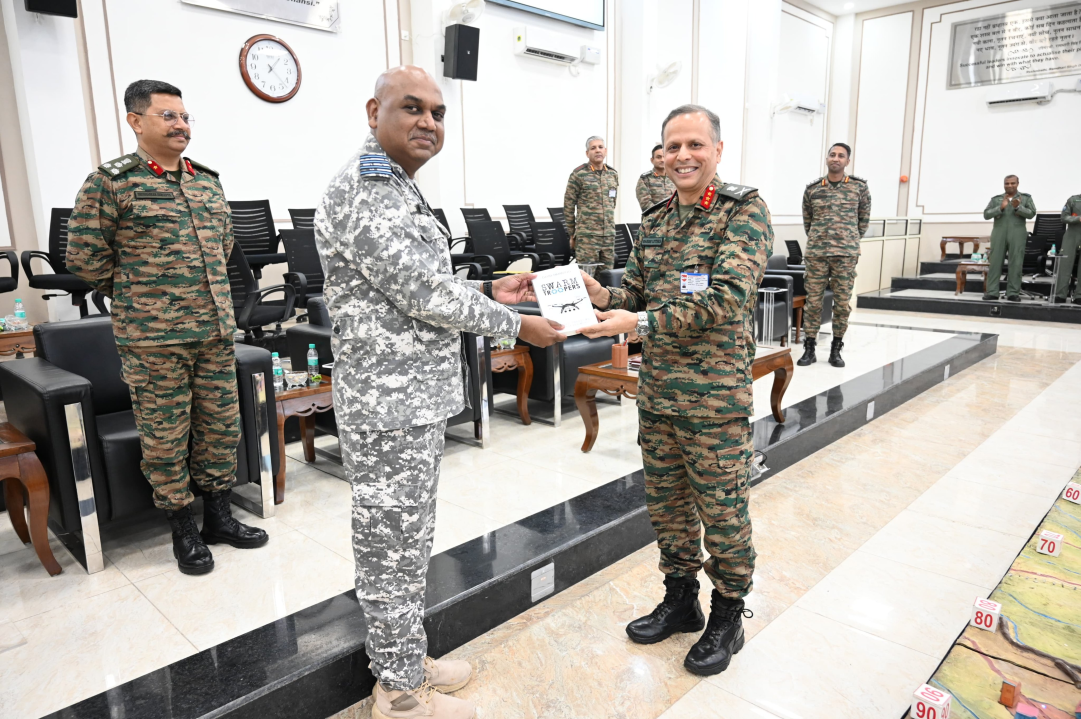
Another important aspect of the visit was the integrated employment of land and air capabilities for shaping the battlespace.
Modern operations require extensive coordination between ground formations and air power, particularly for intelligence and surveillance, battlefield awareness, targeting, air defence, mobility, interdiction and the application of precision combat power.
The engagement highlighted how closer integration between the Indian Army and Indian Air Force can contribute to a more comprehensive understanding of the operational environment and enable commanders to employ available capabilities more effectively.
For officers attending the Higher Air Command Course, exposure to the operational perspective of a major Army formation provides valuable insight into the requirements, capabilities and challenges faced by ground commanders.
Similarly, understanding the capabilities and employment philosophy of air power is critical for Army commanders operating in an environment where air and land operations are increasingly interconnected.
Building Joint Understanding Among Future Commanders
The visit assumes significance in the broader context of the Indian Armed Forces’ growing emphasis on jointness and integrated military operations.
Professional military engagements involving officers from different services provide an opportunity to develop a common understanding of operational problems before officers assume higher command and staff responsibilities.
Such interactions are particularly valuable at senior professional military education institutions, where officers study campaign planning, operational art, national security, military strategy and the employment of joint capabilities.
By examining operational challenges directly with field formations, course participants can connect theoretical concepts discussed during professional military education with practical operational requirements.
The Kharga Corps engagement therefore served as an important platform for exchanging perspectives between experienced Army commanders and Indian Air Force officers undergoing higher command training.
Higher Air Command Course
The Higher Air Command Course is one of the Indian Air Force’s advanced professional military education programmes for officers being prepared for higher command and staff appointments.
At this stage of their careers, officers are required to develop an understanding extending beyond the employment of individual platforms or service-specific capabilities. Greater emphasis is placed on operational planning, joint warfare, strategic studies and the employment of military power across domains.
Visits to formations belonging to sister services consequently form an important component of developing broader operational awareness.
The visit of HACC Serial 50 to Kharga Corps enabled participants to examine the requirements of land warfare and understand how air capabilities can be integrated with ground operations to achieve operational objectives.
Kharga Corps and India’s Strike Capability
Kharga Corps is one of the Indian Army’s major formations associated with offensive operations on the Western Front.
As a Strike Corps formation, it represents a significant concentration of combat capability and plays an important role in the Army’s conventional operational preparedness.
The interaction with its leadership therefore provided the visiting HACC officers with an opportunity to understand the operational considerations involved in planning and executing large-scale land operations and the support that air power can provide during different stages of a campaign.
The discussions also underline how the concept of a Strike Corps continues to adapt as the nature of the battlefield changes.
Jointness Becoming Increasingly Important
The Indian Armed Forces have been progressively strengthening cooperation among the Army, Navy and Air Force as future conflicts are expected to demand increasingly integrated operations.
The effectiveness of modern military power depends not simply on individual platforms or formations but on the ability to combine intelligence, surveillance, fires, manoeuvre, logistics, air power, air defence, cyber and electronic warfare capabilities into a coherent operational framework.
This requires commanders from different services to understand each other’s capabilities, limitations and operational requirements.
Professional exchanges such as the HACC Serial 50 visit to Kharga Corps consequently contribute to building the institutional familiarity and common operational understanding required for effective joint warfare.
The interaction with Lt Gen Manish Luthra and Kharga Corps provided the participating officers with valuable exposure to the evolving operational environment along the Western Front while highlighting the changing nature of Strike Corps operations.
Most importantly, the engagement reinforced the growing importance of integrating land and air capabilities to shape the battlespace, improve operational effectiveness and develop greater synergy among the services.
As warfare becomes increasingly multidomain and technology-driven, such joint professional engagements will remain important in preparing future military commanders to plan and conduct integrated operations in complex operational environments.