

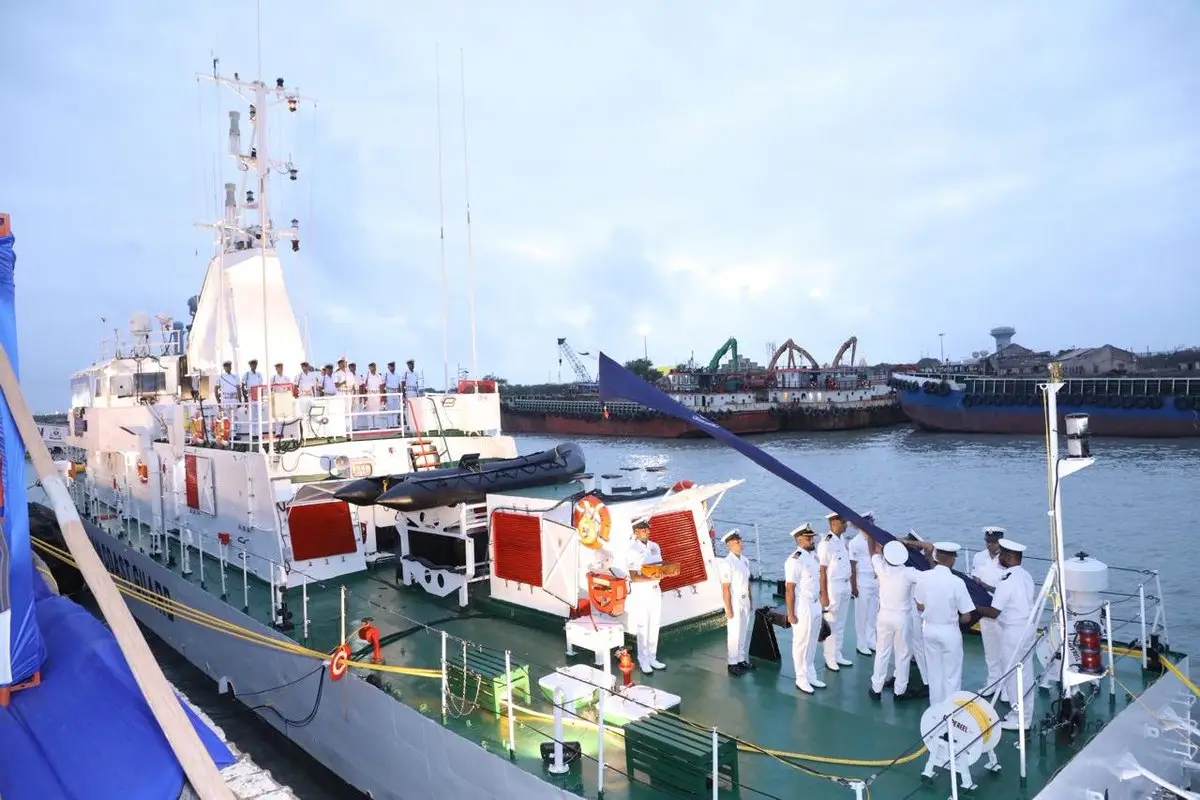
Okha, Gujarat: Indian Coast Guard Ship (ICGS) Meera Behn was decommissioned with full Armed Forces honours at Okha Port on 22 August 2026, marking the end of more than two decades of distinguished service to the nation. The Ministry of Defence confirmed the formal retirement of the vessel, which had been a key asset in safeguarding India’s maritime interests along the western seaboard.

The decommissioning ceremony was presided over by DIG Manjeet Singh Gill, Commander of Coast Guard District Headquarters No. 15 (Okha). It was conducted under the command of Commandant (JG) Thinkal Tharakan. The traditional proceedings included a Guard of Honour, the final hauling down of the Coast Guard Ensign, and the lowering of the Decommissioning Pennant, symbolically concluding the ship’s active service. DIG Manjeet Singh Gill paid tribute to the ship and its successive crews for their “yeoman service” in protecting India’s maritime domain over more than 20 years.
Ship’s Origin and Specifications
Built by Goa Shipyard Limited (GSL), ICGS Meera Behn (pennant number 234) was launched on 28 January 2006 and commissioned on 25 July 2006. It belonged to the water-jet propelled Extra Fast Patrol Vessel (XFPV) class, a series of agile, high-speed vessels designed for rapid response in coastal and near-shore operations.
Key specifications of the class included:
- Full displacement: approximately 270 tonnes
- Length: 48.14 metres
- Beam: 7.5 metres
- Draught: about 2 metres
- Propulsion: Three MTU-Friedrichshafen 16V4000 M90 diesel engines (each producing 2,720 kW) driving three Kamewa 71SII water jets
- Maximum speed: 35 knots
- Endurance: 1,500 nautical miles
- Complement: Around 30 personnel (including five officers)
The water-jet propulsion system gave the XFPVs excellent manoeuvrability in shallow waters and high speed for interception, making them well-suited for coastal patrol, anti-smuggling, anti-poaching, search-and-rescue, and maritime law enforcement roles. Sister ships in the series were named after prominent women freedom fighters and leaders, including Sarojini Naidu, Durgabai Deshmukh, Kasturba Gandhi, Aruna Asaf Ali, Subhadra Kumari Chauhan, and Savitribai Phule.
Legacy of the Name: Meerabehn
The ship was named after Meerabehn (also spelled Mirabehn or Meera Behn), the British-born disciple of Mahatma Gandhi. Born Madeleine Slade on 22 November 1892 in Surrey, England, she was the daughter of Rear Admiral Sir Edmond Slade of the Royal Navy. Inspired by Romain Rolland’s biography of Gandhi, she arrived in India in November 1925 and dedicated her life to the freedom struggle and Gandhian ideals. Gandhi gave her the name Mirabehn (“Sister Mira”), after the 16th-century saint-poet Mirabai.
She lived in Sabarmati and other ashrams, adopted a life of simplicity and celibacy, spun khadi, and participated actively in the independence movement. Meerabehn accompanied Gandhi to the Round Table Conference in London in 1931, faced imprisonment during major campaigns including the Quit India Movement, and later worked on rural reconstruction and environmental causes. She remained in India for nearly 34 years before eventually settling in Europe, where she died in Vienna on 20 July 1982. The naming of the Coast Guard vessel reflected the ideals of selfless service, commitment, and national dedication associated with her life.
Operational Role and Context
Based at Okha under District Headquarters-15 in the North-West Region of the Indian Coast Guard, ICGS Meera Behn operated in a strategically important area covering parts of the Gujarat coast, the Gulf of Kutch, and approaches to key maritime routes. Okha itself hosts significant Coast Guard infrastructure, including hovercraft units used for surveillance over the numerous islands and shallow waters of the region.
As one of the earlier indigenous Extra Fast Patrol Vessels, the ship contributed to the Coast Guard’s core charter duties: coastal security, Exclusive Economic Zone surveillance, fisheries protection, anti-smuggling and anti-poaching operations, search and rescue, and pollution response. While specific individual mission tallies for Meera Behn have not been publicly detailed in the decommissioning statement, vessels of this class formed an important part of the ICG’s surface fleet during a period of expanding coastal security responsibilities following the 2008 Mumbai attacks and subsequent strengthening of maritime domain awareness.
Broader Significance
The decommissioning comes at a time when the Indian Coast Guard continues to modernise its fleet with newer, more capable indigenous platforms, including the Adamya-class Fast Patrol Vessels and larger offshore patrol and pollution control vessels. The retirement of Meera Behn after exactly 20 years of service (2006–2026) underscores the natural lifecycle of high-tempo coastal patrol craft while highlighting the sustained contribution of earlier generations of indigenously built ships.
The ceremony at Okha formally closed a chapter of reliable service by a vessel that carried both operational utility and symbolic weight, named after a foreign-born freedom fighter who fully embraced India’s struggle for independence.