

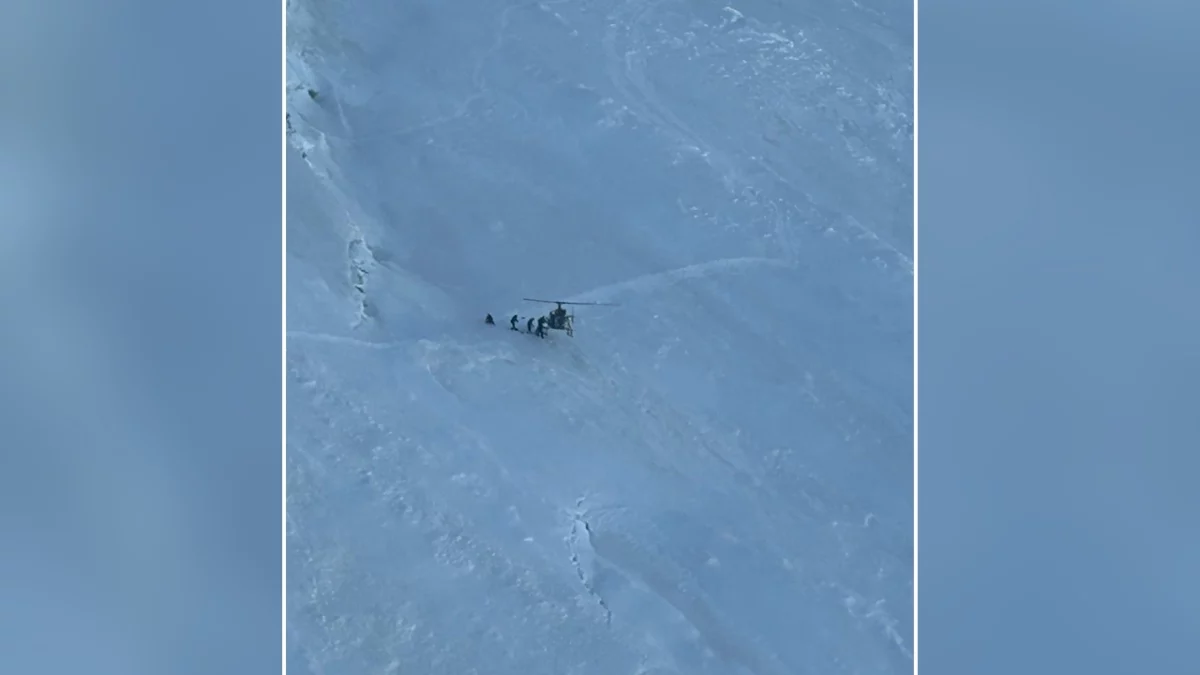
In a challenging high-altitude rescue mission, Indian Army Aviation pilots successfully evacuated a casualty from a snow-covered slope at an altitude of approximately 18,600 feet near the Nun Kun region, demonstrating exceptional flying skill, courage and determination under extremely demanding conditions.





The operation was undertaken in terrain where conventional helicopter landing was severely constrained by the steep and snowy slope, the absence of adequate landing space and strong winds. The difficult conditions required the pilots to carefully assess the terrain and execute the evacuation within a narrow operational window.
To enable the mission, the helicopter was lightened by removing non-essential equipment and was operated with limited fuel. These measures were undertaken to reduce the aircraft’s weight and improve its ability to operate safely in the demanding high-altitude environment.
The pilots faced the additional challenge of finding a viable approach and landing point on the extremely restricted slope. During the critical phase of the evacuation, the helicopter executed a precision landing in which one skid made contact with the slope, allowing the casualty to be evacuated despite the absence of a conventional landing area.
The mission was carried out during the last available landing window of the day, adding urgency to an already complex operation. The crew had to balance the requirements of casualty evacuation with the severe limitations imposed by altitude, weather, terrain and aircraft performance.
Operating at approximately 18,600 feet presents significant challenges for aviation operations, including reduced aircraft performance and rapidly changing weather conditions. The combination of these factors with the steep snow-covered terrain made the evacuation particularly demanding.
The successful mission highlighted the ability of Indian Army Aviation crews to operate in some of the most challenging high-altitude environments and undertake time-critical humanitarian and casualty evacuation missions when conventional evacuation options are limited.
The operation also reflected the importance of specialised training, sound judgement and precise flying skills in high-altitude military aviation. The pilots’ ability to adapt the aircraft configuration and execute a carefully controlled landing was critical to the success of the mission.
The casualty evacuation was conducted by Indian Army Aviation in coordination with the formations deployed in the region. The operation demonstrated the Army’s emphasis on ensuring timely medical evacuation and assistance to personnel operating in remote and difficult terrain.
The mission, highlighted by the Fire and Fury Corps, stands as an example of the professionalism and operational capability of Indian Army Aviation. It also underscores the commitment of Army personnel to ensuring that those in need of urgent assistance are not left behind, even in the most difficult conditions.
The successful evacuation from the snowy slope near Nun Kun is a testament to the skill, courage and compassion of the Army aviation crew, whose precision and determination enabled a life-saving mission under exceptionally challenging circumstances.