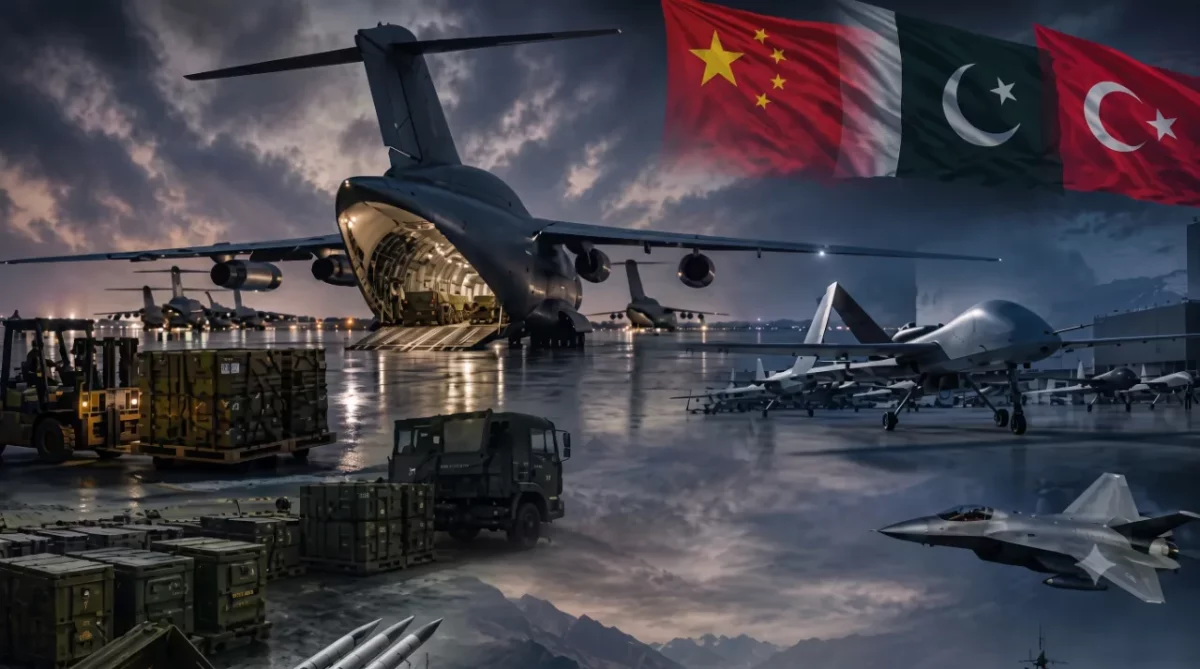
A reported surge in military airlift activity into Pakistan between August 19 and 21 has drawn attention from regional security observers, with open-source flight-tracking data cited by DD News suggesting an intensive 60-hour logistics operation involving Turkish and Chinese military transport aircraft.





According to the report, the activity involved repeated flights into three strategically important Pakistan Air Force installations: Nur Khan Airbase in Rawalpindi, Masroor Airbase in Karachi and Murid Airbase in Punjab. The reported movement has raised speculation that Islamabad may be seeking to rapidly replenish or reinforce military capabilities following losses and vulnerabilities identified during Operation Sindoor.
The exact nature and quantity of equipment transported during the reported airlift have not been officially disclosed. Military cargo manifests are generally classified, and the available flight-tracking information by itself cannot establish precisely what was carried on individual aircraft.
The report links the activity to Pakistan’s efforts to strengthen its air-defence command-and-control architecture. It specifically claims that mobile mission-control and command-and-control equipment may have been among the systems being replenished following damage sustained during Operation Sindoor.
Nur Khan Airbase, located in Rawalpindi, holds particular strategic importance because of its proximity to Pakistan’s military headquarters and its role in the country’s military transport and command infrastructure.
Masroor Airbase in Karachi is another major Pakistani military installation, supporting air operations in the country’s south and serving as an important hub for strategic and maritime-related activities.
Murid Airbase in Punjab has also been associated with Pakistan’s unmanned aerial vehicle capabilities. The reported concentration of military transport activity at these locations has therefore fuelled speculation about efforts to reinforce Pakistan’s air and unmanned warfare infrastructure.
The report further claims that Turkey may have supplied or moved equipment associated with unmanned systems, including Bayraktar TB2 and Bayraktar Akıncı platforms, along with other drone and loitering-munition-related equipment. It also refers to possible components and systems associated with Turkey’s developing unmanned combat aircraft and decoy technologies.
These specific cargo claims, however, have not been independently confirmed through official Turkish or Pakistani announcements cited in the report. They should therefore be treated as reported possibilities rather than established facts.
China has also reportedly increased military logistical activity involving Pakistan. The DD News report claims that Chinese military transport aircraft delivered equipment linked to Pakistan’s air-defence network, including HQ-series surface-to-air missile systems.
If confirmed, the reported activity would underline the depth of defence cooperation between Islamabad, Beijing and Ankara and demonstrate Pakistan’s ability to draw upon multiple foreign defence partners for rapid replenishment and capability enhancement.
The developments come against the backdrop of Pakistan’s expanding defence relationships with Turkey and China. They also follow the signing of the Mecca Joint Defence Agreement by Pakistan, Turkey and Saudi Arabia on August 7, under which the three countries stated that an armed attack against one would be regarded as an attack against all.
The reported military airlift has consequently acquired wider strategic significance, particularly as India continues to assess developments involving countries that could affect its security environment.
The reported replenishment efforts also come amid continuing debate over Pakistan’s military preparedness following Operation Sindoor. Indian defence officials have highlighted the effectiveness of India’s integrated air-defence and strike capabilities during the operation, while Pakistan has continued to strengthen and diversify its military partnerships.
The wider regional picture also includes reports concerning the restoration of the Jaish-e-Mohammed complex at Bahawalpur, which was reportedly damaged during Indian strikes. Claims regarding Pakistani state funding for the reconstruction of the facility have been reported, although such allegations require independent verification.
Taken together, the reported military airlift and continued reconstruction of strategic military and militant infrastructure point to an effort by Pakistan to restore capabilities and reinforce critical networks after the disruptions associated with Operation Sindoor.
The developments also highlight the growing importance of unmanned systems, mobile command-and-control infrastructure, air-defence networks and rapid military logistics in contemporary warfare.
For India, the reported Turkish and Chinese activity reinforces the need to closely monitor Pakistan’s evolving military capabilities and external defence partnerships. Any confirmed transfer of advanced air-defence, drone or command-and-control systems could influence the regional military balance and shape future procurement and preparedness decisions.
At present, the most significant caveat remains the absence of publicly available official cargo details confirming the precise systems transported during the reported 60-hour airlift. Flight-tracking data can establish aircraft movements and patterns, but determining the contents of military cargo requires additional intelligence or official confirmation.
The reported activity nevertheless highlights the speed with which Pakistan’s defence partners could potentially provide logistical and military support during periods of heightened regional tension, making external supply chains an increasingly important factor in South Asian security calculations.