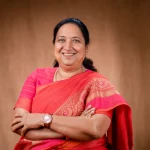

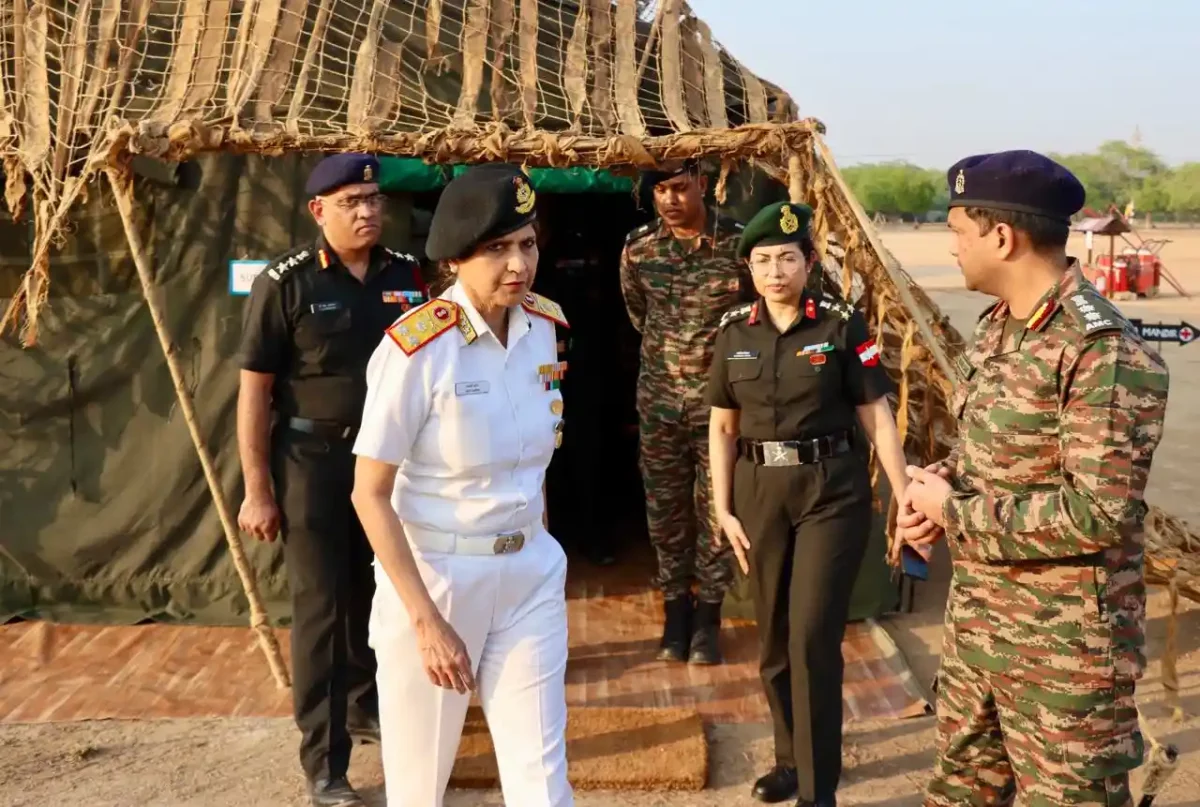
New Delhi, August 31, 2026: Surgeon Vice Admiral Arti Sarin, PVSM, AVSM, VSM, the first woman to head the Armed Forces Medical Services and the highest-ranking woman officer in the history of the Indian Armed Forces, retired from service on Sunday after more than four decades in uniform.
She demitted office as the 46th Director General Armed Forces Medical Services (DGAFMS), the senior-most medical appointment in the Army, Navy and Air Force. Air Marshal Sandeep Thareja, SM, VSM & Bar, presently Director General Medical Services (Air), takes over from Monday, 1 September 2026.
Sarin’s superannuation closes a career that began on 26 December 1985 and spanned clinical practice, teaching, hospital command and tri-service leadership. She is among a small group of officers who have served in all three services — from Lieutenant to Captain in the Army, from Surgeon Lieutenant to Surgeon Vice Admiral in the Navy, and as Air Marshal while heading medical services of the Air Force.
A naval household, an AFMC beginning
Born into a naval family — her father served 41 years and retired as a Commander; her brother Rajesh served about 30 years as a submariner and retired as a Commodore — Sarin studied at Timpany School, Visakhapatnam, and then at the Armed Forces Medical College (AFMC), Pune. She completed her MBBS there, later an MD in Radiodiagnosis from AFMC (1992), a DNB in Radiation Oncology from Tata Memorial Centre, Mumbai, and specialised training in Gamma Knife surgery at the University of Pittsburgh.
She has said she did not set out to reach the top of the medical services. “When I entered college, I certainly didn’t think this would be the path I would take. I simply enjoyed what I did and kept moving forward,” she told ETV Bharat earlier this month.
From wards and classrooms to command
Over the years she served at INHS Dhanvantari (Port Blair), INHS Kalyani (Visakhapatnam), INHS Sanjivani (Kochi) and INHS Asvini (Mumbai), and as Principal Medical Officer at Naval Dockyard, Mumbai. As a clinician and academic she headed Radiation Oncology at Army Hospital (Research & Referral), Delhi; Command Hospital (Southern Command), Pune; AFMC; and INHS Asvini. She examined for the National Board of Examinations and taught at universities in Mumbai and Pune.
Command appointments followed. She was Command Medical Officer, Southern Naval Command — the second woman in that post — during the COVID-19 years, when the command set up quarantine facilities and improvised solutions under pressure. In January 2021 she took over INHS Asvini from Surgeon Rear Admiral Sheila S. Mathai in a rare change of command between two women flag officers. She later served as Command Medical Officer, Western Naval Command.
On 5 October 2022 she was promoted Surgeon Vice Admiral, becoming only the sixth woman in the Indian Armed Forces to reach three-star rank and the third woman Vice Admiral in the Navy after Punita Arora and Sheila S. Mathai. She then commanded her alma mater as Director and Commandant of AFMC, succeeding Lieutenant General Rajshree Ramasethu. In January 2023 she became Director General Medical Services (Air) in the rank of Air Marshal; in March 2023 she moved to Director General Medical Services (Navy).
First woman DGAFMS
On 1 October 2024 she assumed charge as DGAFMS, succeeding Lieutenant General Daljit Singh. The post reports to the Ministry of Defence and the Chief of Defence Staff and sets medical policy for serving personnel, veterans and families across the three services. Her elevation made her the first woman to hold the appointment and, by rank and appointment, the highest-ranking woman officer the armed forces have produced.
As DGAFMS she spoke often of faster casualty evacuation, point-of-care and prolonged field care, mental as well as physical resilience, and partnerships with ICMR, IITs, IISc and DRDO. She argued that precision medicine — the same discipline that drew her to Gamma Knife work — maps onto operational medicine: rapid, accurate decisions under constraint. On artificial intelligence she was pragmatic: useful in diagnostics and paperwork, she said, if it returns time to the patient.
The second wave of COVID-19 remained a defining memory. As commanding officer of the large naval hospital INHS Asvini she later recalled a 24-hour effort to move a critical oxygen consignment from Jamnagar. “The most remarkable aspect of our response was the human element,” she said.
She was also associated with the Supreme Court’s National Task Force on safe working conditions for doctors. At AFMC she oversaw academic and research links, including work that led to a Centre for Preventive Oncology and memoranda with institutions such as NIV Pune, Tata Memorial Hospital and IIT Bombay. On 10 August 2026 she paid a farewell visit to AFMC, where a book on adolescent behaviour and lifestyle enrichment, ABLE, was unveiled.
Decorations and farewells
President Droupadi Murmu conferred the Param Vishisht Seva Medal on her at the Defence Investiture Ceremony (Phase-II) at Rashtrapati Bhavan on 29 June 2026. Sarin already held the Ati Vishisht Seva Medal (2024) and the Vishisht Seva Medal (2021), besides commendations from the Chief of the Naval Staff (2001), a GOC-in-C (2013) and the Chief of the Army Staff (2017).
On receiving the PVSM she said: “I accept this on behalf of my entire team across all three services, who have worked diligently to provide the highest levels of medical care to our service members, their dependents, and veterans.”
In the weeks before retirement she was seen off at several institutions. The Indian Coast Guard hosted a farewell at its New Delhi headquarters on 18 August, together with Vice Admiral Atul Anand, Additional Secretary in the Department of Military Affairs. Director General Paramesh Sivamani described their service as “an enduring inspiration for future generations.”
Family and succession
Sarin is married to Surgeon Rear Admiral C. S. Naidu, AVSM, VSM, a hepatobiliary surgeon who served 38 years in the Navy. In 2020 the couple were simultaneously Command Medical Officers of two naval commands — she in the South, he in the East — a first for the service. They have a son.
Her successor, Air Marshal Sandeep Thareja, an AFMC alumnus commissioned in December 1986, is a gastroenterologist trained at AIIMS New Delhi. He has commanded Military Hospital Pathankot and Command Hospital Lucknow, served as Director and Commandant of AFMC, and as DGMS (Air) worked on medical preparedness for the Gaganyaan programme and the operationalisation of the BHISHM Cube rapid-response medical system.
Sarin’s retirement does not erase the institutional fact her appointment established: the apex of military medicine in India is no longer a post that only men have held. What she leaves is a record of clinical specialisation, hospital command, tri-service literacy and a public argument that military medicine is both high-technology and, in her phrase, a matter of “healing hands” in hostile places.