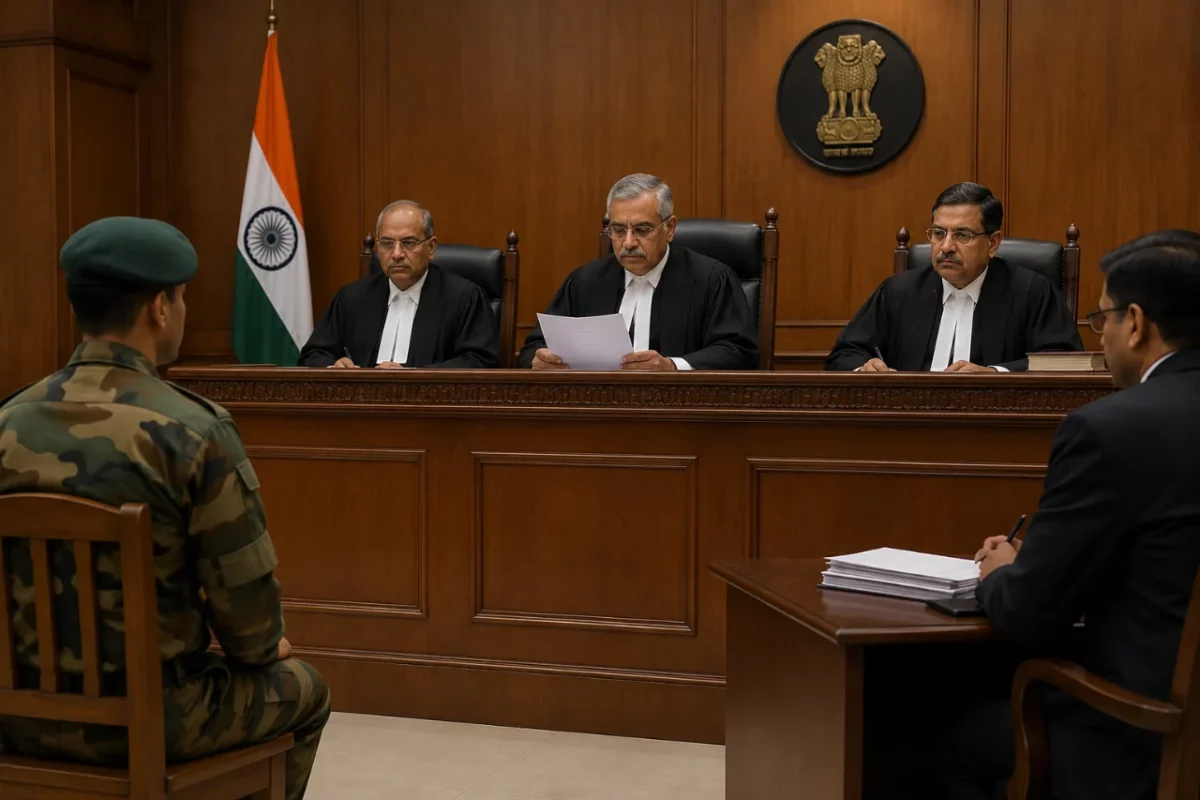
New Delhi: The Armed Forces Tribunal (AFT) has set aside the discharge of an Agniveer who was removed from the Indian Army for failing to disclose a criminal case registered against him when he was a minor, directing the Army to reinstate him with consequential service benefits.





A bench comprising Chairperson Justice Rajendra Menon and Administrative Member Rasika Chaube allowed the petition on August 17, 2026, and quashed the discharge order issued on January 20, 2026.
The tribunal held that the Army’s decision could not be sustained in law, particularly because the Allahabad High Court had already directed that the criminal case in question should not be treated as a pending case against the Agniveer for the purpose of his selection and appointment.
FIR Dates Back to When Agniveer Was 17
The case originated from the Agniveer’s selection during the 2024–25 recruitment rally. He successfully cleared the physical tests and was subsequently enrolled in the Army under the Agnipath scheme.
However, after he joined service, police verification revealed that an FIR had been registered in Meerut on October 3, 2020. The case named him along with 16 other individuals and invoked various provisions of the Indian Penal Code.
According to his counsel, the FIR arose from a village dispute and contained general allegations against him. Importantly, he was around 17 years old at the time of the alleged incident.
The Army subsequently treated his failure to mention the FIR in his enrolment documents as suppression of material information.
A show-cause notice was issued to him on September 12, 2025. His Commanding Officer eventually discharged him on January 20, 2026, under Item IV of Rule 13(3) of the Army Rules, 1954, which can be invoked in cases involving alleged concealment of facts at the time of enrolment.
The Agniveer challenged the decision before the Armed Forces Tribunal.
Allahabad High Court Had Already Granted Protection
A crucial factor in the case was an earlier order passed by the Allahabad High Court.
On April 10, 2025, while considering proceedings under Section 528 of the Bharatiya Nagarik Suraksha Sanhita (BNSS), the High Court had directed that the Meerut criminal case should not be treated as a “pending criminal case” against the petitioner for the purpose of his selection or appointment as an Agniveer.
The AFT held that this direction was binding on the authorities.
According to the tribunal, the High Court’s order effectively gave the candidate legal protection to continue pursuing his appointment in the Indian Army despite the pending FIR.
The tribunal observed that the pending case could therefore not, in the circumstances, be treated as a disqualification.
It further held that if the Army believed the High Court’s protection did not extend to the candidate’s failure to disclose the FIR in his enrolment form, the appropriate course would have been to approach the High Court and seek clarification or modification of its order.
Instead, the Army proceeded with his discharge.
The AFT consequently found that action could not be taken merely on the ground that the Agniveer had not disclosed the pending criminal case when the High Court had already granted him specific protection regarding the same FIR.
Juvenile-Era Criminal Cases Cannot Automatically Become Lifelong Bar
The tribunal also considered the special legal protection available to people who were minors at the time of an alleged offence.
The case was examined in the context of the Juvenile Justice framework as well as previous judgments of the Supreme Court, High Courts and the Armed Forces Tribunal.
Indian juvenile justice law follows the principle of giving children a “fresh start” rather than allowing an incident from their childhood to permanently affect their future.
Section 24 of the Juvenile Justice (Care and Protection of Children) Act, 2015 provides protection against disqualification attached to a conviction for a child dealt with under the Act, subject to statutory exceptions.
The broader legal principle assumes particular significance in military recruitment, where police verification and enrolment forms require candidates to disclose criminal proceedings and other material information.
The AFT’s ruling distinguishes between deliberate concealment of an adult criminal case and circumstances involving a case dating back to when the recruit was a minor, especially where a competent High Court has already granted protection concerning that case.
In the present matter, the FIR reportedly arose from a village dispute involving several people. The available record does not indicate that the Agniveer had been convicted or found guilty by a Juvenile Justice Board.
Army Directed to Reinstate Agniveer
Setting aside the January 20 discharge order, the Armed Forces Tribunal directed the Army authorities to reinstate the Agniveer on the basis of his existing appointment and provide him consequential service benefits.
The available account of the order does not specifically clarify whether the consequential benefits will include back wages for the period during which he remained out of service.
The tribunal has, however, left the door open for the Union government to approach the Allahabad High Court if it wants clarification or modification of the protection granted by that court in April 2025.
Unless that protection is modified, the High Court’s direction continues to bind the authorities.
Ruling Could Have Wider Implications for Military Recruitment
The judgment is significant beyond the circumstances of a single Agniveer because criminal-record verification frequently becomes a contentious issue during recruitment to the armed forces.
Military enrolment places considerable importance on integrity and truthful disclosure, and suppression of a pending criminal case can have serious consequences for candidates.
At the same time, courts have repeatedly held that every omission cannot automatically be treated in the same manner. Factors such as the candidate’s age at the time of the alleged offence, nature and seriousness of the allegations, status of the criminal proceedings and applicable legal protections can be relevant.
Juvenile cases carry an additional layer of statutory protection intended to ensure that involvement with the criminal justice system during childhood does not ordinarily become a lifelong barrier to employment.
The AFT’s ruling reinforces that military authorities must take those protections into account while dealing with verification cases.
It also underlines that where a constitutional court has already passed a specific order protecting a candidate from adverse consequences arising from a particular FIR, military authorities cannot effectively bypass that protection through administrative action without first seeking clarification or modification from the court.
The ruling does not mean that every instance of non-disclosure by an Army recruit must be ignored. Authorities can still examine the seriousness of an offence, the circumstances in which it occurred, applicable provisions of juvenile law and any present security or integrity concerns.
In this case, however, the tribunal concluded that discharging the Agniveer for failing to disclose an FIR dating back to when he was a minor was legally unsustainable in light of the protection already granted by the Allahabad High Court.
The January 20 discharge has therefore been quashed, and the Indian Army has been directed to take the Agniveer back into service.