

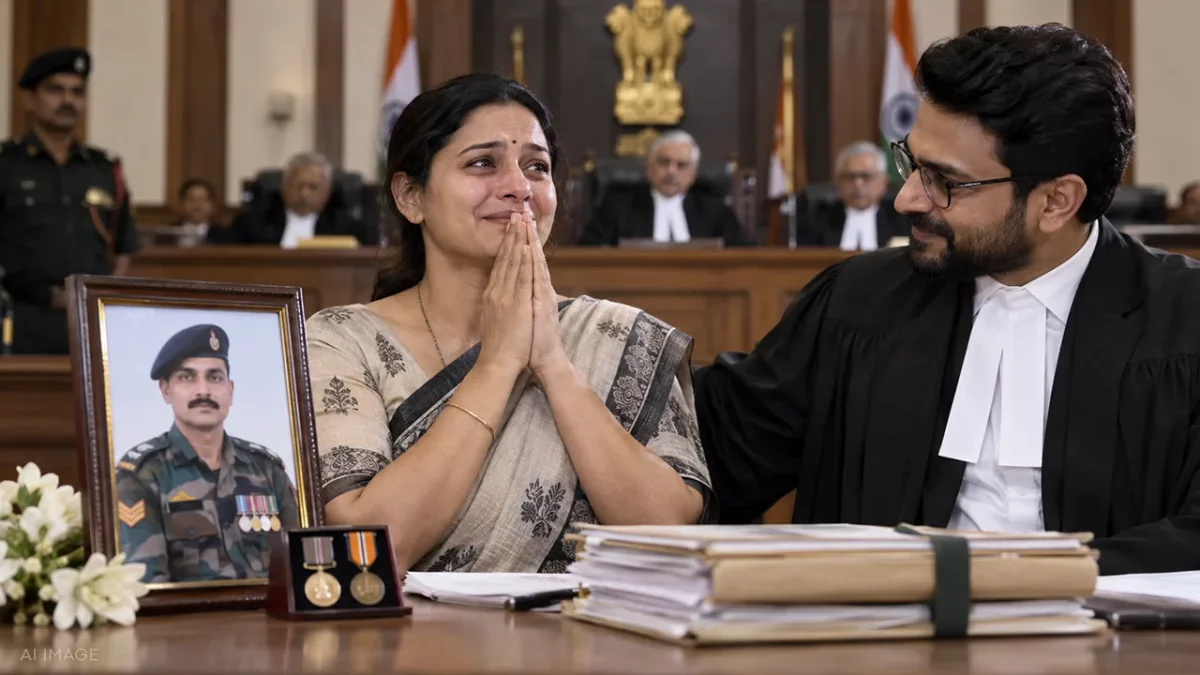
Chandigarh, September 13, 2026 — In an unusual family-pension ruling, the Chandigarh Bench of the Armed Forces Tribunal has directed the Centre to grant ordinary family pension to Satnam Kaur, the second wife of late Army Havildar Jagat Singh, even while holding that their marriage was legally void under the Hindu Marriage Act, 1955.



A Bench comprising Justice Umesh Chandra Sharma, Judicial Member, and Air Marshal Manavendra Singh, Administrative Member, passed the order on 3 September 2026 in Satnam Kaur’s application against the Union of India and others. The Tribunal sat at Chandimandir in Panchkula.
Service and marital history
Jagat Singh married Mohinder Kaur on 1 January 1940 and was enrolled in the Indian Army on 9 July 1940. He served until 9 July 1961 and thereafter received service pension. The first marriage remained childless.
On 13 April 1970, while Mohinder Kaur was still alive, Jagat Singh entered into a second marriage with Satnam Kaur. The Tribunal recorded that the first wife had consented. In affidavits executed on 30 March 1970, Jagat Singh and Mohinder Kaur stated that the first marriage had remained childless and that Mohinder Kaur had willingly permitted him to marry again in the hope of having a child. Jagat Singh also undertook to maintain his first wife throughout her lifetime.
Satnam Kaur and Jagat Singh thereafter lived together as husband and wife. A daughter, Sukhwinder Kaur, was born of the relationship. The names of Mohinder Kaur, Satnam Kaur and Sukhwinder Kaur were recorded in Jagat Singh’s Army service documents. Other papers, including a ration card and a voter identity card, supported Satnam Kaur’s claim.
Pension after the soldier’s death
Jagat Singh died on 13 February 1998. Family pension was granted to Mohinder Kaur from 14 February 1998. After Mohinder Kaur died on 9 February 2017, the pension ceased. Satnam Kaur then sought ordinary family pension from 10 February 2017.
The authorities rejected the claim by letter dated 15 September 2018. They cited the destruction of the old service records after the stipulated retention period and Army regulations concerning plural marriages, including Rule 333(A) of the Regulations for the Army, read with the Hindu Marriage Act. The Centre maintained before the Tribunal that the second marriage was null and void.
Tribunal’s findings
The Bench accepted that the second marriage, solemnised during the lifetime of the first wife, was void under Sections 5, 7 and 11 of the Hindu Marriage Act, 1955. It nevertheless drew a distinction when deciding the pension claim.
Relying on Supreme Court precedent, including the 2023 judgment in Smt. Shiramabai & Ors. v. The Captain, Record Officer and Another, the Tribunal observed that long and continuous cohabitation as husband and wife can raise a presumption in favour of marriage. The presumption is rebuttable, and the burden lies heavily on the person who seeks to deny the relationship its legal character.
In this case, the first wife’s consent, the long cohabitation after 13 April 1970, the birth of a daughter, and the Army records were held to establish the relevant facts. The respondents produced no document to controvert them.
The Bench stated that although the second marriage may be null and void, “on account of cohabitation the second wife will be entitled to maintenance and other pensionary benefits at least after the death of the first wife or after the date of divorce between the first wife and the individual.”
Directions
The Tribunal quashed the rejection letter of 15 September 2018 and directed the authorities to grant Satnam Kaur ordinary family pension from 10 February 2017, together with consequential benefits and interest at 6 per cent per annum. Payment is to be made within three months of receipt of the certified order. In the event of default, the interest rate will rise to 8 per cent per annum.
The decision concludes an eight-year legal contest that began with the 2018 rejection. It turns on the particular facts of consent, recorded cohabitation and official entries rather than on a general validation of a second marriage contracted during the subsistence of the first. Courts in other recent matters have taken a stricter view of void second marriages under Army pension regulations; the Chandigarh Bench confined relief to the circumstances proved in this case.