

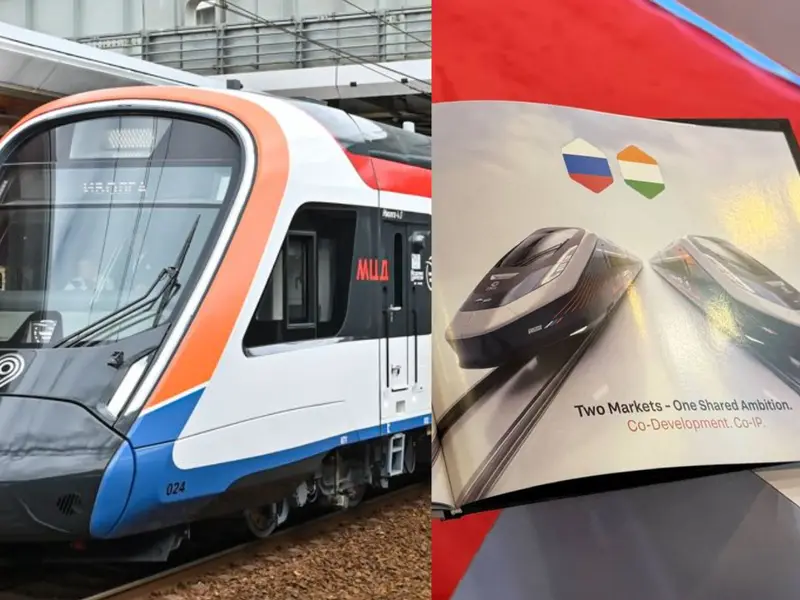
Russia has proposed its Ivolga FG high-speed train concept for India, with Russian rolling stock major Transmashholding (TMH) offering to jointly develop and manufacture the trains in the country. The proposal was presented on the sidelines of the 18th BRICS Summit held in New Delhi, adding a new dimension to the expanding India-Russia cooperation in the railway sector.




The Ivolga FG concept has a proposed design speed of 360 kmph and is being positioned by TMH as a potential high-speed rail solution for the Indian market. The Russian company has proposed joint research and development in high-speed railway technology, combining Russian engineering and scientific expertise with local manufacturing capabilities in India.
The proposal comes at a time when India is expanding its ambitions in high-speed and semi-high-speed rail infrastructure. The country’s railway modernisation programme has increasingly focused on faster passenger services, improved rolling stock and the development of domestic manufacturing capabilities.
TMH already has an established presence in India’s railway manufacturing ecosystem through Kinet Railway Solutions, a joint venture involving Transmashholding and Rail Vikas Nigam Limited (RVNL). The partnership provides an existing industrial platform through which the Russian company is participating in India’s passenger train manufacturing programme.
Under the existing project, the partnership is working on the manufacture and maintenance of 120 Vande Bharat sleeper trainsets for Indian Railways. Each trainset comprises 16 coaches, with production taking place at the Marathwada Rail Coach Factory in Latur, Maharashtra.
The proposed Ivolga FG programme would therefore build upon an existing India-Russia railway partnership rather than representing an entirely new industrial relationship. TMH’s proposal for joint development and production could potentially deepen cooperation by moving into higher-speed railway technology.
The Ivolga name is already associated with a family of modern electric multiple-unit passenger trains manufactured by Transmashholding at Tver Carriage Works in Russia. These trains have been developed primarily for high-capacity urban and suburban passenger services and are notably used on Moscow Central Diameters routes.
The Ivolga family has evolved through multiple generations, with newer variants incorporating features intended to improve passenger movement, comfort and operational efficiency. The Ivolga 4.0, for example, features three doors per intermediate car to accelerate passenger boarding and alighting.
Existing production versions of the Ivolga family generally operate at substantially lower speeds than the proposed Ivolga FG concept, with standard variants reaching maximum speeds in the range of 120 to 160 kmph. The proposed 360 kmph Ivolga FG should therefore be understood as a high-speed concept being offered to India rather than simply an existing Ivolga commuter train operating at 360 kmph.
The established Ivolga platform has nevertheless demonstrated a range of features relevant to modern passenger rail. These include wide doorways, open inter-car gangways, climate-control systems, adaptive lighting, USB charging facilities and dedicated spaces for bicycles, scooters and passengers with reduced mobility.
The newer generations of Ivolga trains are also reported to incorporate a high proportion of domestically sourced Russian components and parts. Such localisation reflects the same broader industrial principle that India is pursuing through its own railway manufacturing programmes—developing domestic supply chains and reducing dependence on imported systems.
For India, the most significant aspect of the Russian proposal could therefore extend beyond the headline speed of 360 kmph. TMH’s offer includes joint research and development and local production, potentially allowing Indian industry to participate in the development of high-speed rolling-stock technologies rather than simply importing finished trains.
Joint development could also create opportunities for technology cooperation, engineering expertise and the development of specialised manufacturing capabilities. If the proposal progresses, questions around technology transfer, localisation, lifecycle support, infrastructure compatibility and commercial viability would be central to any eventual decision.
The 360 kmph design speed places the proposed Ivolga FG in a different category from the conventional high-speed and semi-high-speed trains currently forming the backbone of India’s expanding passenger rail modernisation programme. Such speeds require not only suitable rolling stock but also dedicated infrastructure, advanced signalling, high-quality track systems, maintenance facilities and appropriate safety architecture.
The proposal therefore represents a potential long-term technology pathway rather than an immediate replacement for existing passenger train programmes. India’s requirements for high-speed rail will ultimately depend on infrastructure development, passenger demand, economics and compatibility with national railway standards.
The timing of the proposal is also significant. Presenting the Ivolga FG concept on the sidelines of the BRICS Summit provides the railway initiative with a wider strategic context. India and Russia have maintained extensive cooperation across several sectors, and transportation and industrial partnerships have become additional areas for economic and technological engagement.
For Russia, participation in India’s expanding railway market offers an opportunity to leverage its engineering and rolling-stock capabilities in one of the world’s largest rail networks. For India, cooperation with an established international rolling-stock manufacturer could potentially provide access to high-speed railway technologies while supporting domestic manufacturing.
The existing TMH-RVNL partnership could provide a foundation for such cooperation. The experience of manufacturing and maintaining Vande Bharat sleeper trainsets in India gives the Russian company an existing industrial relationship and familiarity with the country’s railway manufacturing environment.
At the same time, any transition towards 360 kmph operations would represent a substantial technological and infrastructure challenge. High-speed rolling stock must operate within an integrated ecosystem in which trains, tracks, signalling, power supply, communications and maintenance systems are designed to work together.
The Ivolga FG proposal consequently places emphasis not merely on the train itself but on the possibility of joint development of a broader high-speed railway technology capability. The proposed collaboration could become relevant to India’s long-term efforts to expand indigenous expertise in advanced railway engineering.
For Indian passengers, the prospect of trains capable of speeds approaching 360 kmph would represent a major evolution in inter-city connectivity. However, the eventual benefits would depend on the creation of infrastructure capable of supporting such speeds and on the economic viability of operating these services.
The proposal also illustrates the increasingly competitive international market for India’s railway modernisation programmes. With the country expanding domestic train manufacturing while seeking advanced technologies, international companies are looking for partnerships that combine foreign expertise with Indian production capabilities.
TMH’s offer of joint development and local manufacturing fits into this evolving model. Rather than simply supplying finished rolling stock, the company is proposing cooperation in research, technology development and production within India.
The Ivolga FG proposal, therefore, marks an interesting development in India-Russia railway cooperation. While the 360 kmph train remains a proposed concept for the Indian market, its presentation signals Moscow’s interest in participating in India’s future high-speed rail ambitions.
If pursued further, the initiative could potentially bring together Russian high-speed rail engineering expertise and India’s growing domestic railway manufacturing capabilities. The outcome will ultimately depend on technical evaluation, infrastructure requirements, commercial considerations and the terms of any future agreement.
For now, the proposal adds another potential option to India’s evolving high-speed rail landscape and highlights the broader shift towards technology collaboration and local production in the country’s railway sector.