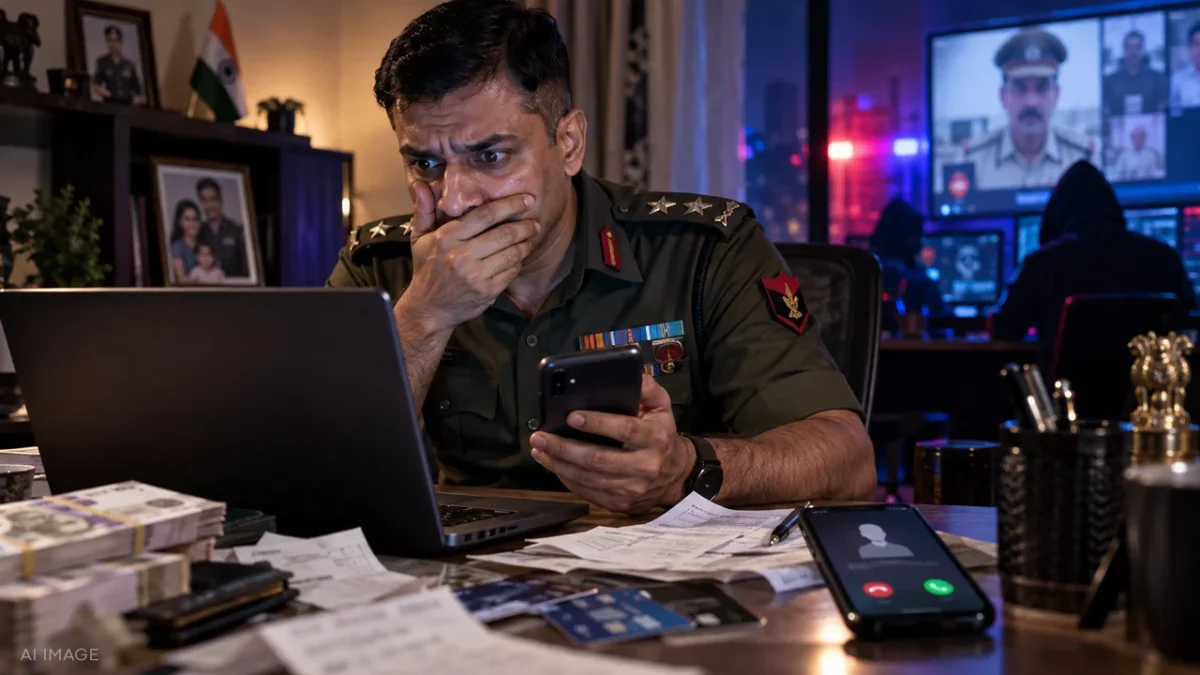
Pune: A retired Army officer in his seventies has alleged that he was cheated of Rs 1.28 crore after fraudsters posing as telecom officials and officers of the Mumbai Crime Branch and the Central Bureau of Investigation (CBI) placed him under a so-called “digital arrest” and forced him to liquidate savings and fixed deposits.





According to an FIR registered last week at the Pune city cyber police station, the veteran received a call on 20 August 2026 from a woman who claimed to be calling from “Telecom Headquarters in New Delhi.” She alleged that a telephone number registered in his name was being used from Mumbai to make fraudulent calls and to circulate obscene videos. The callers later sent a fabricated FIR and photographs purportedly showing the offending material over WhatsApp.
The conversation then shifted to men claiming to represent the Mumbai Crime Branch and the CBI. On video calls, one impersonator appeared in police uniform and identified himself as CBI officer “Pawar.” Another presented himself as a senior officer named “Vijay Khanna.” They questioned the veteran about his family, bank accounts, fixed deposits and gold holdings, and warned that he faced arrest unless he cooperated with what they described as a verification exercise.
Under continuous pressure through voice and video calls, the veteran was instructed to break fixed deposits and transfer funds into accounts nominated by the callers. Police suspect those accounts were mule accounts used to move stolen money. Between the last week of August and the first week of September, he transferred a total of Rs 1.28 crore from savings accounts and fixed deposits. The fraudsters insisted that routing money through multiple accounts was a routine part of the investigation.
Suspicion grew as the demands continued and more accounts were introduced. On 1 September, the veteran’s wife spoke to their daughter, who lives abroad. The daughter recognised the pattern as a digital arrest fraud and alerted her parents. The veteran then contacted the cybercrime helpline and Pune city cyber police, who registered the FIR. No accused have been publicly identified by their real names. The investigation is under way.
The case follows a familiar script. In a digital arrest scam, impersonators claim that a victim’s telephone, Aadhaar details or bank account has been linked to pornography, money laundering, terrorism or other serious offences. They produce fake documents, maintain constant video surveillance, forbid contact with family or police, and demand transfers “for verification,” promising that the money will be returned. There is no legal provision in India for a “digital arrest.” Genuine police or central agencies do not instruct citizens to move personal savings into third-party accounts over the telephone.
Pune has recorded several large losses of this kind among elderly residents in 2025 and 2026, including cases in which funds were later traced through hundreds or thousands of mule accounts and, in some investigations, converted into cryptocurrency. National figures compiled from official complaints put digital-arrest losses in the thousands of crores since 2022, with senior citizens remaining a primary target.
Anyone receiving such a call is advised to disconnect immediately, not share bank, Aadhaar or OTP details, and not transfer money. Suspected fraud should be reported at once on the national cybercrime helpline 1930 or through the National Cyber Crime Reporting Portal at cybercrime.gov.in, and to the local cyber police station. Early reporting improves the chance of freezing mule accounts before the funds are layered further.