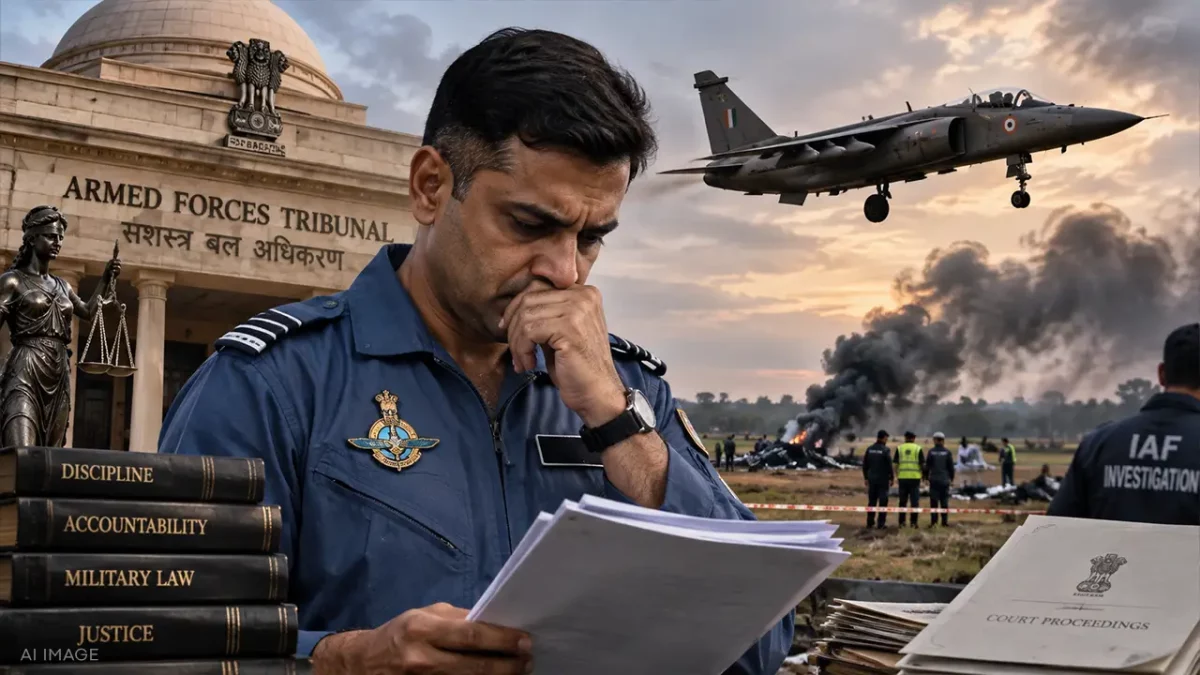
New Delhi / Dehradun, September 22, 2026 — Nearly 15 years after an Indian Air Force Jaguar fighter crashed during a low-level training sortie, the Armed Forces Tribunal (AFT) has upheld the censure imposed on the then flight commander for supervisory lapses in preparing a newly posted pilot for flying.





A Bench comprising a judicial member and an administrative member, in its order dated September 14, dismissed the challenge filed by the Wing Commander against a six-month award of “Severe Displeasure.” The Tribunal held that the officer had programmed a Flight Lieutenant for flying before the pilot had completed all mandatory pre-flying requirements.
Importantly, the Tribunal did not hold the Wing Commander responsible for directly causing the crash. Its finding was confined to supervisory failure in the planning and preparation of a newly reported pilot.
On August 4, 2011, Jaguar JS-197 crashed during a low-level training sortie after taking off from Air Force Station Gorakhpur. The aircraft came down near Dhilai Firozpur village in the Madhuban police station area of Mau district, Uttar Pradesh.
The Flight Lieutenant, who had joined the squadron only four days earlier, was killed in the crash. An 18-year-old girl working in nearby fields also died after being struck by debris.
The Court of Inquiry concluded that the most probable cause of the accident was Controlled Flight Into Terrain (CFIT), arising from an inadvertent descent that the pilot did not detect in sufficient time to permit recovery.
Maintenance records, Aircraft Data Recorder material and a report from BAE Systems were cited to show that a Differential Tail Plane snag reported on August 1 had been investigated and rectified, and that the aircraft had subsequently been certified serviceable for flying.
The Flight Lieutenant reported to the squadron at Air Force Station Gorakhpur on July 31, 2011. As flight commander, the Wing Commander was responsible for preparing flying schedules in consultation with the commanding officer.
He instructed the newly posted pilot to complete arrival formalities, simulator flying, a general test and familiarisation with local orders and procedures before commencing flying.
The simulator was unserviceable on August 1. Despite this, the Flight Lieutenant was programmed for a sortie on August 2, although the sortie did not eventually take place.
On August 3, the pilot flew two sorties a dual-check with the commanding officer followed by a solo sortie. The fatal flight took place the following day.
The Wing Commander proceeded on sanctioned leave from August 3 because of a medical emergency involving his daughter. He argued that subsequent sorties, including the fatal flight, had been authorised by other officers and that he could not be held responsible for events after leaving the station.
The Bench relied on the Wing Commander’s own statement before the Court of Inquiry that a newly reporting pilot would normally begin flying after about a week.
It held that the lapse consisted of planning the Flight Lieutenant for flying before completion of all required pre-flying activities. According to the Tribunal, supervisory responsibility began before the final authorisation of a particular sortie.
The Tribunal rejected the officer’s leave-related defence, observing that his leave beginning August 3 did not absolve him of responsibilities that existed up to August 2.
The Bench further held that the Wing Commander had failed to brief the commanding officer and the officiating flight commander that no sortie should be planned until all mandatory pre-flight activities had been completed and the newly posted pilot was ready for flying.
A second Court of Inquiry arose from an anonymous complaint alleging flight-safety violations, concealment of aircraft snags and manipulation of records.
The Tribunal did not accept the technical-snag allegation as a basis for overturning the censure. It held that the Wing Commander’s liability arose from a supervisory failure in preparing the newly posted pilot and not from any finding that his actions had directly caused the aircraft to crash.
The officer also alleged bias, selective action, denial of adequate opportunity to cross-examine witnesses and a connection between the inquiries and adverse annual confidential reports that affected his non-selection for promotion to Group Captain in 2014, 2015 and 2016.
The Union of India denied allegations of victimisation and stated that the officer’s review petition had been examined by the Chief of Air Staff and rejected through a reasoned order on February 8, 2016.
The Bench found no infirmity in the six-month award of “Severe Displeasure” and declined to order an independent inquiry to determine responsibility on the part of other officers.
It confined its examination to whether the censure had a sustainable basis in the inquiry record and dismissed the appeal as devoid of merit. The prayers concerning promotion and annual confidential reports had become infructuous after the Wing Commander took premature retirement on August 31, 2017.
The ruling underscores the Tribunal’s view that a flight commander’s supervisory responsibility for a newly posted pilot begins at the programming and preparation stage and is not limited to the final authorisation of a particular sortie.
At the same time, the ruling draws a clear distinction between supervisory lapses and direct causation of an aircraft accident. In this case, the most probable cause of the crash had been recorded as Controlled Flight Into Terrain.
The Jaguar, a deep-penetration strike aircraft inducted into Indian Air Force service in the late 1970s, has remained in operational use for more than four decades. The August 2011 accident was among the losses involving the aircraft during training and operational flying over the years.
The Tribunal’s September 14 order brings to a close the Wing Commander’s long-running challenge arising from the Courts of Inquiry conducted following the fatal Jaguar crash and the subsequent anonymous complaint.