
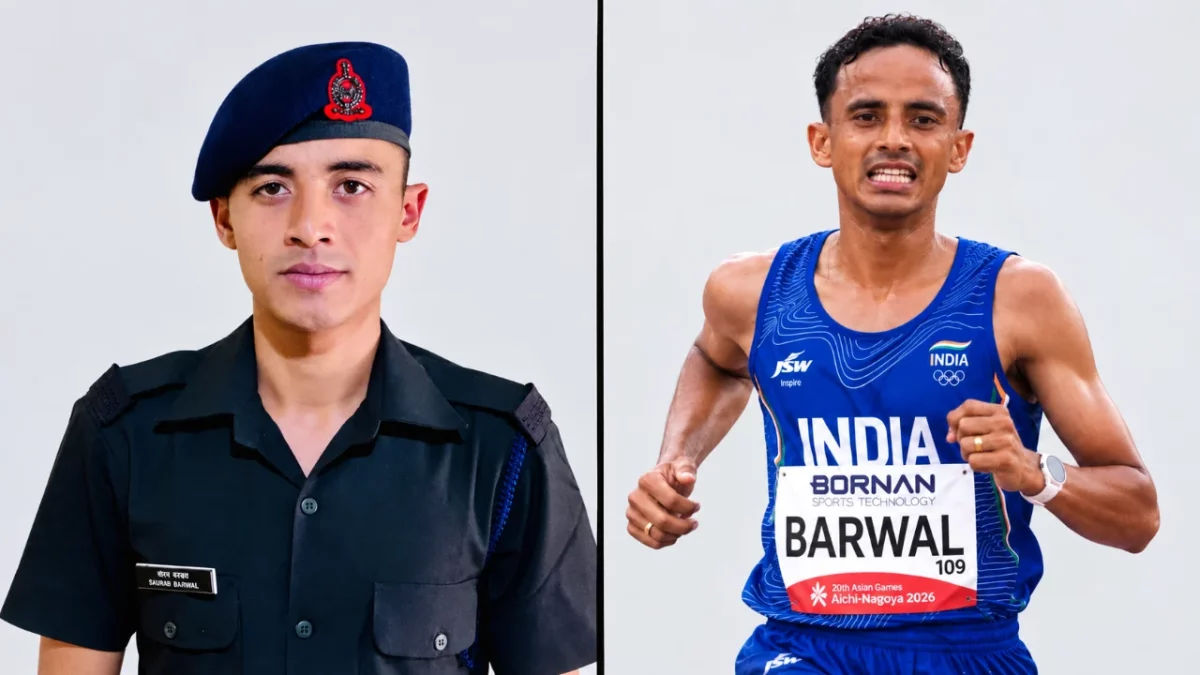
Havildar Sawan Barwal of the Indian Army has scripted a major chapter in Indian athletics by winning the silver medal in the men’s marathon at the 2026 Asian Games in Nagoya, Japan, while setting a new national record of 2 hours, 11 minutes and 37 seconds.




The 28-year-old long-distance runner from Himachal Pradesh finished behind Japan’s Ichitaka Yamashita, who claimed gold in 2:10:49. China’s Peiyou Feng secured the bronze medal with a time of 2:12:13.
Barwal’s performance ended India’s 44-year wait for a medal in the men’s marathon at the Asian Games. The country’s previous medal in the event came when H. K. Seetharan won bronze in 1982.
What makes the achievement particularly significant is that Nagoya was only Barwal’s second competitive marathon. He had made his marathon debut at the NN Marathon Rotterdam on 12 April 2026, where he clocked 2:11:58 and broke the long-standing Indian national record of 2:12:00 set by Shivnath Singh in 1978.
Less than six months later, Barwal improved his own national record by 21 seconds on one of Asian sport’s biggest stages.
Born on 18 February 1998, Barwal hails from Radda Bhakhed village in Joginder Nagar tehsil of Himachal Pradesh’s Mandi district. He comes from a modest family. His father, Kuldeep Barwal, worked as a driver in New Delhi, while his mother, Subhadra Devi, is a homemaker. His elder brother, Sumeet Barwal, also serves in the Indian Army.
Running was not initially Barwal’s chosen sport. As a youngster, he was interested in badminton and had even considered pursuing a career in banking. His journey into athletics began around the age of 14 when he accompanied his elder brother to a local track and joined a 1,500-metre training session.
His potential soon became evident, and he began training at the Joginder Nagar Sports Training Centre under coach Gopal Thakur. Years of competition on the track followed as Barwal developed across the 1,500m, 3,000m, 5,000m and 10,000m events before eventually making the transition to road running and the marathon.
Barwal joined the Indian Army through the sports quota in 2019 and currently holds the rank of Havildar. He is associated with the 501 Field Survey Engineering Group under the Additional Director General, Military Survey, Engineer-in-Chief’s Branch, and has trained extensively at the Army Sports Institute in Pune.
The Army’s structured sporting environment, including specialised coaching, sports science, recovery support and military discipline, has played an important role in his development as an elite endurance runner.
Before becoming a marathoner, Barwal had already established himself among India’s leading distance runners. He won silver in the 10,000m at the 2022 National Open Athletics Championships and bronze at the 2023 Asian Half Marathon Championships in Dubai.
His rise continued with gold in the 5,000m at the 2024 Federation Cup. At the 38th National Games in Dehradun in 2025, he completed a memorable double by winning both the 5,000m and 10,000m titles with meet-record performances. He subsequently finished fourth in the 10,000m at the 2025 Asian Athletics Championships in Gumi.
Barwal’s transition to the marathon proved remarkably successful. His physiological potential, including a reported VO2 max of around 78–79 ml/kg/min, was among the factors that encouraged his coaches to explore his ability over the 42.195-kilometre distance.
His marathon debut in Rotterdam immediately produced history. Barwal crossed the finish line in 2:11:58, shaving two seconds off Shivnath Singh’s record that had stood since 1978. The performance also secured his qualification for the Asian Games.
The closing moments in Rotterdam demonstrated the physical limits of marathon running. Barwal reportedly suffered two brief blackouts in the final metres after pouring water over his head amid cold and windy conditions. He fell twice near the finish but managed to complete the race and enter the Indian record books.
The Asian Games provided confirmation that Rotterdam was not an isolated performance. In Nagoya, Barwal not only secured an international medal but lowered the Indian record again to 2:11:37.
He has been supported by the Reliance Foundation’s Project 2:09 endurance programme and has worked with coaches and mentors including Ajith Markose, Mohammed Yunus Khan and Scott Simmons. His preparations have also included altitude training as part of the effort to develop him into an internationally competitive marathon runner.
Barwal has previously spoken about ambitions of eventually running in the 2:05 to 2:08 range, indicating that his national-record performances are viewed as steps in a longer journey rather than the final objective.
His achievements have also brought recognition beyond athletics. Following his double gold at the 2025 National Games, Barwal received an invitation to attend the Republic Day Parade in 2026 with his family.
From a village in the hills of Mandi to the Asian Games podium, Barwal’s journey has been built over more than a decade of endurance training. His progression through the Indian Army’s sporting system and his rapid adaptation from track racing to the marathon have now placed him among the leading names in Indian distance running.
With two national marathon records in his first two races over the distance and an Asian Games silver medal to his name, Havildar Sawan Barwal has emerged as one of the most significant Indian endurance athletes of his generation.