
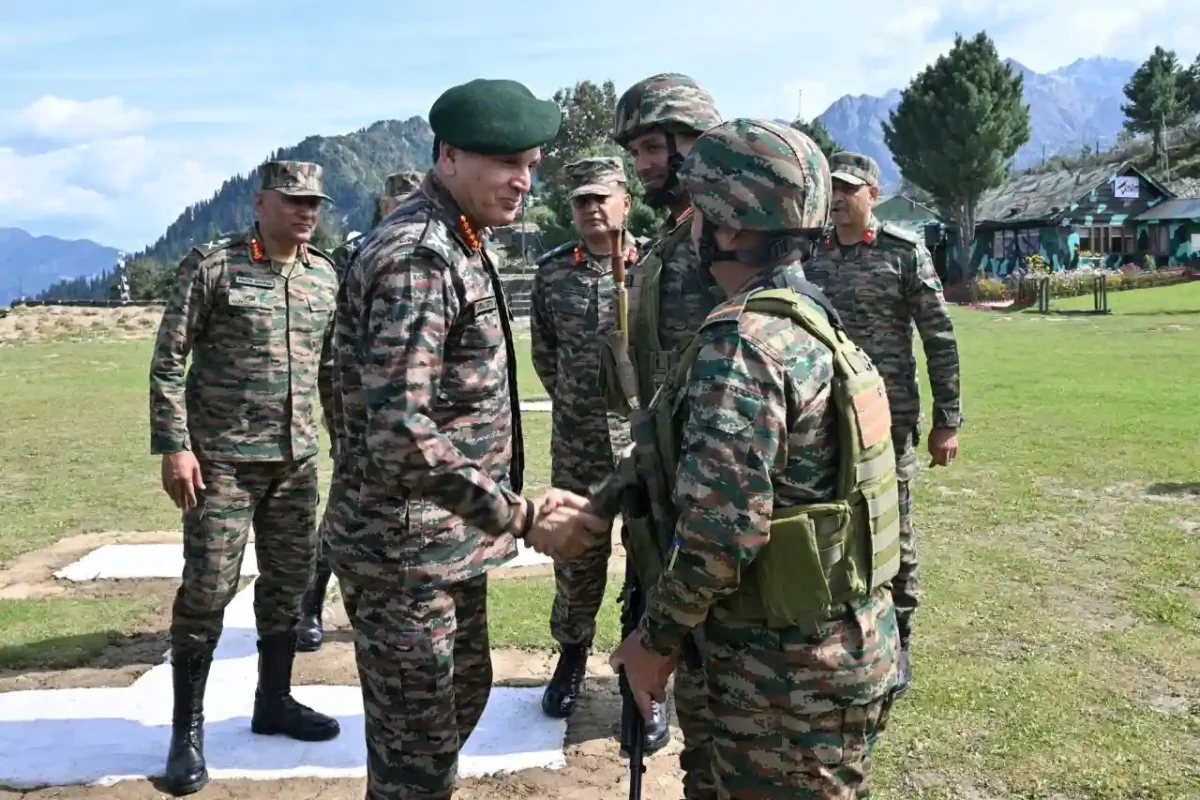
New Delhi, September 28, 2026 — Chief of the Army Staff General Dhiraj Seth on Sunday outlined a seven-point framework, termed ‘SAMARTH’, to strengthen the Indian Army’s operational readiness for prolonged and technology-driven conflicts. Speaking at the NDTV Defence Summit 2026, he argued that modern wars may feature shorter battles but not necessarily shorter wars, and that the force must therefore develop the endurance, adaptability and technological edge required to prevail in an era of “transformative wars.”





The address, titled “Atmanirbharta in an Era of Transformative Wars,” was delivered at the one-day conclave held on September 27. General Seth, who assumed charge as the 31st Army Chief on June 30, 2026, presented SAMARTH as a practical expression of capability development. The Hindi word means “capable.” Each letter denotes a priority:
- S — Sustainability: the capacity to endure long-drawn conflicts.
- A — Adaptation: the ability to adjust faster than evolving threats.
- M — Modernisation: remaining mission-ready.
- A — Acceleration: integrating new capabilities that enhance legacy systems while infusing technology.
- R — Resilience.
- T — Technology, including artificial intelligence, autonomous systems, robotics and drones.
- H — Human-machine teaming.
“Technology must make our soldiers faster, better informed and more effective. It should allow him to make better judgement,” General Seth said. “That is what ‘SAMARTH’ means being a capable force, having endurance and an ability to adapt, and stay ahead of others in this era of transformative wars.” He noted that the capability-development cycle typically lags behind the technology cycle, making a SAMARTH approach essential.
The Army Chief described contemporary conflicts as “wars with pause.” Technology, he observed, shortens individual engagements, yet overall wars often lack a clear termination point and continue through changes in intensity rather than a decisive end. He contrasted this pattern with earlier wars that concluded with an unambiguous marker, such as the 1971 surrender in Dhaka. A lull, he cautioned, should not be mistaken for the end of hostilities.
Amid information operations and social-media “salvos” that can obscure the operational picture, General Seth maintained that one constant remains: land. “Land will always be the one and only tangible and useful factor of success. Victory was, is, and will always be measured in territorial terms, and that territory will be occupied, secured and defended only by the force,” he said. He added that every new capability must answer a single question: how it assists the soldier the yodha — who places boots or tracks on the ground. India’s diverse terrain and threat spectrum, he noted, mean that “one size does not fit all”; the Army requires both reach and strength.
Self-reliance formed a central theme. When a crisis becomes prolonged, Atmanirbharta will distinguish victor from vanquished, General Seth said. He defined it as the ability to endure without being constrained by external supply chains: “Aatmanirbharta must mean design in India, develop in India, manufacture in India, sustain in India, upgrade in India, and also make for the world.” He warned against “indigenous obsolescence” the risk that systems developed at home become outdated before they are fielded and called for self-reliance that remains dynamic and continuously upgraded. The Atmanirbhar Yodha, he added, must remain at the heart of capability development.
The SAMARTH vision complements the ‘VIJAY’ priorities General Seth announced upon taking office in July Vigilance, Innovation and Transformation, Jointness and Integration, Atmanirbharta, and Yodha First and aligns with the broader Decade of Transformation and the national emphasis on indigenous solutions. Together, the frameworks underscore a soldier-centric, technology-enabled force prepared both for rapid multi-domain engagements and for the endurance required when conflict persists.