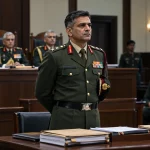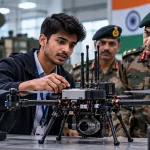

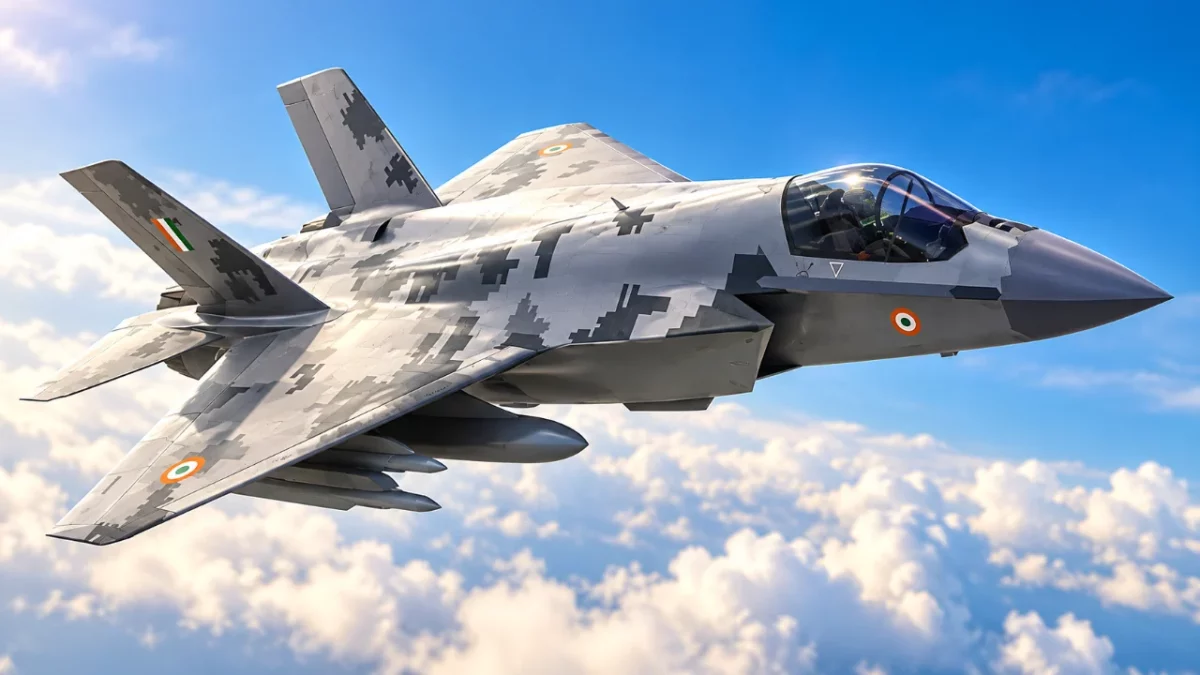
New Delhi: Defence Secretary Rajesh Kumar Singh has set official first-flight targets for India’s two principal indigenous combat aircraft programmes, stating that the Light Combat Aircraft (LCA) Mk2 prototype is expected to fly between June and September 2027, and that the Advanced Medium Combat Aircraft (AMCA) prototype is targeted for September 2028.


The statements were made at the NDTV Defence Summit in New Delhi on 27 September 2026. They constitute the clearest ministerial timeline yet for both platforms and are intended to reduce long-standing uncertainty around schedule slippage.
LCA Mk2: first flight window of June–September 2027
Singh said LCA Mk2 prototype test flights are due next year, “with slippage by a few months probably around June or September next year.” Independent reporting of the same remarks has framed the outer bound as no later than September 2027.
The Mk2 is a 4.5-generation medium-weight fighter designed by the Aeronautical Development Agency (ADA) with Hindustan Aeronautics Limited (HAL) as the production agency. It is intended to sit between the lighter Tejas Mk1/Mk1A and heavier types such as the Su-30MKI and Rafale, and will be powered by the General Electric F414 engine. HAL has separately indicated that the first prototype airframe has completed major fuselage joining and that a first ground run is planned for March 2027, with first flight later in 2027 if integration and clearance work stay on track.
AMCA: September 2028 first-flight target
Singh said the first AMCA prototype is targeted to fly in September 2028 and expressed the hope that it would fly within two years. The aircraft is India’s planned fifth-generation stealth fighter. Prototypes are expected initially to use GE F414 engines, the same family specified for LCA Mk2.
The programme has been opened to private-sector development and production partners after HAL failed to qualify on what Singh described as “fairly routine technical grounds.” He rejected the suggestion that HAL had been deliberately excluded and said the policy objective is to create a second fighter production line outside HAL.
Three entities have been shortlisted and issued a Request for Proposal:
- Tata Advanced Systems (standalone bid)
- A consortium led by Larsen & Toubro with Bharat Electronics and Dynamatic Technologies
- A consortium headed by Bharat Forge with BEML and Data Patterns
Bid submission has been extended to 30 October 2026, with opening scheduled around 31 October 2026. The selected partner will manufacture and integrate prototypes under ADA design authority. The RFP requires five flying prototypes and one structural test article, and stipulates that the first prototype must complete taxi trials and first flight within 30 months of contract award. Meeting a September 2028 flight date therefore requires parallel work on materials, tooling, process qualification and subsystems before contract signature.
A dedicated Aircraft Integration and Flight Testing Centre at Puttaparthi, Andhra Pradesh, is being developed to support integration, testing and certification.
Tejas Mk1A and the near-term fighter gap
Singh also provided an update on Tejas Mk1A, the aircraft intended to arrest the Indian Air Force’s squadron shortfall while Mk2 and AMCA mature. HAL currently has 27 airframes ready. Eleven have been fitted with GE F404 engines; the remaining 16 have flown with Category B engines. GE has undertaken to deliver four F404 engines a month for the remainder of the year. The Defence Secretary said this should allow induction of at least one operational Mk1A squadron by the end of the financial year. HAL has committed to a subsequent rate of 24 aircraft a year, using three internal lines and one private partner, against a combined order of 180 aircraft targeted for completion by 2033.
He said the government has taken no decision on importing a foreign fifth-generation fighter, including the Russian Su-57, as a stopgap. The near-term response to a regional stealth imbalance, he indicated, includes an artificial-intelligence layer on the Integrated Air Command and Control System to improve targeting, evasion and sensor fusion for existing fourth- and 4.5-generation aircraft.
Parallel work continues on the Multi-Role Fighter Aircraft requirement. Bids from Dassault Aviation for 114 Rafale aircraft are under examination. Singh argued that the platform is proven, shares a supply chain with the Navy’s Rafale Marine order, and that France has accepted a mandate for substantial manufacture and indigenisation in India, which would create a second combat-aircraft production line. He stressed that this would not displace the indigenous Tejas Mk1A programme, which would continue on a spiral-development path with indigenous radar and weapons.
Broader force-structure context
Singh said that when he assumed office the Air Force’s three principal concerns were a shrinking fighter fleet and shortages of airborne early-warning and tanker aircraft. All three, he said, are now on a path to being filled once contracts lock delivery schedules. Cabinet approval has been granted and contracts signed to fit indigenous AEW&C suites on six former Air India Airbus A321 airframes; tanker negotiations are in a final stage.
The timelines announced on 27 September are administrative targets rather than certified flight-test dates. They compress an already demanding industrial sequence, particularly for AMCA, where the production partner has not yet been selected. Whether the June–September 2027 window for LCA Mk2 and the September 2028 window for AMCA hold will depend on engine supply, partner award, parallel manufacturing and the remaining integration and certification workload.