
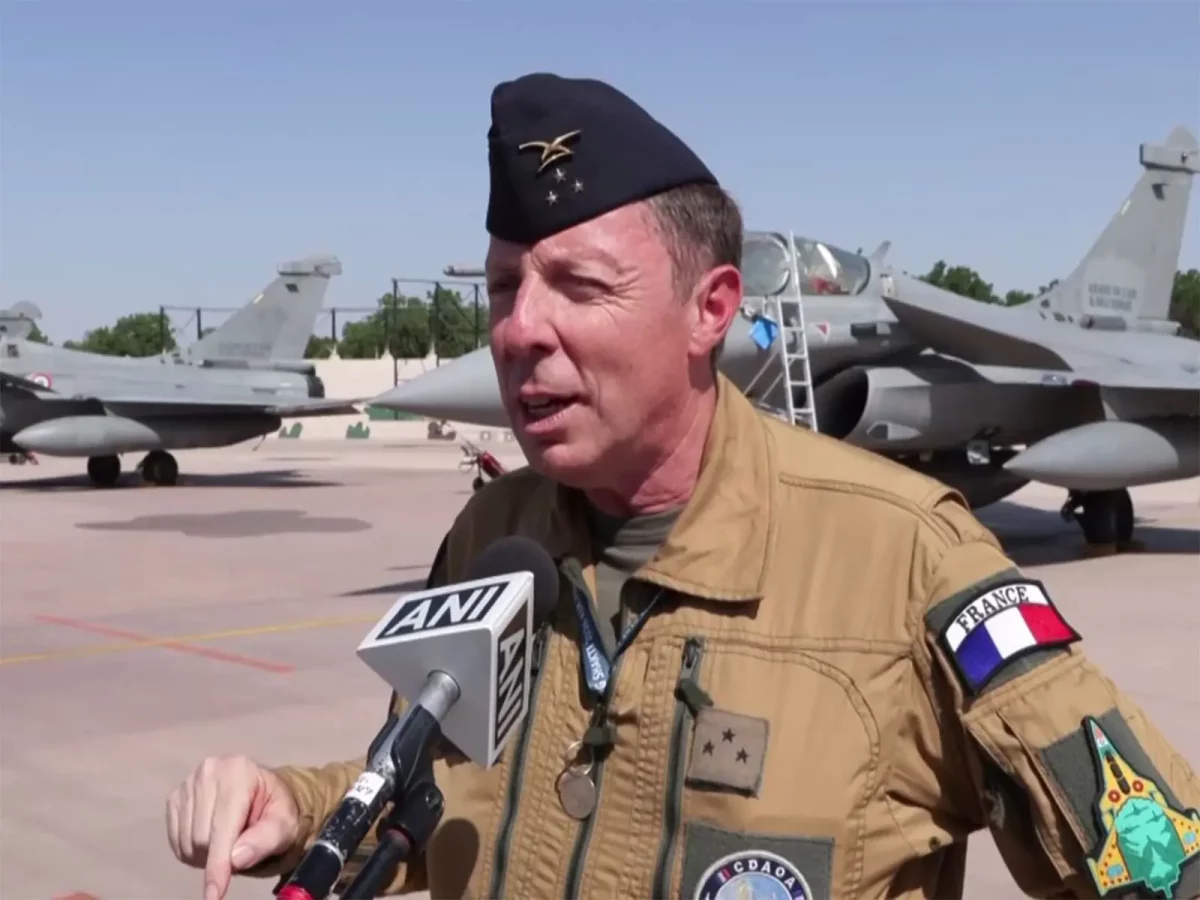
French Air Defence Deputy Commander Julien Sabéné has described Exercise Tarang Shakti as the “highlight” of France’s PEGASE 26 deployment, highlighting the operational lessons exchanged between the Indian and French Air Forces and the interoperability demonstrated between their Rafale fighter fleets.
Speaking to ANI in Jodhpur, Sabéné said the exchange of operational experience during the exercise had provided valuable training for both air forces, particularly as India and France have operated the Rafale fighter in real-world combat scenarios.
“The Indian Air Force has flown the Rafale in combat and so have we,” Sabéné said, adding that combat lessons learned could be exchanged during a large-force engagement exercise such as Tarang Shakti.
He also highlighted the long history of defence cooperation between India and France, noting that the Indian Air Force has operated French-origin aircraft since the 1950s. According to Sabéné, the IAF began operating the Ouragan in 1952, while the Rafale has now been part of the Indian fighter fleet for several years.
He said the presence of the Rafale on both sides provided an opportunity for the two air forces to exchange practices and operational experience.
Sabéné described the Indian leg of PEGASE 26 as particularly significant, saying that Tarang Shakti was a large multinational exercise that provided an opportunity for training for future forms of warfare.
“Stopping here for exercise Tarang Shakti was the highlight for us because it’s a true multinational ambitious exercise that gives us the best training to be ready for the next type of war,” he said.
The French officer also highlighted interoperability between the two air forces beyond fighter operations. He pointed to cross-refuelling activities involving Indian and French tanker aircraft, saying that the exercise demonstrated the ability of the two air forces to refuel from each other’s tankers.
The French contingent participating in Tarang Shakti comprises seven Rafale fighter aircraft, three Multi-Role Tanker Transport aircraft and two A400M transport aircraft.
Sabéné said he had flown as an observer on an A400M during an air-to-air refuelling mission involving a Rafale. He described the operation as having worked successfully.
The exercise has also provided the French contingent with an opportunity to operate alongside the Indian Air Force’s diverse aircraft fleet. Sabéné said the range of aircraft operated by the IAF offered additional learning opportunities for the participating French personnel.
The French deployment to India covered a distance of around 30,000 kilometres. Sabéné said the long-distance deployment reflected France’s position as an Indo-Pacific nation with citizens living in its overseas territories.
The French officer, who previously flew the Mirage 2000, also spoke about flying alongside India’s indigenous Light Combat Aircraft Tejas. He said the aircraft was new to him and that its characteristics reminded him of the Mirage 2000, which he had flown during his fighter-pilot career.
France has also previously operated alongside the US-made F-35. Sabéné noted that the French Air Force had flown with F-35 aircraft during exercises in Alaska.
He also highlighted India’s indigenous defence-development efforts and drew a parallel between the two countries’ emphasis on sovereignty in defence production.
“As a sovereign nation, France is like India,” Sabéné said, while appreciating India’s development of its own fighter aircraft and engines.
Beyond aircraft and operational procedures, Sabéné stressed the importance of interaction between personnel participating in the exercise. He said that getting to know the aircrews and allowing them to discuss their aircraft and best practices was an important component of improving interoperability.
According to him, Jodhpur provided an opportunity for Indian and French aircrews to meet, interact and exchange their experience of operating different aircraft.
PEGASE 26’s participation in Exercise Tarang Shakti was undertaken at the invitation of the Indian Armed Forces and forms part of the wider India-France defence relationship. France’s Ministry of Armed Forces has described the bilateral relationship as “dense and dynamic” and has highlighted exercises including Garuda, Orion and Tarang Shakti as reflecting the level of interoperability between the two militaries.
The French ministry has also highlighted the strengthening of defence cooperation following the induction of Rafale aircraft into the Indian Air Force.
Exercise Tarang Shakti is being conducted at Jodhpur from September 26 to October 12 under the theme “Power in Partnership”. The multilateral air exercise brings together participating air forces to conduct training, exchange expertise and develop interoperability.
Australia, the United States, the United Arab Emirates, France and Germany are among the friendly foreign countries participating in the exercise.
For the French contingent, the exercise has provided an opportunity to operate alongside Indian Rafale aircraft, conduct air-to-air refuelling activities and interact with personnel from a range of participating air forces. Sabéné’s remarks also underline the emphasis placed on exchanging operational experience and lessons learned during the multinational ex