

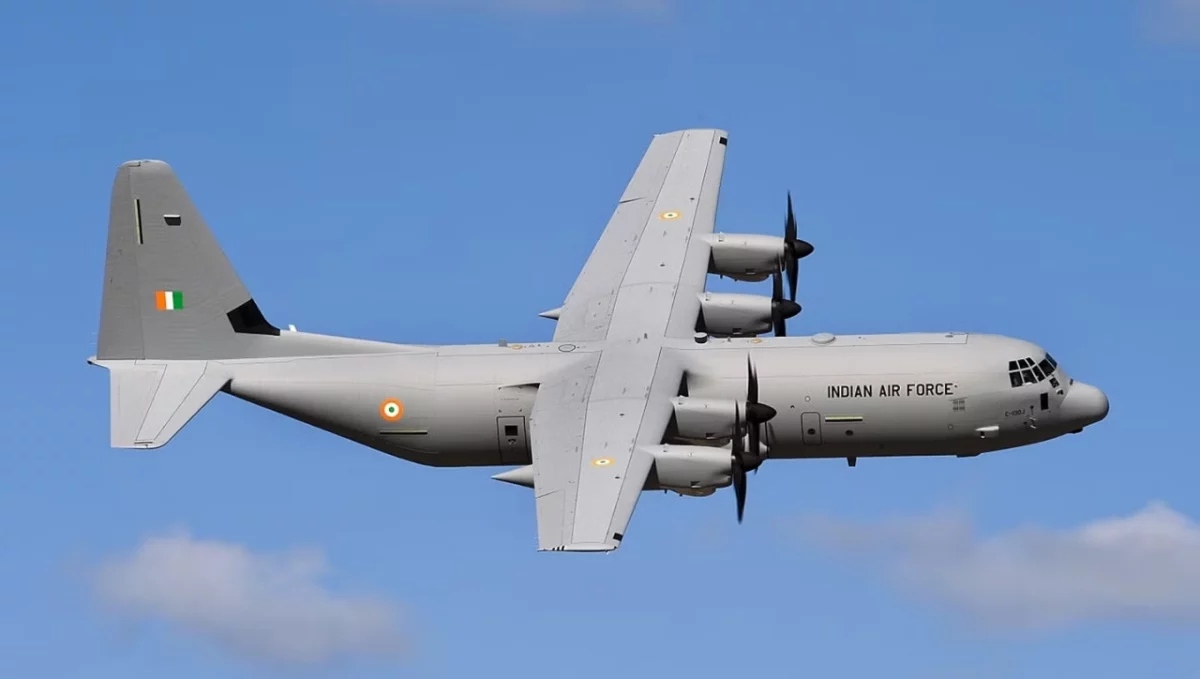
Lockheed Martin has offered to build 48 C-130J-30 Super Hercules aircraft in India and to upgrade the Indian Air Force’s existing fleet, a combination that could produce a common force of 72 advanced airlifters if both elements proceed.




The proposal is tied to the Medium Transport Aircraft (MTA) programme. The Ministry of Defence issued the Request for Proposal on 12 August 2026 for 60 aircraft, with bids due by 2 December. The programme is valued at about ₹1 lakh crore, or roughly USD 10–12 billion. Recent reporting has placed the figure at about USD 10.5 billion.
Under the offer, 12 aircraft would be delivered in flyaway condition from Lockheed Martin’s facility at Marietta, Georgia. The remaining 48 would be manufactured in India with Tata Advanced Systems Limited (TASL). The company is offering the latest C-130J-30 Block 8.1.2 standard, with updated communications, navigation, avionics and software. India’s present aircraft are of an earlier configuration, described by Lockheed as Block 6.
Robert Toth, Vice President for Strategy and Business Development, Air Mobility and Maritime Missions, told The Times of India that the company is prepared to supply “60 advanced Super Hercules (12 in flyaway conditions and 48 made in India)” and to upgrade the existing 12 “to the level of the advanced 60 aircraft, thereby taking IAF’s effective fleet of advanced aircraft to 72.” He said the entire fleet would then share the same lifespan. He also said Lockheed is “ready for complete transfer of technologies of some parts” of the C-130J if it wins the contract, and that selection would give India access to advanced technologies held by the group.
The upgrade is not automatic. Toth later told The Print that modernising the existing 12 aircraft would be a separate contract and is not part of the current MTA proposal. A common 72-aircraft fleet would therefore depend on that follow-on decision as well as on selection for the 60-aircraft tender.
The Indian Air Force inducted its C-130J-30s from 2011 and operates 12 stretched Super Hercules, used for special operations, tactical airlift and humanitarian missions. Lockheed says the fleet has logged more than 58,000 flight hours at an availability rate above 85 per cent. Cited tasks include high-altitude operations in Ladakh, including landings at Daulat Beg Oldi, relief flights during the Nepal floods, and the 2023 evacuation of Indian nationals from Sudan.
Industrial work is already in place. Tata Lockheed Martin Aerostructures Limited has built C-130J empennages in Hyderabad since December 2013 and has delivered 265, according to Lockheed. The company says more than 500 Indian suppliers, including about 140 MSMEs, feed its joint ventures, and that the partnership has generated over USD 700 million in exports. A dedicated C-130J maintenance, repair and overhaul facility in Bengaluru is scheduled for completion by the end of 2026, with the first Indian aircraft expected to enter it in the first or second quarter of 2027. Lockheed is also evaluating a second final-assembly line in India, which would be the first Super Hercules production line outside the United States. Dan Tenney, Senior Vice President for Global Business Development and Strategy, told PTI on 4 October that the existing Tata partnership for C-130J components and empennages “will be expanded in our current bid.”
The Request for Proposal went to five Indian entities: TASL, partnered with Lockheed Martin on the C-130J; Mahindra Defence, partnered with Embraer on the C-390 Millennium; Reliance Defence; Adani Defence; and Hindustan Aeronautics Limited. Airbus has withdrawn, leaving the C-130J-30 and the C-390 as the principal contenders. The MTA is intended to replace the ageing An-32 and Il-76 fleets. The formal requirement is for 60 aircraft and is expected to rise later.
Lockheed’s case rests on an aircraft already cleared for Indian high-and-hot operations, a common training and logistics base if the upgrade follows, and an established private-sector supply chain. The contest will turn on payload against the stated 18-to-30-tonne band, indigenous content, lifecycle cost, and how far local assembly and technology transfer actually go.