

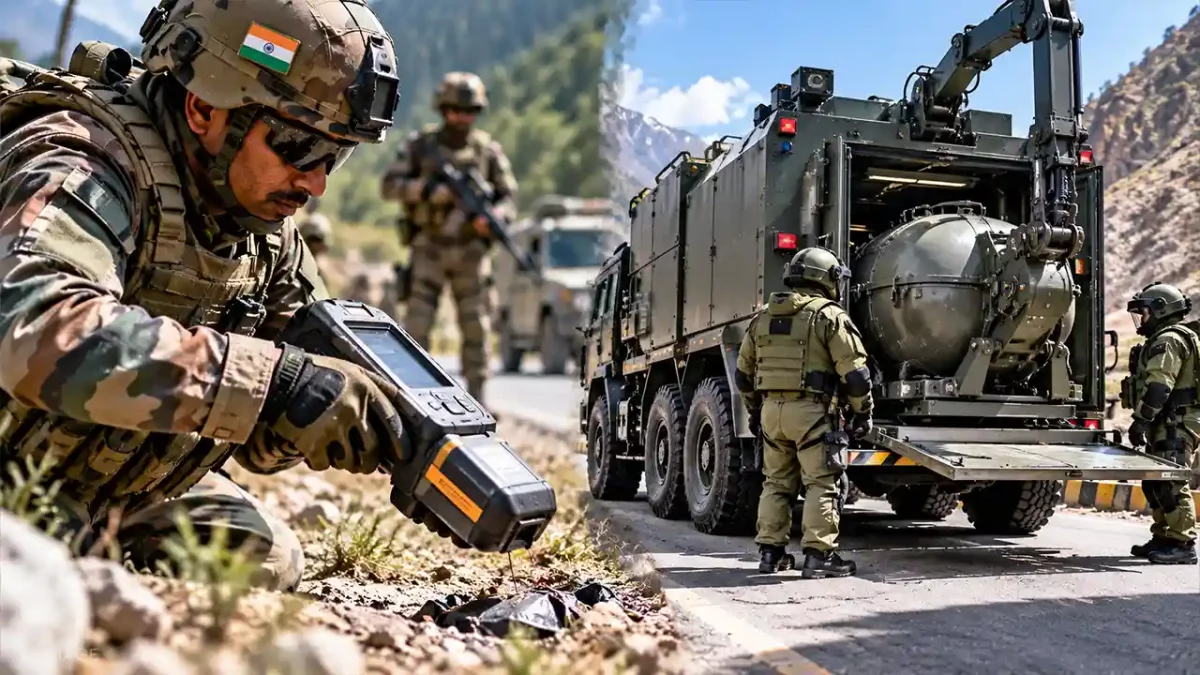
The Indian Army has initiated procurement of 350 portable stand-off explosive detectors and 13 total containment vehicles to strengthen counter-IED capabilities in Jammu and Kashmir, the North East, and Left-wing extremism-affected areas.





The Combat Engineers Directorate at Army Headquarters has issued Requests for Information that are expected to lead to these acquisitions. The move forms part of a wider upgrade of counter-Improvised Explosive Device and force-protection equipment, and is intended to proceed under the Atmanirbhar Bharat route.
Stand-off explosive detectors
The Army is seeking about 350 hand-held systems capable of “safe stand-off inspection.” The detectors must identify traces of military, commercial, and improvised explosives without physical contact, and must return a result within 30 seconds.
The systems are required to detect both organic and inorganic explosives in vapour, liquid, powder, particle, and mixed forms. They must operate on battery power for a minimum of four hours continuously, and must include USB and Bluetooth connectivity for data transfer and for updating explosive-detection libraries as new threat signatures emerge. No specific detection technology has been prescribed at this stage.
The equipment is intended for use at checkpoints, critical installations, and vehicle inspection points, as well as in field conditions, to give bomb-disposal and counter-terror teams a faster and safer means of screening suspicious objects.
The procurement will fall under the Buy (Indian-IDDM), Buy (Indian), and Buy and Make (Indian) categories of the Defence Acquisition Procedure 2020. Vendors must confirm that at least half of the indigenous content comprises materials, components, or software manufactured in India, and must disclose locally made subsystems, critical spares, and manufacturing capacity in India. Equipment that clears technical evaluation will undergo field trials in India on a no-cost, no-commitment basis, after which the lowest-cost compliant bidder will be selected.
Total containment vehicles
Separately, the Army has sought information for 13 Total Containment Vehicles for the safe transportation and, where necessary, neutralisation of improvised explosive devices and unexploded ordnance.
Each vehicle must be able to contain an explosive with a blast effect equivalent to 8 kg of TNT. The containment chamber, described as an “inside-out submarine” and fabricated from high-grade steel, is required to retain the shockwave, high-pressure gases, and shrapnel within the vessel. The vehicles must also permit liquid or vapour samples to be extracted through a vacuum-based system without external contamination, so that forensic evidence can be preserved while handling teams remain protected.
Related counter-IED acquisitions
The two RFIs sit alongside other recent Combat Engineers requirements. Earlier, the Directorate sought details on about 250 telescopic manipulators that would allow bomb-disposal teams to examine and handle suspicious objects from at least four metres. In May, the Ministry of Defence floated a tender valued at about Rs 290 crore for 386 dual-technology mine detectors capable of locating both metallic and non-metallic mines and IEDs. In February 2025, the Army concluded an Rs 80 crore contract with Larsen & Toubro for 223 DRDO-designed chemical agent detectors.
IEDs continue to be used against security forces in Jammu and Kashmir, insurgency-affected areas of the North East, and districts affected by Left-wing extremism. The layered procurement stand-off detection, remote handling, containment and disposal, and dual-technology mine detection is aimed at reducing troop exposure while improving the speed and forensic integrity of explosive-threat response.