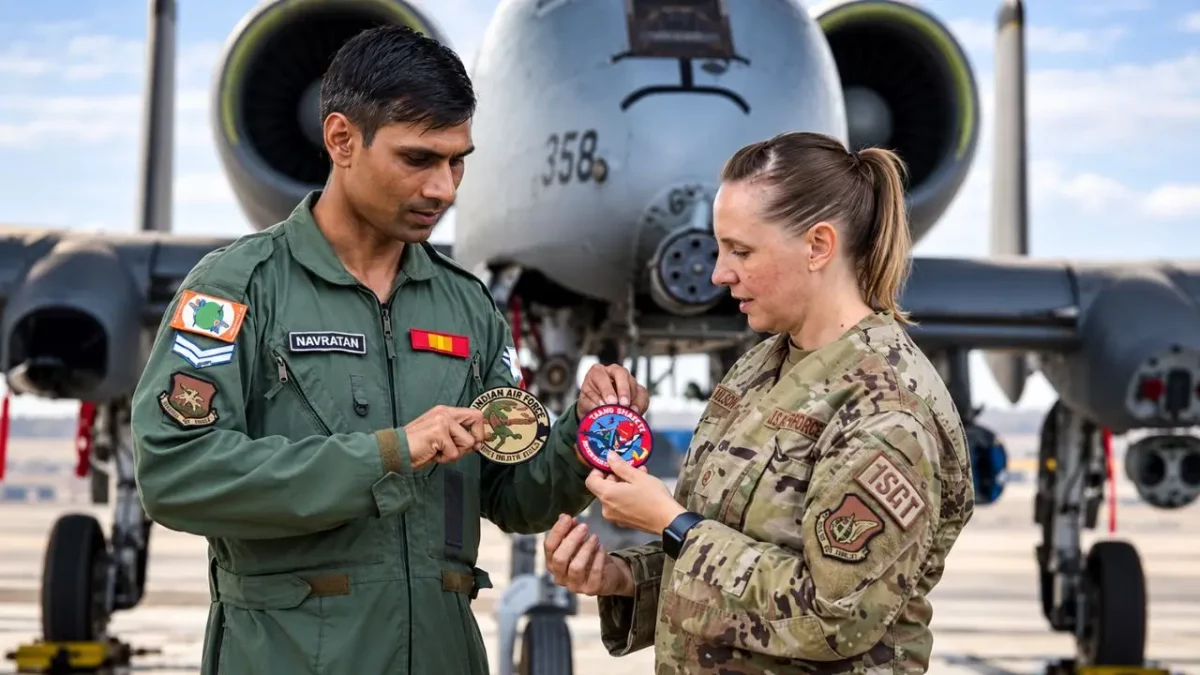
Jodhpur, October 6, 2026: The Indian Air Force’s multilateral air combat exercise Tarang Shakti, under way at Jodhpur, has recorded the largest-ever participation of women officers from the IAF in an international exercise. More than 25 women officers are flying fighter jets and other aircraft during the two-week drills, officials familiar with the matter said.





The women officers are flying alongside around 125 male IAF pilots. In earlier international exercises, the number of women pilots rarely moved beyond single digits. Officials described the scale of participation as a measure of operational competence rather than a symbolic milestone.
“The women officers are flying alongside around 125 male IAF pilots in the exercise. This is not about gender; it is about skills, and the ability to deliver. The IAF is a gender-neutral service where roles are defined by competence and operational capabilities,” one official said.
Exercise framework
Tarang Shakti-26, the second edition of the IAF’s flagship multilateral air exercise, began on September 26 and is scheduled to continue until October 12. Eight air forces are participating with aircraft and personnel: India, the United States, France, Germany, the United Arab Emirates, Australia, Bangladesh and Sri Lanka. Another 32 countries are represented by observers, among them Brazil, Egypt, Italy, Japan, Malaysia, Oman, Singapore, South Africa, Thailand and Vietnam.
More than 80 Indian and foreign aircraft are taking part, with around 1,500 personnel from the participating countries engaged as aircrew, technicians and ground staff. Five airbases in Rajasthan — Jodhpur, Jaisalmer, Bikaner, Uttarlai and Phalodi — are directly involved, with additional IAF stations in neighbouring states supporting the drills. Separately, around 6,000 to 7,000 IAF personnel, including more than 200 women, are deployed in key non-flying roles.
Aircraft and missions
Foreign platforms in the exercise include F-35s, F-16s, Rafales, A400Ms, A330 multi-role tanker transports, KC-135s, C-130s and other specialised aircraft. These are operating with the IAF’s Sukhoi-30s, Rafales, Jaguars, Mirage-2000s, MiG-29s, LCA Mk-1 Tejas, Mi-35s, Mi-17s and IL-78 flight refuelling aircraft. The United States has deployed six F-35 fifth-generation fighters to Jodhpur, the first time the type has taken part in an exercise in India. Formation flying has included US Air Force F-35s alongside the IAF’s Tejas.
The exercise covers visual-range and beyond-visual-range combat, force engagements involving high-value aerial assets, air mobility operations and dynamic targeting, air-to-air refuelling, and combat search and rescue.
IAF Vice Chief Air Marshal Ashutosh Dixit has said the drills draw on recent operational experience, including Operation Sindoor, alongside the experience of partner air forces. “Bringing these together in a realistic training environment allows us to test assumptions, challenge procedures, understand different methods of employing air power and improve interoperability,” he said earlier.
A decade after the fighter stream opened
The participation comes about a decade after the fighter stream was opened to women. The government decided in October 2015 to admit women to the fighter stream on an experimental basis. In June 2016, Flight Cadets Avani Chaturvedi, Bhawana Kanth and Mohana Singh were commissioned as the IAF’s first women fighter pilots.
Women officers have since moved into instructional and front-line flying roles. In May, Squadron Leader Saanya became the first woman officer to earn the Category A Qualified Flying Instructor rating, the highest instructional qualification for an IAF pilot, enabling her to train ab initio pilots, operational pilots and other instructors. Earlier, Squadron Leader Shivangi Singh became the first woman fighter pilot to earn the Qualified Flying Instructor badge after completing the course at the Flying Instructors’ School, Tambaram. Women transport and helicopter pilots had received the badge before her.
The Indian military began inducting women as short-service commissioned officers in the early 1990s. Women officers now fly fighters, serve on warships, command front-line units, receive permanent commission and train at the National Defence Academy. Combat roles in the Army’s infantry and armoured corps remain closed to women.