
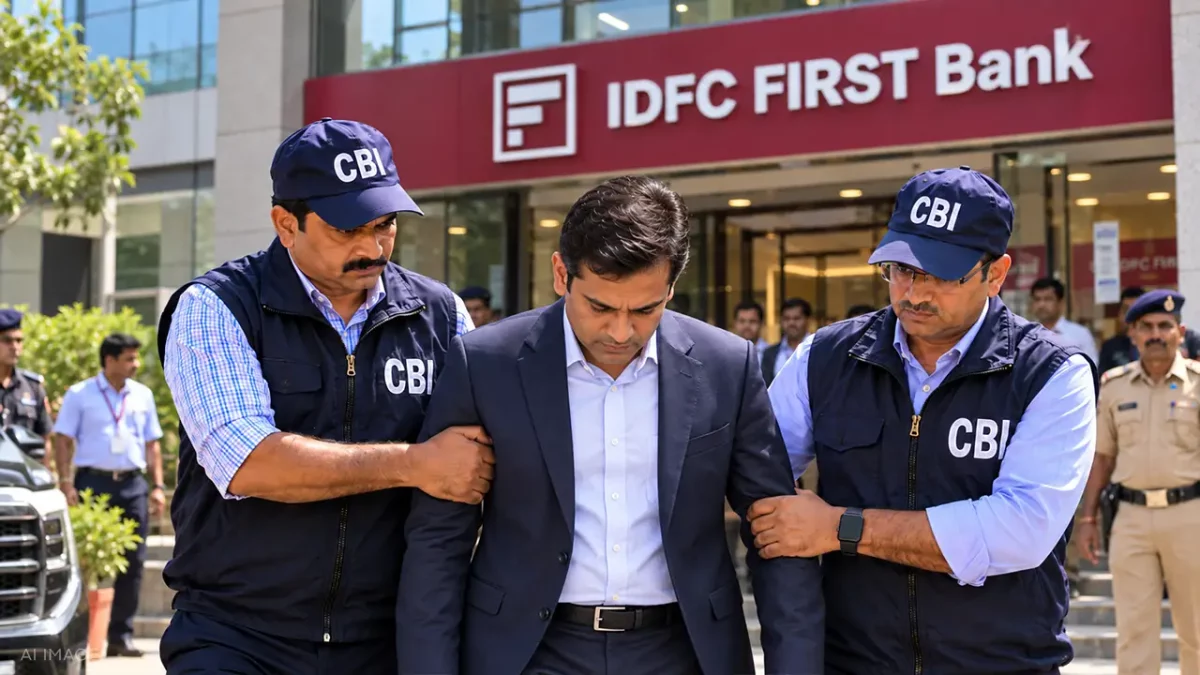
Chandigarh, October 14, 2026: The Central Bureau of Investigation (CBI) has arrested Chandigarh-based businessman Mohit Goyal for allegedly arranging and routing ₹2 crore in cash through a hawala channel to the son of suspended Haryana IAS officer Ram Kumar Singh (R.K. Singh) as part of the ongoing probe into the ₹504 crore IDFC First Bank fraud case.


Goyal, owner of M/s Chandigarh Mega Store and associated firms including Bhagwati Agencies, was arrested on October 13, 2026. He was produced before a court the same day, which granted the CBI three days of police custody to further interrogate him regarding the cash trail and related transactions. Chartered accountant Siddharath Narula and two other accused, Gaurav Kansal and Manoj, were also arrested and remanded in three days of CBI custody.
The Alleged Hawala Trail
According to the CBI, on January 22, 2026, Goyal arranged ₹2 crore in cash through his store and contacts on the instructions of Ribhav Rishi, the former branch manager of IDFC First Bank’s Sector 32, Chandigarh branch, described as the principal architect of the fraud. The cash was then routed through a hawala network and allegedly delivered to Singh’s son, Prashant, in Delhi the same evening.
Investigators have alleged that the funds originated from government money siphoned from the Municipal Council, Kalka (where ₹18.46 crore is stated to be missing under Singh’s supervisory charge), and reached the officer’s son within 48 hours. The CBI has stated: “The siphoned government money of MC (Municipal Council) Kalka thus reached a public servant within 48 hours, in cash generated through him and his network.”
Earlier reporting based on the CBI’s supplementary chargesheet detailed the delivery mechanism. Cash was collected in Chandigarh (including from Mega Store outlets and other sources) and handed to a hawala operator. Identification for the Delhi handover relied on a pre-shared serial number of a ₹10 note. Deliveries in the Chandni Chowk area were made in tranches of ₹1 crore, ₹50 lakh, and ₹50 lakh by operators, with receipts and call records, WhatsApp chats, and tower data cited as evidence.
Goyal’s Alleged Role in Larger Transactions
Between October 11, 2023, and January 28, 2026, accused firms allegedly transferred ₹59.50 crore to Goyal and his entities through banking channels. Of this, ₹14.05 crore was returned through banking channels, while the remaining ₹45.45 crore was allegedly handed back in cash. Goyal is also accused of allowing the syndicate to use his firm’s bank account and signing blank cheques. Of approximately ₹58.68 crore received by his firm, around ₹54.04 crore was transferred to individuals and jewellers on instructions, without corresponding purchases of goods. Recipients named by the CBI include Sawan Jewellers (₹5.99 crore), M B Gold (₹4.59 crore), Sham Jeweller (₹3.62 crore), and others.
Background of the Fraud Case and IAS Officer’s Role
The broader case involves the alleged illegal diversion of public funds belonging to eight Haryana government departments and bodies (with the Haryana-linked loss estimated at around ₹504 crore; the overall figure rises to approximately ₹657 crore when two Chandigarh Administration entities are included). Funds were allegedly moved into specific branches of IDFC First Bank and later AU Small Finance Bank through irregular accounts, bypassed guidelines, forged fixed deposit receipts, and shell entities, before being siphoned via cash, gold, and other channels.
Ram Kumar Singh, a 2012-batch IAS officer promoted from the Haryana Civil Services, served as Commissioner of the Municipal Corporation, Panchkula, and held charge of the Municipal Council, Kalka. He was suspended by the Haryana government in April 2026 and arrested by the CBI on June 18, 2026. The agency has alleged that he conspired with bank officials and others, approved the opening of accounts and transfer of large sums in violation of finance department guidelines, issued cheques knowing they would be misused, and is responsible for a ₹100 crore loss to the Panchkula Municipal Corporation (covered by fake FDRs) along with the Kalka shortfall.
He has been chargesheeted, and the CBI has sought prosecution sanction against him and other IAS officers named in the case (including Vineet Garg, Pankaj Agarwal, Mohammad Shayin, and Saket Kumar). Allegations against the officers have included receipt of cash, gold coins, and other favours.
The CBI has filed multiple chargesheets (including a major one on September 2, 2026), naming a total of 37 accused so far. Twenty-six have been arrested, 54 searches conducted, and incriminating material including gold worth approximately ₹20 crore seized. The investigation continues, with the agency seeking to map the full chain of the January 22 cash transaction, identify others involved, and examine whether similar arrangements were made for other public servants.
The case underscores the alleged nexus between bank officials, intermediaries, and senior bureaucrats in the diversion of public funds, with hawala channels used to move proceeds rapidly. Proceedings remain ongoing before the special CBI court in Panchkula.