

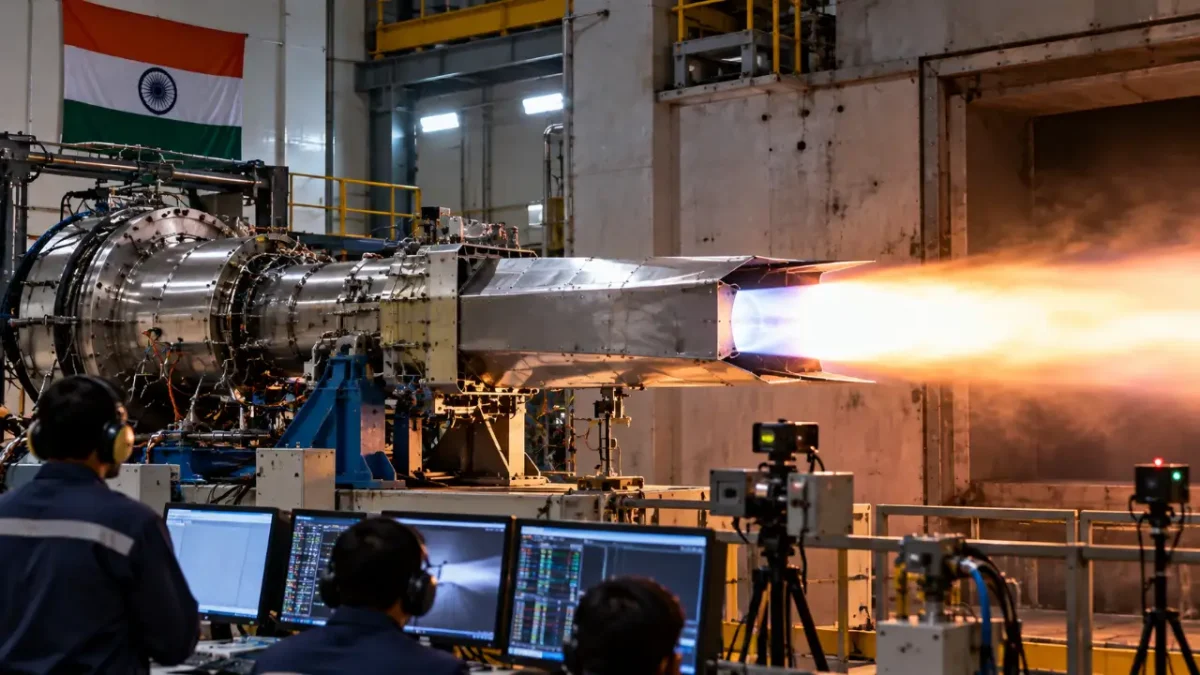
New Delhi, October 2026: The Ministry of Defence has issued a tender for the procurement of 500 scramjet propulsion systems intended for India’s hypersonic missile programme. The tender, listed under reference IA: 011-23018861 (also reported as IA-01123018861), marks a significant step toward strengthening indigenous hypersonic strike capabilities and expanding the country’s hypersonic weapons ecosystem.





The requirement underscores the growing emphasis on advanced air-breathing propulsion technology capable of sustaining missile flight at speeds exceeding Mach 5 (more than five times the speed of sound, or over 6,100 km/h). Scramjet (Supersonic Combustion Ramjet) engines are regarded as a critical enabling technology for next-generation hypersonic cruise missiles.
Unlike conventional rocket engines, which must carry their own oxidiser and therefore have limited endurance, a scramjet draws oxygen from the atmosphere and sustains combustion while airflow remains supersonic. This allows prolonged powered flight at hypersonic speeds, greater range, and enhanced manoeuvrability.
The tender follows a series of successful long-duration ground tests of an actively cooled full-scale scramjet combustor conducted by the Defence Research and Development Laboratory (DRDL), a key DRDO facility in Hyderabad, at its state-of-the-art Scramjet Connect Pipe Test (SCPT) Facility. In January 2026, the combustor achieved a run time of over 12 minutes (more than 700 seconds). This was significantly extended on 9 May 2026, when a run time exceeding 1,200 seconds was demonstrated.
These tests validated the design of the advanced combustor, the performance of the indigenous test facility, and the use of indigenously developed liquid hydrocarbon endothermic fuel, high-temperature thermal barrier coatings, and advanced manufacturing processes. Earlier subscale long-duration tests had been conducted in 2025. Defence Minister Rajnath Singh described the achievements as laying a solid foundation for the Hypersonic Cruise Missile Development Programme, while DRDO Chairman Dr. Samir V. Kamat congratulated the teams on positioning India at the forefront of advanced aerospace propulsion technologies.
An order for 500 units is substantially larger than the handful of engines typically required for pure developmental testing. While the Ministry has not specified the exact missile system, the quantity indicates planning for production of a scramjet-powered hypersonic cruise missile.
Such a weapon would differ from boost-glide hypersonic systems (for example, the long-range anti-ship hypersonic missile tested in 2024), which are accelerated to high speed by a rocket and then glide unpowered. A sustained scramjet-powered cruise missile remains under power throughout much of its trajectory and can manoeuvre more effectively, complicating interception by existing air-defence systems.
India’s broader hypersonic efforts include the Hypersonic Technology Demonstrator Vehicle (HSTDV), which successfully demonstrated scramjet-powered flight in 2020, and Project Vishnu, under which the Extended Trajectory–Long Duration Hypersonic Cruise Missile (ET-LDHCM) is being developed.
The ET-LDHCM is intended as a scramjet-powered system capable of speeds around Mach 8, with a baseline range exceeding 1,500 km (and potential future extension), and multi-platform launch options. Related programmes such as BrahMos-II also explore hypersonic capabilities. The procurement is expected to support domestic manufacturing, specialised aerospace supply chains, and advanced propulsion expertise under the Atmanirbhar Bharat initiative.
The development occurs amid a global race in hypersonic weapons. China has fielded systems such as the DF-17 and YJ-21, while Russia’s Zircon is among the few reported operational scramjet-powered missiles. Hypersonic weapons compress adversary decision timelines and challenge conventional missile defences due to their combination of extreme speed and manoeuvrability.
The Ministry’s tender does not imply that 500 operational hypersonic missiles have already been manufactured or inducted; supplier selection, production, integration, testing, and certification processes remain ahead. It does, however, signal clear intent to accelerate the transition from successful ground demonstration to eventual operational deployment of advanced hypersonic cruise missile platforms, thereby strengthening long-range precision-strike capabilities and strategic deterrence.