

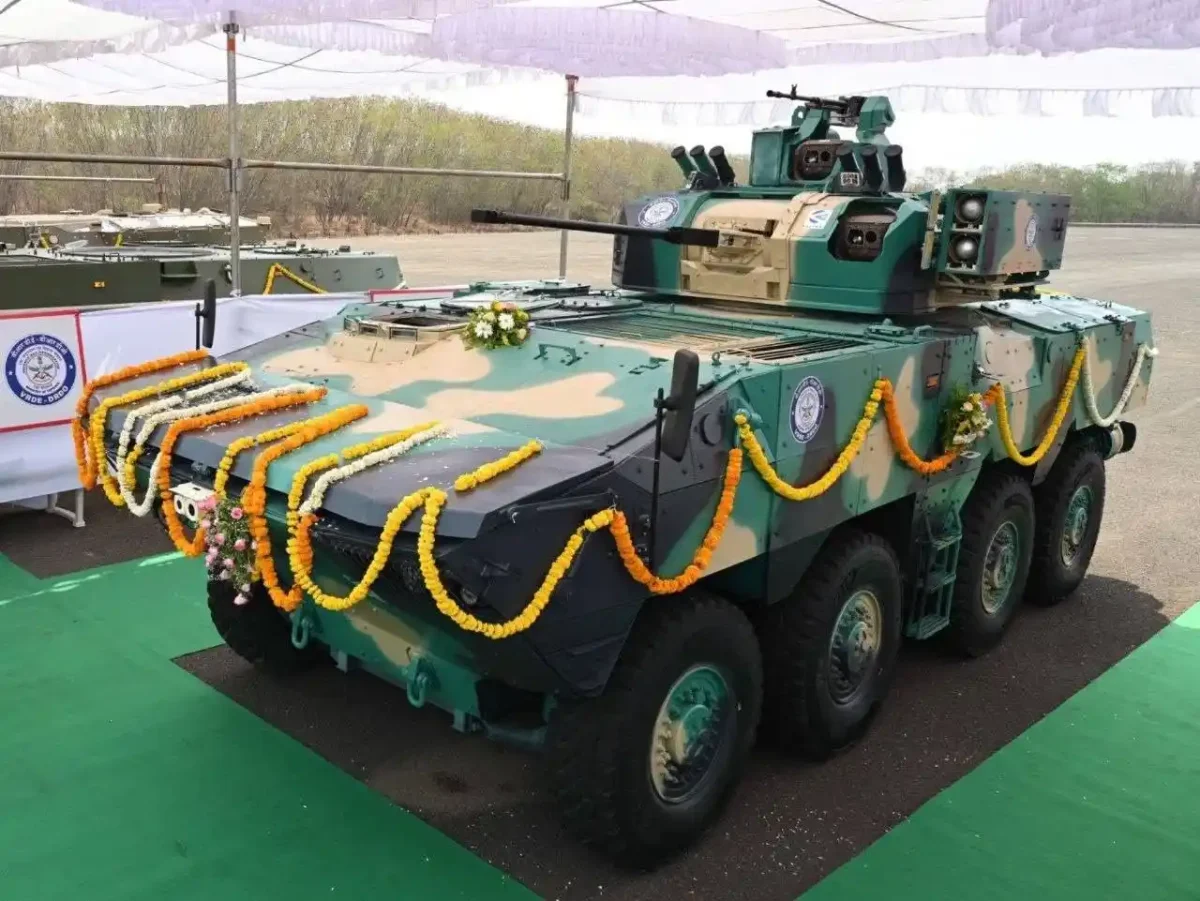
The Defence Research and Development Organisation (DRDO) has achieved a significant milestone in its Vikram VT-21 programme, with the wheeled variant of the next-generation infantry combat vehicle (ICV) meeting operational requirements during development trials.

A senior DRDO official stated that extensive trials of the wheeled platform have been encouraging. The vehicle successfully demonstrated mobility, trench-crossing capability, and amphibious performance with its turret fitted. Trials of the tracked variant are progressing in parallel.
The Vehicle Research and Development Establishment (VRDE), a DRDO laboratory in Ahilyanagar, developed both the tracked and wheeled variants in collaboration with Tata Advanced Systems Limited and Bharat Forge Limited, supported by several micro, small and medium enterprises. The prototypes were unveiled on 25 April 2026.
DRDO is targeting induction of the platforms by 2029, subject to successful testing and acceptance by the Indian Army. The Army will now conduct further user trials across deserts, plains and high-altitude regions. These evaluations will assess mobility, weapons systems, firing capabilities and performance under varying operating conditions. Feedback from the trials will guide any required modifications before the vehicles progress toward induction.
The programme aims to replace the Indian Army’s ageing fleet of Russian-origin BMP-II infantry combat vehicles, which have formed the backbone of its mechanised infantry since the 1980s. The wheeled variant is expected to offer advantages in road mobility and rapid movement, while the tracked version is better suited to difficult off-road terrain. Both platforms are designed to transport infantry safely and support troops in combat.
Key features of the Vikram VT-21 include an indigenously developed 30 mm unmanned (crewless) turret that allows operators to remain inside the protected hull, a coaxial 7.62 mm machine gun, and the ability to launch anti-tank guided missiles. The platforms incorporate modular armour providing STANAG Level 4 and 5 protection against ballistic and blast threats, amphibious capability aided by hydrojets, and a high power-to-weight ratio from a high-output diesel engine paired with automatic transmission. Current indigenous content stands at approximately 65 per cent, with plans to raise it to 90 per cent.
A senior mechanised infantry officer noted that modern platforms such as Germany’s Puma, Sweden’s CV90 family, the US Bradley and South Korea’s K21 emphasise the integration of protection, firepower, surveillance and communications rather than armour and weapons alone. The Vikram VT-21 is intended to meet similar requirements for more complex and hybrid warfare environments.
The programme reflects the Development cum Production Partner (DCPP) model, combining DRDO’s design and research expertise with private industry’s manufacturing capabilities. Successful induction would strengthen domestic armoured-vehicle production, improve quality and spares support at scale, and reduce dependence on imported technologies. Both variants have previously cleared the Ministry of Defence’s Technical Evaluation Committee for the wheeled armoured fighting vehicle and Future Infantry Combat Vehicle (FICV) programmes.
Army trials across diverse terrains will be decisive in determining whether the Vikram VT-21 can meet operational requirements in India’s varied environments.