
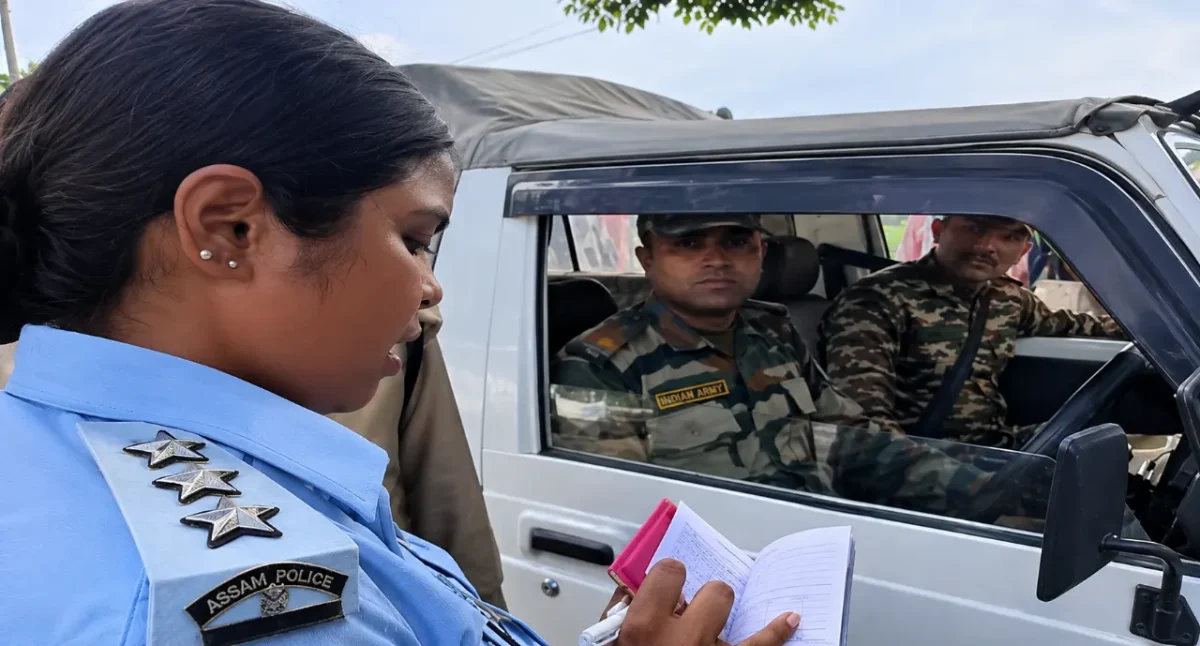
A routine traffic enforcement drive conducted by the Jorhat District Transport Office (DTO) on Wednesday resulted in an Indian Army vehicle being stopped and its driver penalised. Officials, including a Motor Vehicle Inspector (MVI) and traffic personnel, halted an Army Gypsy bearing Army number plates during a roadside inspection. The exchange was recorded on video and has since circulated widely.
During the interaction, the transport official repeatedly questioned the occupants about seatbelt compliance. The driver and personnel stated that they held military driving licences. A woman traffic police officer insisted that a civilian driving licence was mandatory when operating the vehicle outside the Army campus.
Even after the military licence was produced, the officials reportedly refused to accept it as valid and directed the driver to step out of the vehicle. The driver was penalised for alleged violations relating to both the seatbelt and the licence. The official also warned that the matter could be reported to senior authorities and that the driver risked losing his job.
Legal Position
Section 18 of the Motor Vehicles Act, 1988, specifically provides for driving licences to drive motor vehicles belonging to the Central Government. It authorises the prescribed authority to issue licences, valid throughout India, to persons who have completed eighteen years of age, for driving vehicles that are the property of, or under the exclusive control of, the Central Government and are used for Government purposes relating to the defence of the country and unconnected with any commercial enterprise. Such a licence must specify the class or description of vehicle the holder is entitled to drive and the period of validity. It does not authorise the holder to drive any other motor vehicle.
Rule 20 of the Central Motor Vehicles Rules, 1989, designates the competent authorities for issuing these licences. For the Army, the authorities are officers-commanding of units of the rank of Major and above (with corresponding ranks specified for the Navy and Air Force).
A properly issued military driving licence is therefore legally recognised and valid across India for authorised defence vehicles. Its validity is not confined to military campuses. In the present case, the vehicle was a standard Army Gypsy with Army registration, consistent with the class of vehicles for which such licences are issued.
The seatbelt requirement stands on a separate footing. Under Section 194B of the Motor Vehicles Act (as amended), drivers and front-seat passengers are required to wear seatbelts. Non-compliance attracts a penalty, typically ₹1,000 for a first offence. A military driving licence does not create an exemption from this rule.
Reactions and Context
Coverage by outlets including Northeast Live and Pratidin Time has framed the incident under the theme that no one is above the law. Several veterans and defence-related voices on social media have, however, described the handling as inappropriate.
They have pointed to the clear statutory recognition of military driving licences under Section 18 and Rule 20, and have criticised the refusal to accept the licence and the reported warning of job loss as reflecting a lack of awareness of the applicable law. Some have called for the matter to be taken up with Eastern Command and the Assam transport authorities.
Jorhat is part of a region with significant Army presence, including counter-insurgency responsibilities. While operational considerations are sometimes cited in discussions of seatbelt use in certain tactical situations, the statutory seatbelt obligation applies on public roads in the absence of a specific exemption.
The episode has highlighted both the ongoing emphasis on road-safety enforcement in Assam and the need for consistent application of the Motor Vehicles Act’s special provisions for defence personnel and vehicles. No further official statement from the Jorhat DTO, Assam Transport Department, or the Army has been reported as of 19 November 2026. The driver was issued a challan for the alleged violations.
This incident underscores that while road-safety rules such as seatbelt compliance apply uniformly, the Motor Vehicles Act expressly recognises military driving licences issued for Central Government defence vehicles as valid throughout the country.