

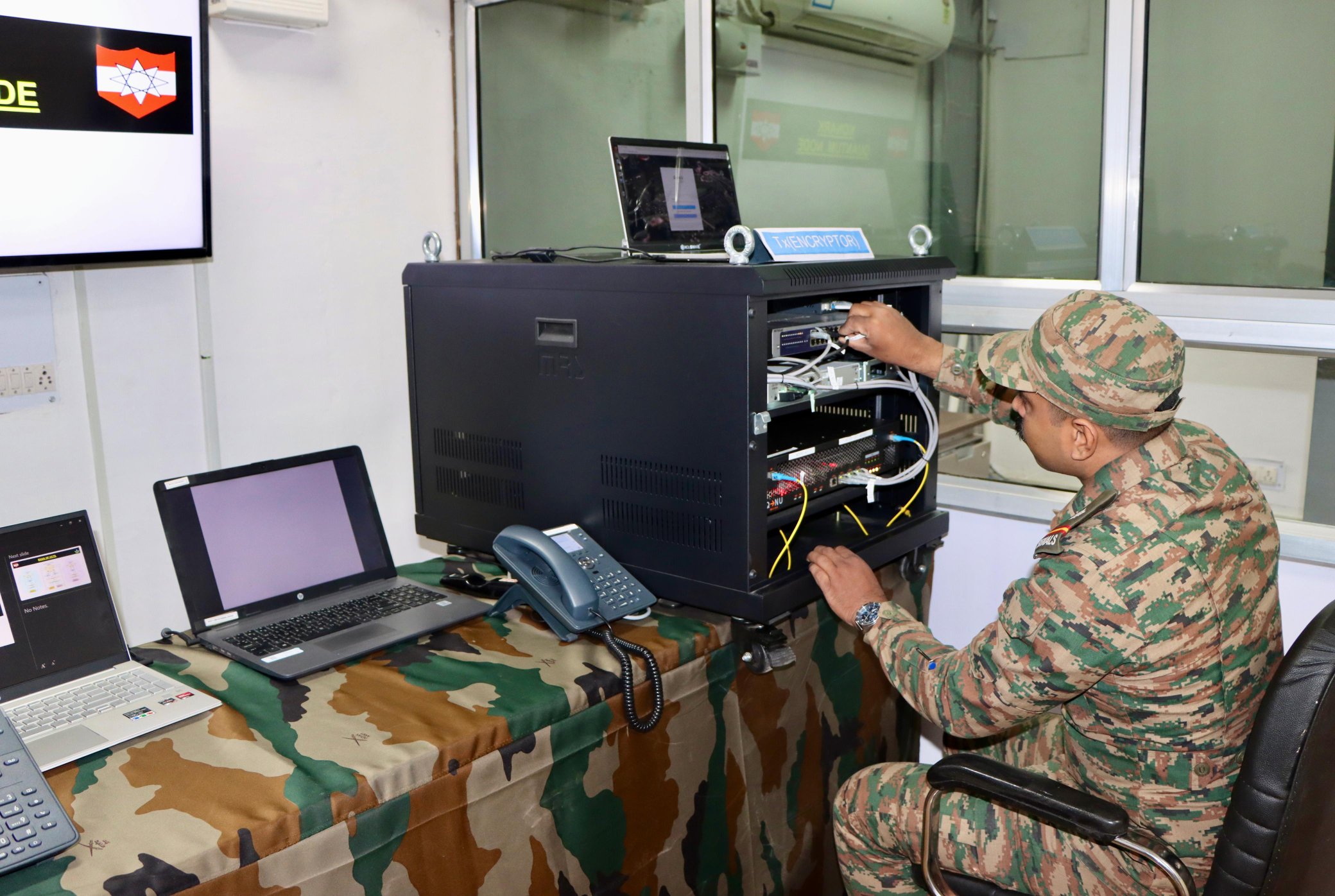
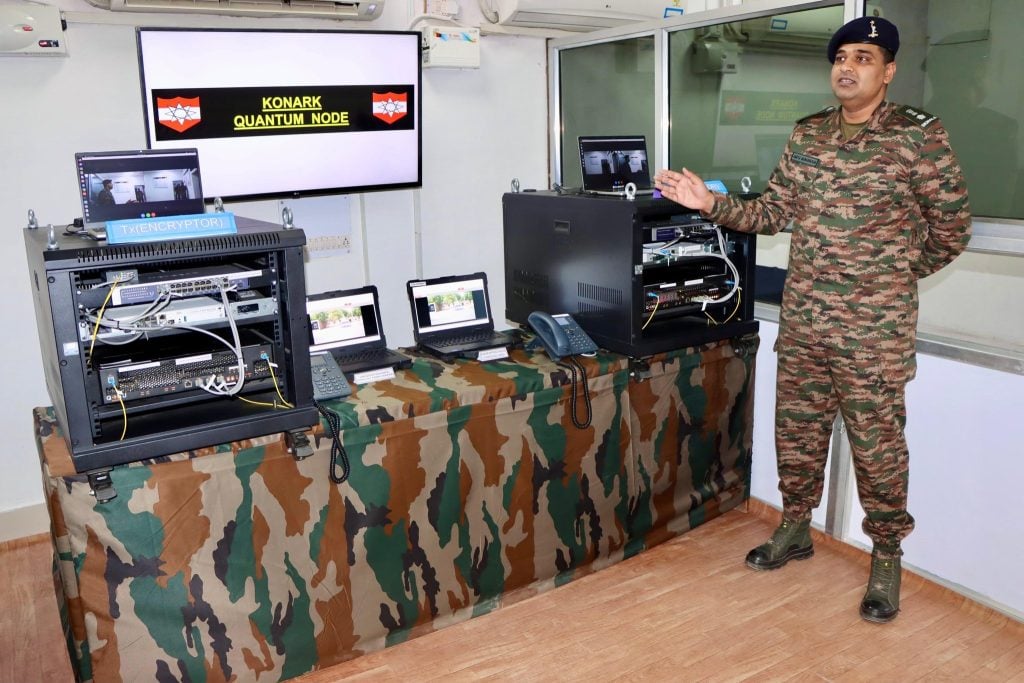
In a significant stride toward modernizing military communication, the Indian Army’s Konark Corps has successfully executed a pioneering project on quantum encryption in field conditions at Jodhpur. This breakthrough, part of the Innovations for Defence Excellence (iDEX) initiative, marks a transformative step for secure military networks by leveraging quantum key distribution (QKD) technology. The achievement positions the Indian Army among an elite group of global forces adopting quantum-based solutions for ultra-secure communication.





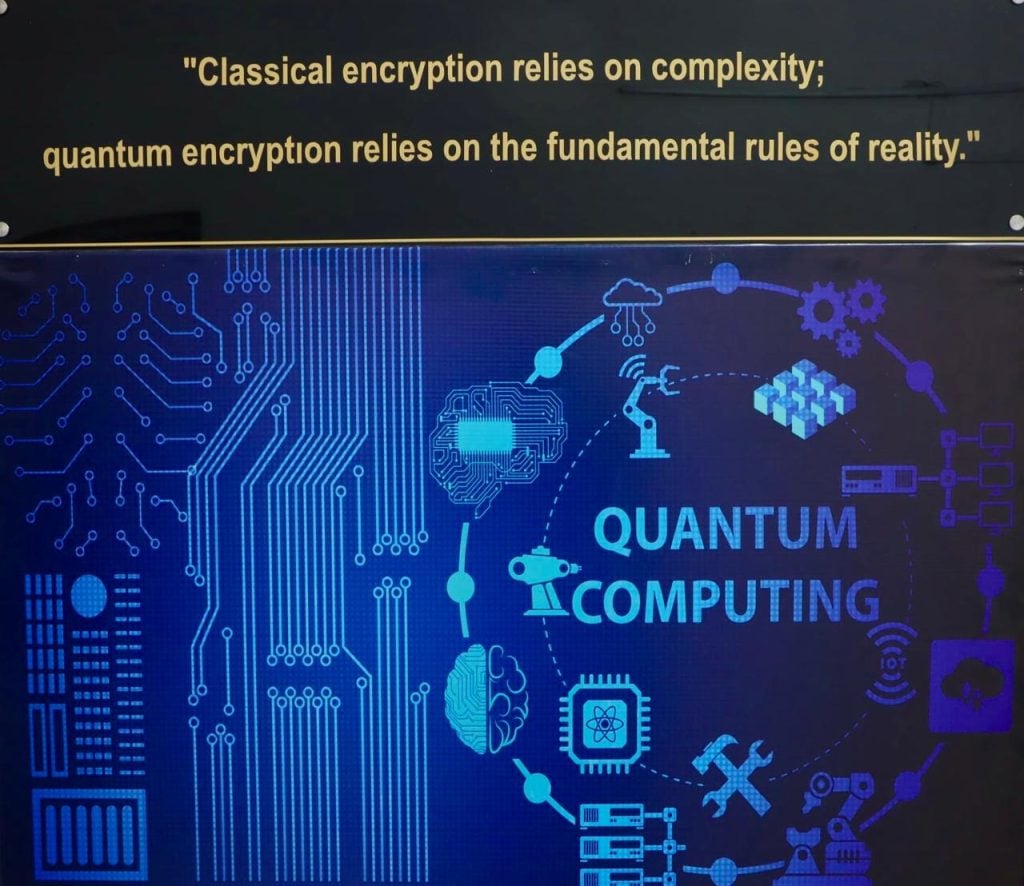
Quantum encryption represents a paradigm shift from traditional cryptographic methods. While classical encryption relies on computational complexity—using intricate algorithms to secure data—quantum encryption is grounded in the fundamental principles of quantum mechanics. Specifically, it utilizes the no-cloning theorem and quantum entanglement to ensure security. The no-cloning theorem states that it is impossible to create an identical copy of an unknown quantum state, meaning any attempt to intercept a quantum key would inevitably disturb the system and alert the communicating parties. Quantum entanglement, on the other hand, creates a unique link between particles, enabling the detection of eavesdropping attempts in real time.

In practical terms, the Konark Corps’ project focused on generating quantum secure keys in field conditions, a challenging environment compared to controlled laboratory settings. The successful implementation of QKD allows for the secure exchange of encryption keys using qubits, the basic units of quantum information, which differ fundamentally from the bits used in classical and post-quantum cryptography. Unlike bits, which are either 0 or 1, qubits can exist in a superposition of states, making them inherently more secure for key distribution.
The project was undertaken under the iDEX framework, a Ministry of Defence initiative launched to foster innovation and technology development in collaboration with startups, academia, and research institutions. The iDEX program has been instrumental in addressing critical defence challenges, with quantum technology being a key focus area. On October 29, 2024, Raksha Mantri Shri Rajnath Singh launched the third edition of the Acing Development of Innovative Technologies with iDEX (ADITI 3.0) challenge, which included problem statements related to quantum technology and military communication, further underscoring the strategic importance of this domain.
This achievement builds on India’s broader efforts to advance quantum technology. In 2021, the Indian Army established a quantum laboratory at Mhow, Madhya Pradesh, to explore applications of quantum mechanics in military operations. Additionally, institutions like the Indian Institute of Technology (IIT) Jodhpur have been at the forefront of quantum research through their Quantum Information and Computation (QIC) group. Nationally, collaborations such as the partnership between IIT Madras and IBM, initiated in September 2022, have positioned India as a key player in the global quantum computing landscape. IIT Madras, as the first Indian institution to join the IBM Quantum Network, gained access to advanced quantum systems, accelerating research and development in this field.
The successful deployment of quantum encryption in field conditions has far-reaching implications for military communication. Traditional encryption methods, while robust, are increasingly vulnerable to advances in quantum computing, which could potentially break classical cryptographic systems by solving complex mathematical problems at unprecedented speeds. Quantum encryption, however, is resistant to such threats, as its security is based on the laws of physics rather than computational difficulty.
For the Indian Army, this technology ensures that sensitive communications—ranging from tactical battlefield instructions to strategic command directives—remain impervious to interception. The ability to generate and distribute quantum secure keys in real-world scenarios like Jodhpur’s arid terrain demonstrates the practical viability of this technology, paving the way for its integration into broader military networks.
Moreover, this development aligns with the global race to harness quantum technology for national security. The National Security Agency (NSA) of the United States, for instance, has been a leader in cryptology, emphasizing the importance of quantum key distribution for securing government and military communications. India’s entry into this domain not only strengthens its defence capabilities but also positions it as a contributor to the global discourse on quantum security.
The Konark Corps’ achievement is a testament to the Indian Army’s commitment to technological innovation, often described as a “Decade of Transformation.” By adopting quantum encryption, the Army is not only future-proofing its communication systems but also setting a precedent for other sectors to explore quantum technologies. The success of this iDEX project is likely to spur further investment and research, potentially leading to advancements in quantum computing, sensing, and cryptography for both military and civilian applications.
As India continues to build its quantum ecosystem—through initiatives like the Indian Institute of Science Quantum Technology Initiative (IQTI) and collaborations with global leaders like IBM—the country is well on its way to becoming a hub for quantum innovation. For the Indian Army, this milestone in Jodhpur is a crucial step toward ensuring that its communication networks remain secure, resilient, and ready for the challenges of the quantum era.