
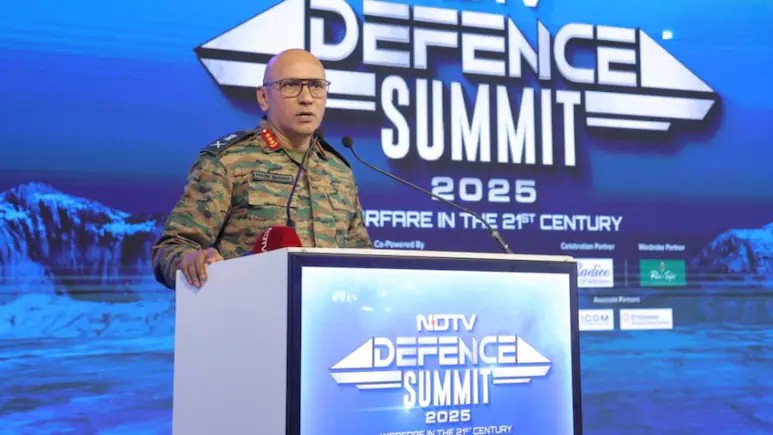
At the NDTV Defence Summit, Northern Army Commander Lieutenant General Pratik Sharma revealed how India’s counter-terrorism approach has evolved in response to changing tactics by Pakistan-backed groups. Speaking about Operation Sindoor and Operation Mahadev, he outlined the intelligence and operational challenges faced after the April 22 Pahalgam terror attack.




Lt Gen Sharma confirmed that on May 7, the Indian military struck nine terror camps in Pakistan and Pakistan-occupied Kashmir. Of these, seven camps hidden in hilly terrain were targeted by the Army, while Muridke and Bahawalpur were assigned to the Air Force. “The camps along the LC were very difficult to detect, concealed deep in folds of the hills. Gathering technical or human intelligence was extremely challenging,” he said.
He accused Pakistan Army chief Gen Asim Munir of “direct provocation” ahead of the Pahalgam attack. “This was incitement not only for terrorists but also for the Pakistani Army,” he said, pointing to Munir’s April 16 speech in Islamabad.
Within 30 minutes of the May 7 strikes, Pakistan violated the ceasefire with cross-border firing. But, according to Lt Gen Sharma, India was prepared for immediate retaliation. Over 100 terrorists are believed to have been killed in the strikes, carried out as retribution for the massacre of 26 civilians in Pahalgam.
Calling Operation Sindoor a “masterstroke,” Lt Gen Sharma said it demonstrated India’s ability to act decisively below the conventional war threshold — following in the footsteps of the 2016 surgical strikes and 2019 Balakot airstrikes.
The commander also described the July Operation Mahadev, in which three terrorists linked to the Pahalgam attack were eliminated after a 97-day manhunt. He noted that terrorists no longer operate from urban areas but now hide in caves, hills, and forests, making operations more prolonged.
“Gone are the days when we had specific intelligence and could surround a house and neutralize terrorists quickly. Today, operations often stretch beyond 30 days,” he said, underlining the changing face of counter-terror operations in Kashmir.