
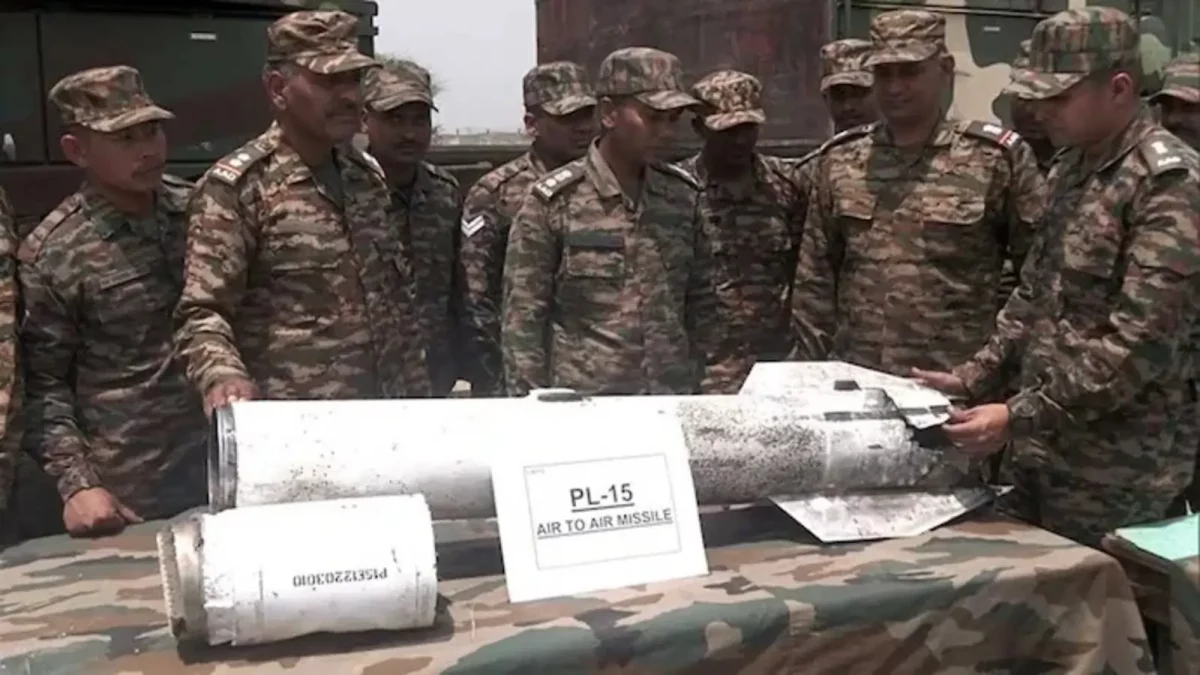
In a significant development, the Defence Research and Development Organisation (DRDO) has decided to integrate several advanced technologies from the Chinese PL-15E long-range air-to-air missile into India’s indigenous Astra Mark-II programme, following a detailed technical analysis of an unexploded missile recovered during Operation Sindoor in May this year.





The missile, fired by a Pakistan Air Force (PAF) jet — believed to be a JF-17 or J-10C — was recovered fully intact from a field near Hoshiarpur, Punjab, on May 9, after it failed to detonate due to the absence of a self-destruct mechanism. This rare recovery provided India’s defence scientists with an invaluable opportunity to study one of China’s most advanced beyond-visual-range (BVR) air combat weapons.
A Rare Intelligence Windfall for India
Sources revealed that the PL-15E, with an estimated range of 145 kilometres, is an export variant of China’s top-tier missile. Unlike India’s indigenous air-to-air missiles, it lacks self-destruct features — allowing it to be recovered and examined intact.
DRDO experts have reportedly identified several superior technologies in the Chinese system, including a miniature Active Electronically Scanned Array (AESA) radar, next-generation solid propellant enabling speeds above Mach 5, and advanced anti-jamming systems. These technologies, particularly in radar guidance and electronic warfare resistance, are now being adapted for integration into the Astra Mk-II missile, India’s next-generation air-to-air weapon.
Pakistan’s Military Response and Regional Dynamics
The recovery came amid Operation Sindoor, India’s coordinated military response to the April 22 Pahalgam terror attack, which claimed 26 civilian lives. The operation, launched on May 7, showcased India’s increasing reliance on indigenously developed precision-strike weapons such as BrahMos, Rampage, and SCALP missiles, which performed with exceptional accuracy.
Meanwhile, intelligence inputs indicate that Pakistan is seeking to bolster its arsenal following the losses suffered during the operation. The Pakistan Air Force is reportedly pursuing PL-17 long-range missiles from China, acquiring 2,000 YIHA kamikaze drones from Turkey, and has even submitted a list of high-tech weapon requirements to the United States, according to sources.
India’s Response: Expanding Missile Superiority
Indian defence planners are now moving to acquire additional Meteor missiles for Rafale fighters to ensure numerical and qualitative superiority in future engagements. Simultaneously, development of a next-generation BrahMos missile with an extended 800-kilometre range is underway — capable of striking deep inside enemy territory and neutralizing strategic assets.
With Pakistan deploying Chinese HQ-9 air defence systems, India’s strategy is shifting towards stand-off precision warfare. Future air operations are expected to rely heavily on long-range supersonic and stealth missiles designed to operate outside enemy radar envelopes, ensuring superior air dominance and survivability.
Ceasefire Violations and Strategic Posturing
Despite a ceasefire declared on May 10 at 5 p.m., Pakistani forces reportedly launched kamikaze drones and rockets into Indian territory across the Jammu and Rajasthan sectors, violating the agreement. Similar aggressive behaviour was observed recently when Pakistan conducted air strikes on civilian areas in Spin Boldak, Afghanistan, even after committing to a temporary truce with the Taliban.
Indian defence sources warned that while India chose restraint following the May 10 violations, future provocations will invite proportionate and decisive responses.
The PL-15E missile recovery not only deepens India’s understanding of China-Pakistan military collaboration, but also accelerates the country’s push for indigenous defence innovation — turning an adversary’s weapon into an opportunity for technological advancement.