

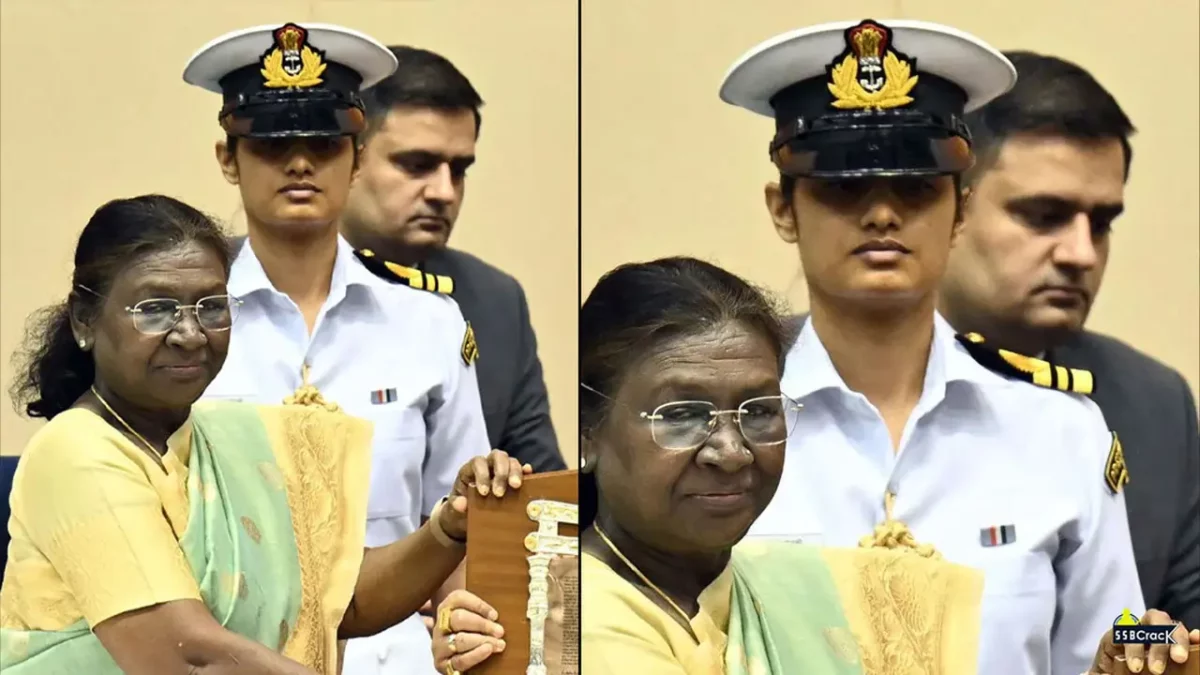
Lieutenant Commander Yashasvi Solanki of the Indian Navy has created history by becoming the first woman Navy officer to be appointed as Aide-de-Camp (ADC) to the President of India. Her appointment to the prestigious position at Rashtrapati Bhavan marks a proud milestone not only for the Indian Navy but also for women officers serving across the Indian Armed Forces.




At a time when women are increasingly taking up challenging and high-responsibility roles in the military, Lieutenant Commander Solanki’s achievement stands as a powerful symbol of merit, discipline, and professional excellence. Her journey reflects the changing face of India’s defence forces, where capability and commitment continue to open new doors for officers irrespective of gender.
Born into a humble and hardworking family, Lieutenant Commander Solanki belongs to Maharashtra and received her early education in Rajasthan. Her father is a secondary school teacher, while her mother is a homemaker. Growing up in a modest environment, she imbibed the values of discipline, sincerity, and perseverance from an early age.
During her school years, she was actively involved in sports, especially badminton and volleyball. These activities helped her develop physical fitness, teamwork, confidence, and resilience—qualities that later became important assets in her military career. Her early exposure to sports also strengthened her ability to perform under pressure and work effectively in a team environment.
After completing her schooling, she pursued higher education at the Government College of Engineering, Aurangabad, Maharashtra. The institution, affiliated with Dr. Babasaheb Ambedkar Marathwada University, provided her with a strong academic foundation before she chose the path of uniformed service.
Her decision to join the Indian Navy reflected her desire to serve the nation in a challenging and meaningful way. In 2019, she was commissioned into the Indian Navy through the Short Service Commission in the Naval Armament Inspection Cadre.
The Naval Armament Inspection Cadre plays a crucial role in the operational readiness of the Navy. Officers of this branch are involved in the inspection, quality assurance, production, procurement, and life extension of naval weapons, ammunition, missiles, rockets, underwater weapons, and related systems. It is a highly technical and responsible branch that demands precision, knowledge, and accountability.
Over the years, Lieutenant Commander Solanki built a reputation for professionalism, competence, and dedication to duty. Her service record, conduct, physical fitness, communication skills, and overall officer-like qualities made her suitable for one of the most prestigious staff appointments in the country.
The appointment of an ADC to the President is not merely ceremonial. It is a highly selective and sensitive role that requires an officer of exceptional integrity, discipline, presence of mind, and professionalism. The officer must be capable of handling high-level protocol, state functions, official engagements, and close coordination with various military and government agencies.
Lieutenant Commander Solanki was selected after a rigorous process that reportedly included screening of service records, detailed assessment at Rashtrapati Bhavan, interaction with President Droupadi Murmu, and security clearances. She also underwent an orientation programme before formally assuming her duties.
As ADC to the President, she serves as a personal military staff officer to the Supreme Commander of the Indian Armed Forces. Her duties include assisting in the President’s official schedule, coordinating ceremonial functions, accompanying the President during important engagements, ensuring protocol compliance, and supporting the smooth conduct of state and military events.
The President of India is traditionally assisted by five ADCs—three from the Indian Army, one from the Indian Navy, and one from the Indian Air Force. Lieutenant Commander Solanki’s appointment is historic because she became the first woman officer from the Indian Navy to occupy the naval ADC position.
The role demands constant alertness and preparation. An ADC must remain updated on events, protocol, military matters, and official engagements, as the officer works in close proximity to the highest constitutional office in the country. Lieutenant Commander Solanki herself has acknowledged the responsibility of staying prepared at all times, as the President may ask anything at any moment.
Her achievement is also significant in the broader journey of women in the Indian Armed Forces. Over the years, women officers have broken several barriers across services, taking up roles in aviation, command appointments, staff positions, operational duties, and ceremonial responsibilities. Lieutenant Commander Solanki’s appointment adds another important chapter to this evolving story.
She joins the growing list of women officers whose achievements have inspired future generations. From senior women officers who reached three-star ranks to women serving in combat support roles, flying branches, naval appointments, and high-profile staff positions, the armed forces have witnessed a steady expansion of opportunities for women.
Her appointment also comes at a time when the Indian military is focusing on greater jointness, professionalism, and inclusion. The increasing visibility of women officers in prestigious roles sends a strong message to young aspirants that the armed forces reward merit, dedication, and excellence.
For countless young girls across India, Lieutenant Commander Yashasvi Solanki’s journey is a source of inspiration. From a modest family background to the corridors of Rashtrapati Bhavan, her rise shows that determination, education, discipline, and hard work can lead to extraordinary achievements.
Her story is not just about becoming the first woman Navy officer to serve as ADC to the President. It is about breaking barriers with quiet confidence. It is about representing the Indian Navy with dignity. It is about proving that women officers are fully capable of serving in roles that demand the highest levels of trust, protocol, and responsibility.
Lieutenant Commander Yashasvi Solanki’s historic appointment will be remembered as a proud moment in the Indian Navy’s journey and in the continuing progress of women in uniform. She stands as a symbol of courage, competence, and the changing spirit of India’s armed forces.