
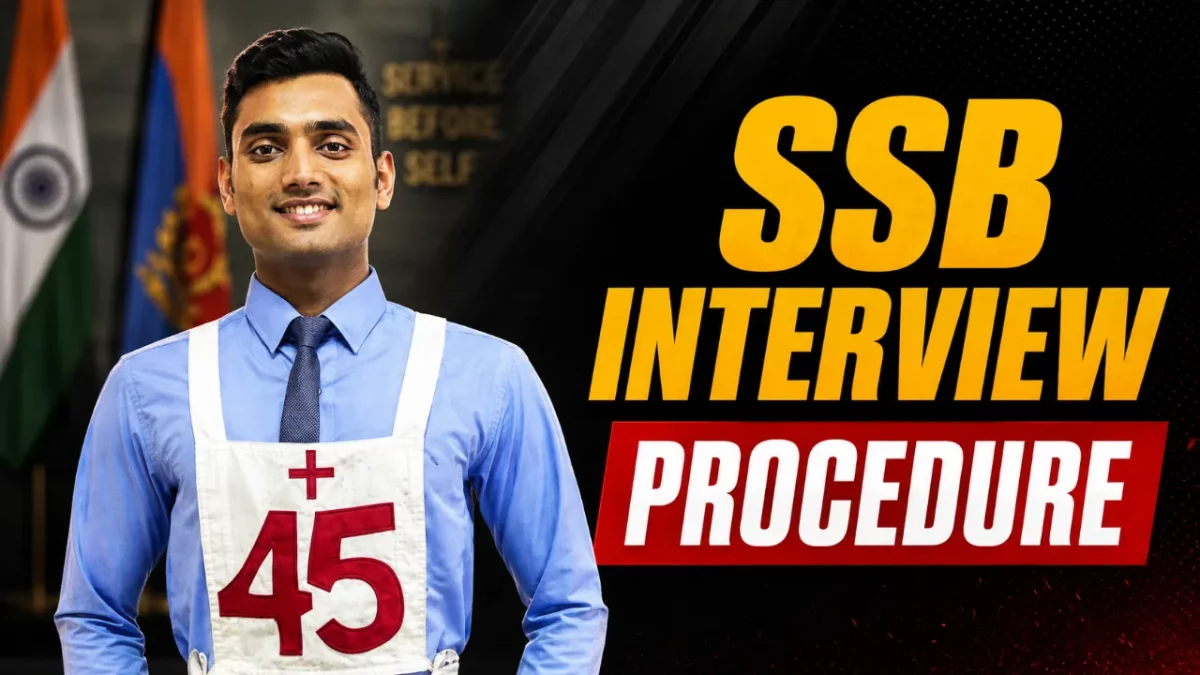
The Services Selection Board (SSB) interview is the most comprehensive personality and leadership assessment used by the Indian Armed Forces to select potential officers for the Army, Navy, and Air Force. Conducted after clearing written examinations such as NDA, CDS, or AFCAT (or through direct entries), it evaluates whether a candidate possesses the Officer Like Qualities (OLQs) required to lead troops in peacetime and war.
Unlike conventional interviews that focus primarily on knowledge or academic performance, the SSB is a scientific, multi-dimensional process lasting five days (plus a reporting day). Three independent assessors a Psychologist, a Group Testing Officer (GTO), and an Interviewing Officer (IO) evaluate the candidate through different techniques. Recommendation requires consistency across these assessors (often called triangulation of personality). Only a small percentage of candidates who appear are finally recommended.
As of 2026, the core five-day structure remains the traditional process of Stage I (Screening) and Stage II (Psychology, GTO, Interview, and Conference). Discussions about a possible computerised Stage I system (CSSS + OPAM) have circulated, but official call-up letters and ongoing batches continue to follow the established OIR + PPDT format. Candidates should prepare for the current system while monitoring official notifications from joinindianarmy.nic.in, careerairforce.nic.in, and joinindiannavy.gov.in.
Officer Like Qualities (OLQs) – The Foundation of Selection
The entire process revolves around 15 OLQs, traditionally grouped into four factors:
Planning and Organising
- Effective Intelligence
- Reasoning Ability
- Organising Ability
- Power of Expression
Social Adjustment
- Social Adaptability
- Cooperation
- Sense of Responsibility
Social Effectiveness
- Initiative
- Self-Confidence
- Speed of Decision
- Ability to Influence the Group
- Liveliness
Dynamic
- Determination
- Courage
- Stamina
Assessors look for natural, consistent evidence of these qualities rather than rehearsed behaviour. Inconsistency between what a candidate writes, says, and does is one of the most common reasons for rejection.
Day 0 / Reporting Day
Candidates report as per the call-up letter (often the evening before or early morning of Day 1). Activities typically include:
- Document verification (original certificates, call letter, identity proof, photographs, etc.)
- Allotment of temporary chest numbers (candidates are addressed only by these numbers thereafter)
- Filling of the Personal Information Questionnaire (PIQ) form
- Briefing on rules, schedule, and conduct
- Allotment of accommodation and messing arrangements
The PIQ is critical. It forms the primary basis for the Personal Interview. Entries must be accurate, specific, and honest. Vague or exaggerated claims are easily exposed later. Candidates are advised to rest well, maintain disciplined behaviour from the moment they enter the centre, and avoid unnecessary interaction with others that could create a poor first impression.
Day 1 – Stage I: Screening (The Elimination Round)
This is the most critical filter. Approximately 50–70% of candidates are screened out and sent home the same day. Only those who clear Stage I proceed to the remaining four days.
1. Officer Intelligence Rating (OIR) Test
Two booklets (Verbal and Non-Verbal Reasoning) containing roughly 40–50 questions each. Time is limited (often around 17–30 minutes per booklet depending on the centre). There is no negative marking. Performance is graded from OIR-1 (highest) to OIR-5. The test assesses basic reasoning, pattern recognition, analytical ability, and mental speed under time pressure. Practice with standard reasoning material (series, analogies, coding-decoding, figure classification, mirror/water images, etc.) is essential.
2. Picture Perception and Description Test (PPDT)
A hazy or ambiguous picture is projected for 30 seconds. Candidates note the number of characters, their approximate age, sex, mood, and the overall situation, then write a structured story (what led to the situation, what is happening, and what will happen) in about 4 minutes.
Thereafter, candidates are divided into groups. Each narrates their story briefly, followed by a group discussion to arrive at a common story. Assessors observe observation skills, imagination, clarity of expression, positivity of the story, initiative, listening ability, and group behaviour. Domination or complete silence both work against the candidate.
Results are usually declared by early afternoon. Screened-in candidates stay; others are returned with travelling allowance (for first-time candidates of a particular entry).
Preparation tips for Day 1: Practise OIR under strict time limits. For PPDT, train yourself to construct positive, action-oriented stories with a clear hero who demonstrates OLQs. In discussion, contribute meaningfully, support good ideas, and help the group reach consensus without forcing your view.
Day 2 – Psychological Tests
These are projective tests designed by the Defence Institute of Psychological Research (DIPR) to reveal the subconscious personality. They are highly time-constrained so that candidates respond spontaneously rather than with prepared answers. At some AFSBs the psychology battery may be conducted earlier, but the content remains the same.
1. Thematic Apperception Test (TAT)
Eleven pictures + one blank slide. Each picture is shown for 30 seconds; candidates write a story in 4 minutes covering past, present, and future. The hero of the story is generally taken as a reflection of the candidate. Stories should be positive, realistic, and show initiative, responsibility, and constructive action.
2. Word Association Test (WAT)
Sixty words are flashed one after another for 15 seconds each. Candidates write the first sentence or idea that comes to mind. Responses should ideally be positive, action-oriented, and reflective of OLQs. Negative or passive associations are noted.
3. Situation Reaction Test (SRT)
Sixty everyday or stressful situations are given. Candidates write their reactions in a total of about 30 minutes. Responses reveal decision-making ability, presence of mind, sense of responsibility, and practical intelligence.
4. Self Description Test (SD)
Candidates write short paragraphs on how parents, teachers/friends, and they themselves view them, plus what qualities they would like to develop. Consistency with the PIQ and other tests is closely examined.
Key principle: Authenticity and consistency matter more than “perfect” answers. Coached or memorised responses often create mismatches that assessors detect easily.
Personal Interviews may begin on the afternoon of Day 2 for some candidates.
Day 3 and Day 4 – Group Testing Officer (GTO) Tasks and Personal Interview
The GTO series assesses behaviour in group settings, practical leadership, teamwork, physical courage, and organising ability through indoor and outdoor tasks. Candidates usually wear white PT kit (T-shirt, shorts/track pants, sports shoes). Tasks are progressive and designed so that no single candidate can complete them alone.
Typical sequence (exact order and combination may vary slightly by centre):
- Group Discussion (GD): Two informal discussions (one current affairs/social issue, one abstract or general). No appointed leader. Assesses power of expression, initiative, cooperation, and ability to influence without domination.
- Group Planning Exercise (GPE): A model of a terrain with a multi-problem scenario is given. Candidates write individual solutions, then discuss and arrive at a group plan.
- Progressive Group Task (PGT): Outdoor obstacles of increasing difficulty using limited resources (planks, ropes, poles, etc.). Rules must be followed.
- Half Group Task (HGT): Similar to PGT but with half the group, giving each candidate more visibility.
- Group Obstacle Race / Snake Race: Team race carrying a rolled “snake” (heavy load) over a series of obstacles. Tests stamina, cooperation, and team spirit under physical stress.
- Lecturette: Candidates pick a topic from a set of four, prepare for about 3 minutes, and speak for 3 minutes. Assesses knowledge, confidence, organisation of thoughts, and power of expression.
- Individual Obstacles: Ten obstacles of graded difficulty to be attempted within a fixed time (usually 3 minutes). Points are awarded for each completed obstacle. Physical fitness and determination are observed.
- Command Task: The candidate is made commander of a small group and given an obstacle to solve with limited resources and selected subordinates. Leadership style, planning, and ability to utilise people are assessed.
- Final Group Task (FGT): A concluding group obstacle task that allows the GTO to confirm or revise earlier impressions.
Personal Interview
Conducted by the Interviewing Officer (usually a senior officer) over 35–60 minutes on any of Days 2–4. It is based heavily on the PIQ and covers family background, education, hobbies, achievements, failures, current affairs, motivation for joining the forces, and situational questions. The IO probes for depth, consistency, and genuine interest. Body language, confidence, and honesty are closely observed.
Preparation advice: Maintain physical fitness (running, basic obstacles, strength training). In group tasks, balance initiative with cooperation — neither dominate nor remain passive. Help the group succeed. In the interview, be natural, specific, and prepared to justify every PIQ entry.
Day 5 – Conference
All three assessors and the Board President sit together and discuss each candidate. For clear cases, the decision is already firm. Borderline candidates may be called in for a brief interaction (a few questions or observations of bearing and confidence). Results are announced the same day (usually by afternoon). Recommended candidates are given further instructions for medical examination; others are returned.
After Recommendation
Recommended candidates undergo a detailed medical examination at a Military Hospital. Those declared fit are placed on the final merit list (based on written marks + SSB performance). Joining instructions are issued according to vacancies and merit position. Medical unfitness or low merit ranking can still result in non-selection even after SSB recommendation.
Key Preparation Strategy and Common Pitfalls
- Develop genuine OLQs through real-life experiences rather than coaching scripts.
- Practise OIR, PPDT stories, TAT/WAT/SRT under timed conditions.
- Stay updated on current affairs (national, international, defence).
- Improve physical fitness and outdoor confidence.
- Maintain consistency across written tests, speech, and actions.
- Avoid domination, complete silence, negative stories, inconsistency between PIQ and interview, or over-rehearsed answers.
- Treat every moment at the centre (including free time and interactions with staff/peers) as part of the assessment.
SSB Centres (Overview)
Army: Selection Centre East (Prayagraj), Selection Centre Central (Bhopal), Selection Centre South (Bengaluru), Selection Centre North (Jalandhar).
Air Force: 1 AFSB Dehradun, 2 AFSB Mysuru, 3 AFSB Gandhinagar, 4 AFSB Varanasi, 5 AFSB Guwahati.
Navy: Various NSBs including Coimbatore, Visakhapatnam, Kolkata, and boards co-located at Army centres (e.g., 12 SSB Bengaluru, 33 SSB Bhopal).
Exact allotment depends on the entry and administrative convenience.
The SSB process is demanding because it seeks future leaders who will be responsible for the lives of soldiers and the security of the nation. Candidates who approach it with self-awareness, positive attitude, physical preparedness, and genuine desire to serve stand the best chance. Success is less about “cracking techniques” and more about demonstrating authentic officer-like potential over five intensive days.
Stay disciplined, stay positive, and prepare thoroughly. The uniform awaits those who earn it.
SSB Interview Preparation Books and Study Material
| Study Material | Download Source |
| Let’s Crack SSB Interview [Book] | Buy Now |
| Breaking the Code Of SSB Psychology [Book] | Buy Now |
| OIR Test and PPDT [Book] | Buy Now |
| SSB Psychological Tests Workbook | Buy Now |
| OIR Test eBook [ 150+ Solved Questions] | Download Now |
| SRT Solved eBook [100 Solved Questions] | Download Now |
| Word Association Test [100 Solved Words] | Download Now |
| SSB Interview eBook [FREE] | Download Now |
| My Appointment With A Psychologist eBook [FREE] | Download Now |
| 5 Day Complete SSB Interview Video | Download Now |
Conclusion
SSB selection stands as ultimate test of officer potential. Five demanding days probe every aspect of leadership capability – from intellectual prowess and psychological strength to physical command and personal character.
Military excellence demands complete mastery of selection protocols. Officers who grasp each evaluation phase, understand assessment criteria, and meet precise requirements prove their readiness for command responsibility. Medical fitness and merit standing mark the final steps toward earning the right to serve India in uniform.
True officers demonstrate 15 sacred qualities through every thought, word, and deed. This unwavering dedication to excellence, supported by deep understanding of selection demands, forges the spirit of military leadership. Here stand tomorrow’s defenders of India – ready, worthy, and prepared to lead.