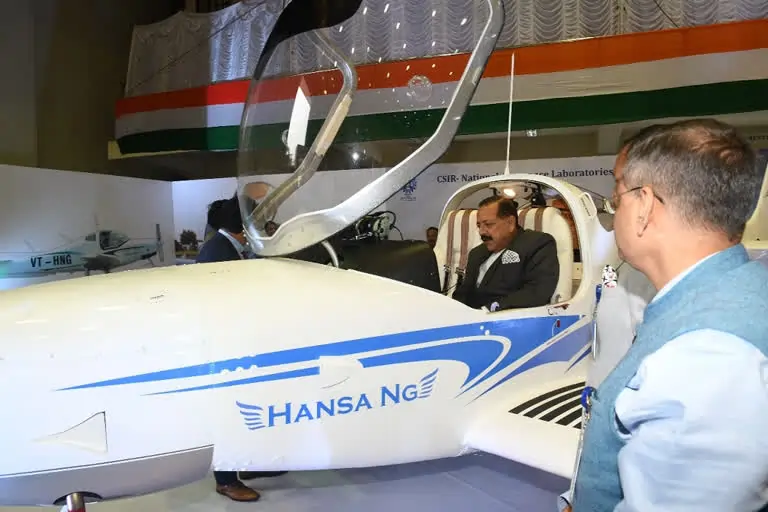
India marked a major leap in its aviation and aerospace capabilities with Union Minister Dr. Jitendra Singh formally launching the country’s first fully indigenous pilot trainer aircraft, Hansa-3(NG). The unveiling represents a decisive push toward self-reliance in aviation training platforms and a reduced dependence on foreign imports.





Developed by the CSIR–National Aerospace Laboratories (NAL), Bengaluru, the Hansa-3(NG) is the production-ready variant of the long-running Hansa training aircraft programme. The latest version features a state-of-the-art all-composite airframe, offering improved durability, reduced weight, and enhanced performance over legacy metal airframes.
Production Kicks Off in Andhra Pradesh
Manufacturing has already begun at a new ₹150-crore facility set up by Pioneer Clean Amps in Kuppam, Andhra Pradesh. The plant is designed to produce up to 100 aircraft annually, signalling one of the largest indigenous trainer aircraft manufacturing efforts in the country.
The Hansa programme dates back to the early 1990s, when NAL first conceptualised the aircraft to meet India’s growing civilian pilot training needs. The upgraded NG variant reflects decades of iterative improvements and modernisation.
In April this year, CSIR-NAL signed a formal manufacturing agreement with Pioneer Clean Amps, enabling large-scale production and market rollout.
Meeting India’s Soaring Pilot Demand
Speaking at the Bengaluru event, Dr. Jitendra Singh said India will require nearly 30,000 pilots over the next 15–20 years as civil aviation expands rapidly. He described the Hansa-3(NG) as a “critical step toward building a fully indigenous pilot training ecosystem.”
The aircraft is expected to significantly support Private Pilot License (PPL) and Commercial Pilot License (CPL) training across flying clubs, aviation institutes, and civil aviation academies. Its indigenisation is also projected to boost aviation entrepreneurship and skill-based employment.
Push for Aatmanirbharta in Aviation
The government views the Hansa-3(NG) launch as part of a broader strategy to strengthen India’s homegrown aerospace capabilities. With sustained support for domestic R&D and manufacturing, India aims to build a strong civil–military aviation synergy and emerge as a global player in the light aircraft category.
The rollout of Hansa-3(NG) marks a proud milestone—representing innovation, scale, and the growing confidence of India’s aviation ecosystem.