

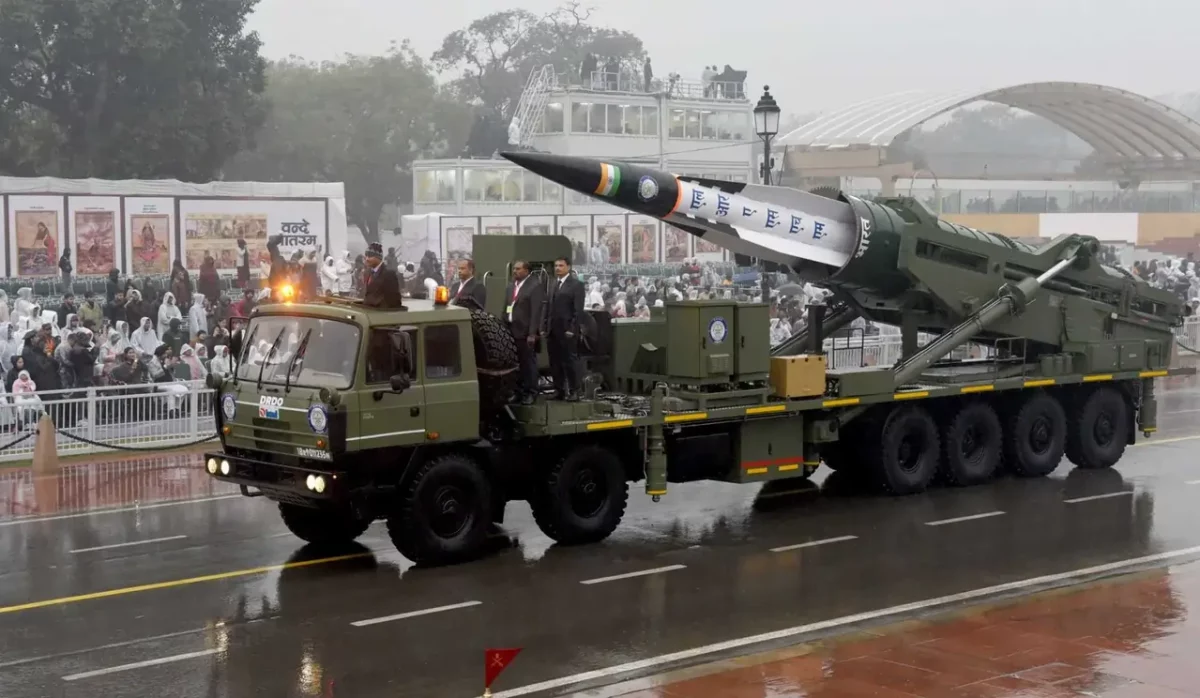
India’s Long Range Anti-Ship Missile (LR-AShM), also known as LRAShM or Long Range Anti-Ship Hypersonic Missile, is an advanced boost-glide hypersonic glide vehicle (HGV) developed by the Defence Research and Development Organisation (DRDO) primarily for the Indian Navy. It is designed to strike high-value maritime targets like aircraft carriers, destroyers, and other warships at extended ranges while evading detection and interception through extreme speeds, maneuverability, and low-altitude terminal flight.





The missile supports coastal defense batteries and is launched from shore-based transporter-erector-launchers (TELs). Variants for ship launch are under development, with potential land-attack roles for the Army and adaptations for air/underwater platforms. It enhances India’s anti-access/area-denial (A2/AD) capabilities in the Indian Ocean Region (IOR), countering growing naval threats from China and Pakistan.
Development History
India’s hypersonic research traces back to a 2007 statement by Dr. A.P.J. Abdul Kalam urging development of such systems. Scramjet and hypersonic vehicle work began in 2008, constrained initially by funding but advanced through computational fluid dynamics and infrastructure like the Hypersonic Wind Tunnel (HWT) at Hyderabad (inaugurated 2020, operational since 2019, simulating Mach 5–12). Additional facilities include IIT Kanpur’s Hypervelocity Expansion Tunnel (Mach 8–29) and about 12 hypersonic wind tunnels nationwide.
The Hypersonic Technology Demonstrator Vehicle (HSTDV) test in 2020 validated key technologies like scramjet combustion. The LR-AShM project specifically started at DRDO’s Advanced Systems Laboratory in Hyderabad around 2017–2018, with design finalized by 2022 for a 1,500 km-range system. Development involves multiple DRDO labs, industry partners (e.g., Bharat Dynamics), and components derived from programs like the K-15 (Sagarika) SLBM and BrahMos supersonic missile. It was first publicly referenced in the Ministry of Defence’s 2023 Year End Review.
Project leadership includes figures like Project Director A. Prasad Goud, with aerodynamic testing at facilities like the National Aerospace Laboratories’ trisonic wind tunnel.
Design and Technical Specifications
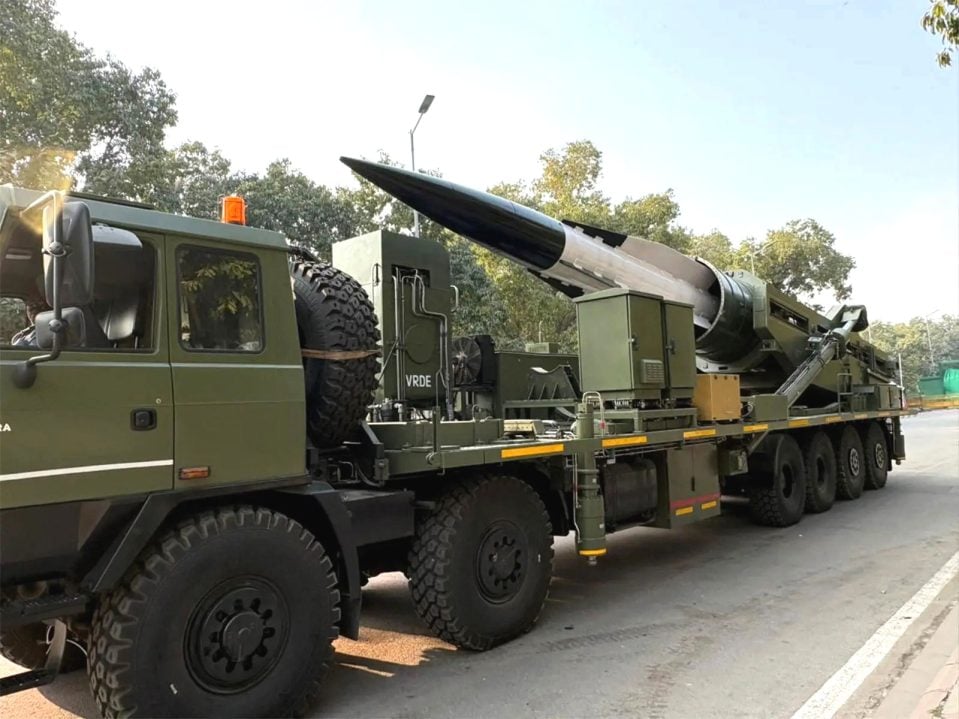
The LR-AShM is a boost-glide system: a two-stage solid-fuel rocket booster accelerates it to hypersonic speeds, deploying a delta-winged or straked HGV payload for atmospheric glide and maneuvers. Some analyses describe it as having quasi-ballistic characteristics with “skip-glide” or “porpoising” maneuvers for evasion.
Key specs include:
- Length: Approximately 14 meters (46 feet)
- Diameter: About 1.4 meters (4.6 feet)
- Weight: Less than 20 tons (<44,000 pounds)
- Range: Demonstrated/operational >1,500 km (930 miles); future variants up to 3,500 km
- Speed: Peak up to Mach 10 (~12,000 km/h); average glide ~Mach 5
- Propulsion: Two-stage solid propellant rocket motor (booster + sustainer); cold-launched from hermetically sealed canister with attitude control thrusters
- Trajectory: Ballistic boost phase, transitioning to glide with complex maneuvers, low-altitude terminal run-in; high aerodynamic efficiency with lift-generating surfaces (cruciform mid-body, triangular aft fins)
- Thermal Protection: Composite materials and shielding to withstand >2,000°C
- Guidance: Mid-course inertial navigation system (INS) + multi-GNSS; terminal active radar homing (ARH) with X-band synthetic aperture radar monopulse seeker (derived from BrahMos/ECIL tech) for precision against moving targets
- Warhead: Conventional (various payloads possible); kinetic energy impact plus explosive effect
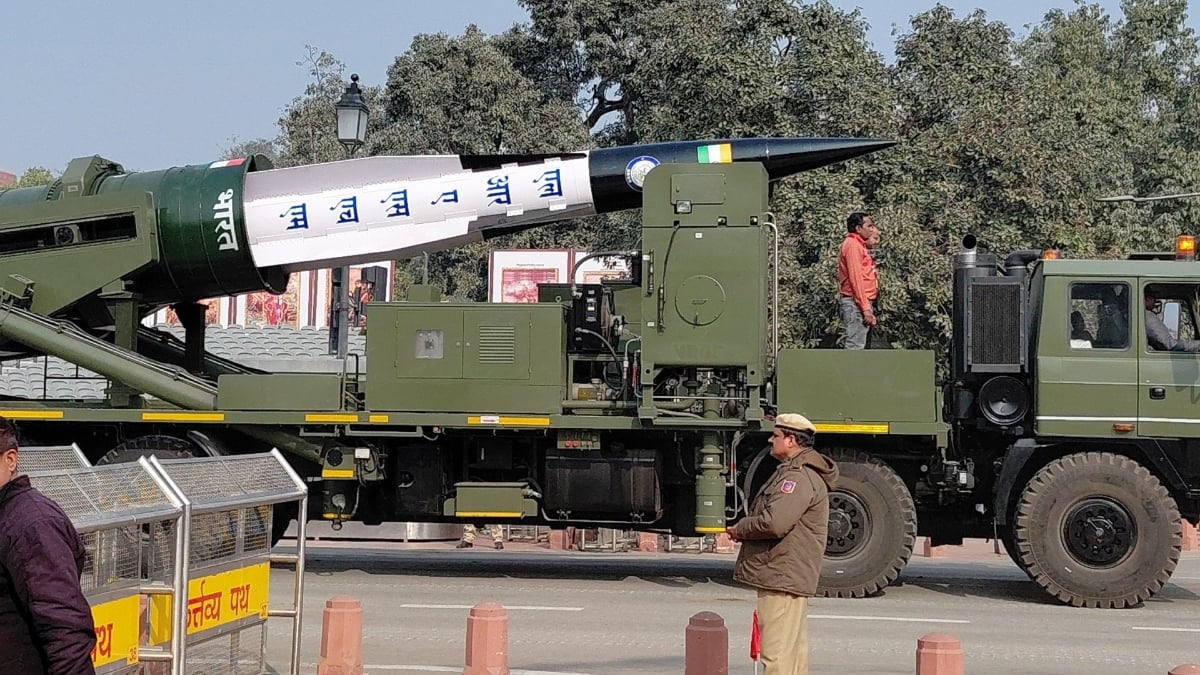
- Launch Platform: 12×12 wheeled TEL truck (single missile per canister); ship-launched variant in development
The missile performs terminal maneuvers for accuracy and survivability, with onboard electronic counter-countermeasures (ECCM) and real-time trajectory adjustment.
Flight Tests and Validation
- First Test (2023): Conducted from the Integrated Test Range (likely Abdul Kalam Island, Odisha), validating basic capabilities.
- Second Test (November 16, 2024): Successful flight from Dr. APJ Abdul Kalam Island. The missile (marked LR-02) demonstrated terminal maneuvers, high accuracy, and hypersonic performance. An area warning extended to ~1,700 km. It confirmed the delta-wing HGV configuration’s advantages over pure quasi-ballistic paths.
Post-test, the system advanced to limited serial production (as of late 2025), with ongoing refinements before full operational evaluation.
Public Unveiling
The LR-AShM made its public debut on January 26, 2026, during India’s 77th Republic Day parade at Kartavya Path, New Delhi. It was displayed on its mobile TEL alongside other DRDO systems, highlighting progress in indigenous hypersonic technology. Officials described it as a major milestone for coastal strike and maritime deterrence.
Operational Capabilities and Strategic Importance
The LR-AShM enables rapid engagement (covering 1,500 km in ~15 minutes) of static or dynamic naval targets, including carriers and large vessels, with low detectability due to speed, altitude profile, and maneuvers. It serves sea-denial roles in the IOR, preventing adversary access to sensitive waters.
It complements systems like BrahMos (shorter range/supersonic) and fills gaps for conventional long-range strikes beyond nuclear-armed Agni missiles. Against China’s expanding fleet and systems like DF-ZF/YJ-20, or Pakistan’s developments (e.g., SMASH), it provides qualitative advantages in range, speed, and evasion.
Induction is targeted for the Indian Navy by around 2029 (initially shore/ship-based), with multi-service potential (Army/Air Force variants, possibly nuclear-capable payloads). It strengthens integrated rocket forces and overall strategic posture.
Future Developments
Plans include:
- Extended-range versions (up to 3,500 km)
- Ship-launched, air-launched, and submarine-compatible variants
- Integration of advanced warheads/sensors
- Full operational clearance following additional trials (expected in 2–3 years post-2024 test)
The LR-AShM positions India among nations (China, Russia, US) with operational or near-operational long-range hypersonic anti-ship capabilities, marking a significant leap in indigenous defence technology.