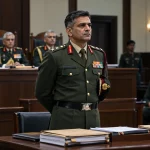


A military court martial represents a specialized judicial mechanism within the armed forces, designed to adjudicate offenses committed by service personnel under military law. Unlike civilian courts, which operate under general criminal statutes, court martials focus on maintaining discipline, operational efficiency, and the unique hierarchical structure inherent to military organizations. In the context of the Indian Armed Forces, comprising the Indian Army, Navy, and Air Force, court martials serve as essential instruments for enforcing accountability while addressing breaches of conduct that could undermine national security or unit cohesion. This article provides a comprehensive overview of court martials in India, including their legal foundations, types, procedures, and distinctions from civilian judicial processes.

Historical and Legal Framework
The concept of court martials traces its origins to ancient military traditions, evolving through British colonial influences into the modern Indian system. Post-independence, India adapted these mechanisms to align with its constitutional framework, ensuring they uphold principles of justice while accommodating military necessities.
The legal basis for court martials in the Indian Armed Forces is enshrined in branch-specific legislation:
- The Army Act, 1950, governs the Indian Army.
- The Air Force Act, 1950, applies to the Indian Air Force.
- The Navy Act, 1957, regulates the Indian Navy.
These Acts outline offenses, trial processes, and penalties, with provisions for appeals under the Armed Forces Tribunal Act, 2007, which established the Armed Forces Tribunal (AFT) as a quasi-judicial body for reviewing court martial decisions. Additionally, the President of India holds the authority under Article 72 of the Constitution to pardon, reprieve, or commute sentences imposed by court martials. The system applies to all personnel subject to military law, excluding trials for murder or rape of civilians, which are typically handled by civilian courts.
While the core principles remain consistent across branches, slight variations exist. For instance, the Army and Air Force Acts provide for four types of court martials, whereas the Navy Act features analogous structures with terms like “disciplinary courts” equivalent to district court martials.
Types of Court Martial
In the Indian Armed Forces, court martials are categorized into four primary types, each tailored to the severity of the offense, the rank of the accused, and operational contexts. These classifications ensure proportionate and efficient adjudication.
- General Court Martial (GCM): This is the most authoritative form, convened for grave offenses such as mutiny, desertion, or those warranting severe punishments, including death or life imprisonment. It can try any personnel, including officers.
- District Court Martial (DCM): Intended for intermediate offenses, this court handles cases involving Junior Commissioned Officers (JCOs) and other ranks but not officers. Its sentencing powers are capped at two years’ imprisonment and dismissal from service.
- Summary General Court Martial (SGCM): Utilized in exigent circumstances, such as active service or remote operations where a full GCM is impractical, this court retains broad powers similar to a GCM, including the ability to impose death sentences for expedited justice.
- Summary Court Martial (SCM): Reserved for minor infractions, this is the simplest and swiftest form, applicable only to JCOs, Warrant Officers, Non-Commissioned Officers (NCOs), and lower ranks. Sentencing is limited to one year of imprisonment (or three months in certain cases), and it is typically presided over by the unit’s Commanding Officer.
The Air Force follows a similar four-type structure, while the Navy employs equivalent categories, emphasizing operational adaptability at sea.
Composition and Convening Authority
The composition of a court martial varies by type to reflect its scope and ensure impartiality. For a GCM, at least five officers with a minimum of three years’ commissioned service are required, with the senior officer presiding. A DCM comprises at least three officers with two years’ service, and an SGCM also requires three officers. An SCM is unique, as it is conducted solely by the Commanding Officer, attended by two additional officers or JCOs who do not vote.
Convening authority rests with senior commanders: the Central Government, Chief of the Army Staff (or equivalent in other branches), or delegated officers for GCMs and DCMs. SGCMs may be convened by field commanders during operations, and SCMs by unit Commanding Officers. A Judge Advocate from the Judge Advocate General’s (JAG) department often assists, ensuring procedural adherence.
Procedure of Court Martial
The court martial process is structured to balance thoroughness with military exigency, drawing parallels to civilian trials under the Code of Criminal Procedure, 1973, while incorporating military-specific elements.
- Initiation and Investigation: Proceedings commence with a Court of Inquiry (CoI) to assess allegations, akin to a preliminary police investigation. Witnesses provide statements, but no punishments are issued at this stage.
- Summary of Evidence: If the CoI finds merit, a tentative charge sheet is prepared, and evidence is recorded. The accused may cross-examine witnesses.
- Trial: The court assembles, charges are read, and pleas are entered. Evidence is presented, with the prosecution and defense arguing their cases. Decisions are reached by majority vote, with specific requirements for death sentences (e.g., two-thirds concurrence in GCMs). The Indian Evidence Act, 1872, applies, subject to military modifications.
- Sentencing and Vetting: Upon conviction, a recommendatory sentence is pronounced and vetted by the JAG department for legality and proportionality.
Trials must occur within three years of the offense, with exceptions for certain crimes like desertion. The accused may challenge court members for bias.
Rights of the Accused
Personnel facing court martial are afforded protections aligned with constitutional rights, including the presumption of innocence, protection against self-incrimination, and the right to a fair trial. They may engage civilian lawyers at personal expense or receive assistance from a defending officer. Access to evidence, witness examination, and silence during proceedings are guaranteed.
Confirmation, Appeals, and Remedies
Most sentences require confirmation by higher authorities, who may mitigate, remit, or commute them. Post-confirmation, petitions can be filed with the Army Commander or Central Government. Appeals lie with the AFT, which may suspend sentences, and ultimately to the Supreme Court. The Central Government or Chief of Staff may annul proceedings deemed unjust.
Differences from Civilian Courts
Court martials differ fundamentally from civilian courts in purpose, speed, and composition. They address military-specific offenses under dedicated Acts, prioritizing discipline and operational readiness over protracted proceedings. Judges are military officers rather than professional jurists, and trials emphasize command hierarchy. While evidence rules overlap, court martials operate independently to safeguard national security interests.
Conclusion
Court martials in the Indian Armed Forces embody a balanced approach to justice, integrating legal rigor with military imperatives. Governed by robust statutory frameworks, they ensure accountability while protecting rights, thereby sustaining the integrity of India’s defense apparatus. Ongoing reforms, influenced by judicial oversight, continue to refine this system for greater transparency and fairness.
Also Read: