

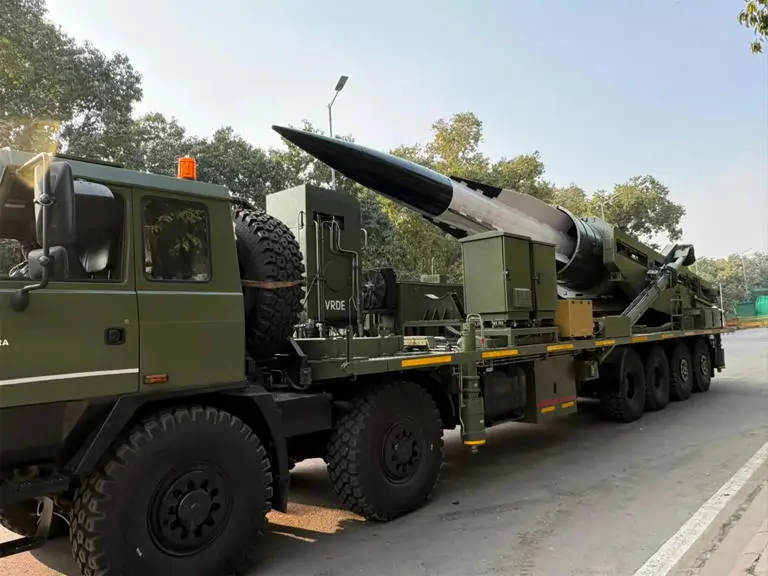
India’s 77th Republic Day Parade on January 26, 2026, will feature a major first with the public unveiling of the Long-Range Anti-Ship Hypersonic Glide Missile (LRAShM), developed by the Defence Research and Development Organisation (DRDO). The missile will be displayed at Kartavya Path, marking a significant moment in how India showcases its advanced strategic capabilities.





A New Dimension in Maritime Strike Capability
Designed to meet the operational requirements of the Indian Navy, the LRAShM is an anti-ship missile with an estimated range of around 1,500 kilometres, enabling it to engage enemy warships across vast stretches of the Indian Ocean Region. Its induction is expected to substantially enhance India’s maritime strike reach and deterrence posture, particularly in safeguarding critical sea lanes.
Hypersonic Speed and High Survivability
One of the missile’s most defining features is its hypersonic speed, allowing it to reach targets at extreme distances in a very short time—potentially within 15 minutes. According to DRDO officials, this combination of speed and advanced flight profile significantly reduces the chances of detection and interception by adversary radar and air defence systems, thereby increasing survivability in contested environments.
How Hypersonic Glide Technology Works
Unlike conventional ballistic missiles, the LRAShM employs hypersonic glide technology. After launch, the glide vehicle travels at extremely high speeds while maintaining aerodynamic efficiency, enabling it to manoeuvre and glide over long distances. This results in an unpredictable trajectory that is far more difficult to track and intercept than traditional missile systems.
Flexible Payload, Potent Naval Role
While detailed specifications remain classified, the missile is understood to be capable of carrying different payloads, allowing it to engage a wide spectrum of naval targets. DRDO has indicated that the system is designed to defeat all classes of warships, providing the Indian Navy with a powerful long-range option against surface combatants.
Looking Beyond 1,500 km
Hypersonic systems are widely regarded as the future of advanced warfare. DRDO is simultaneously working on both hypersonic glide and hypersonic cruise missile technologies, with potential future ranges extending to 3,000–3,500 kilometres as the technology matures.
Other Indigenous Systems on Display
In addition to the LRAShM, the Republic Day Parade will also showcase several other indigenous platforms, including the Dhanush Gun System, Akash (L) Launcher, Suryastra Universal Rocket Launcher System, and Akash missile variants, underlining the depth and breadth of India’s growing domestic defence manufacturing ecosystem.
The debut of the LRAShM at the Republic Day Parade signals India’s growing confidence in its indigenous, high-end military technologies, particularly in the maritime domain, and highlights a decisive step forward in speed, reach, and strategic deterrence.