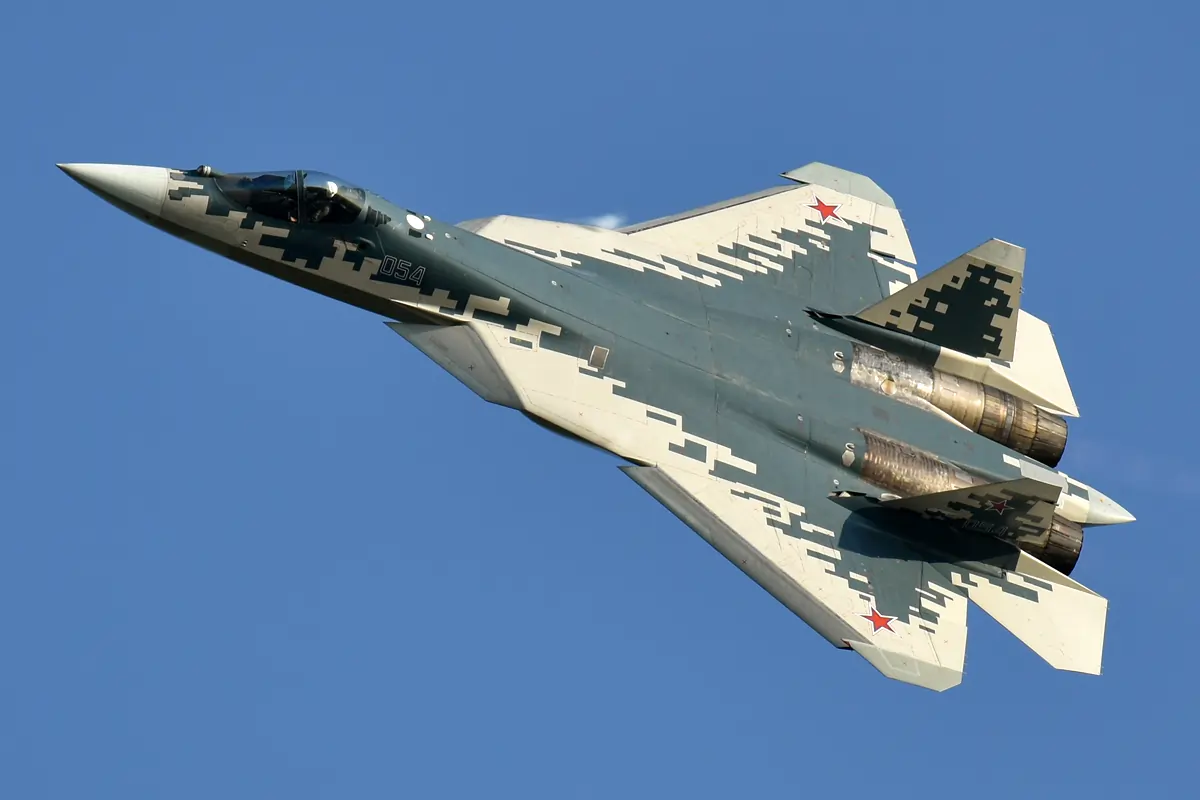
Russia has offered India its advanced twin-seat Su-57M1E fifth-generation stealth fighter jet, along with full technology transfer and access to source code, in a move aimed at strengthening defence cooperation and addressing the Indian Air Force’s future combat aircraft requirements.





The proposal reportedly emerged during high-level interactions between Indian and Russian officials at the Wings India 2026 aviation exhibition. Moscow has also proposed reviving the Fifth Generation Fighter Aircraft (FGFA) programme, which India exited in 2018.
Advanced Technology and Local Production
According to reports, Russia’s United Aircraft Corporation (UAC) has offered India extensive industrial participation, allowing domestic production of key aircraft components. The offer includes cutting-edge technologies such as:
- Next-generation engines (Izdeliye 30 / AL-51F1)
- Active Electronically Scanned Array (AESA) radar
- Advanced optical sensors
- Artificial intelligence-enabled combat automation
- Source code access to integrate Indian weapons such as BrahMos and Astra missiles
The aircraft’s twin-seat configuration is also designed to support modern manned-unmanned teaming (MUM-T) concepts, where the second crew member manages a network of combat drones while the pilot focuses on air combat operations.
Strategic Context
The proposal comes at a time when the Indian Air Force is exploring options to maintain its technological edge, especially as China already operates fifth-generation fighters such as the J-20 and J-35.
India is also in the process of finalising a deal with France for 114 Rafale fighter jets to address immediate operational requirements. However, India’s indigenous Advanced Medium Combat Aircraft (AMCA) programme is expected to enter production only in the mid-2030s, creating a capability gap in the interim.
Possible Interim Acquisition
Defence sources suggest India could consider procuring around two squadrons (approximately 40 aircraft) of the Su-57M1E as a strategic bridge capability while continuing to prioritise the AMCA project.
If the proposal moves forward, it could significantly influence South Asia’s air power balance, with regional observers closely monitoring developments in India’s fifth-generation fighter acquisition plans.