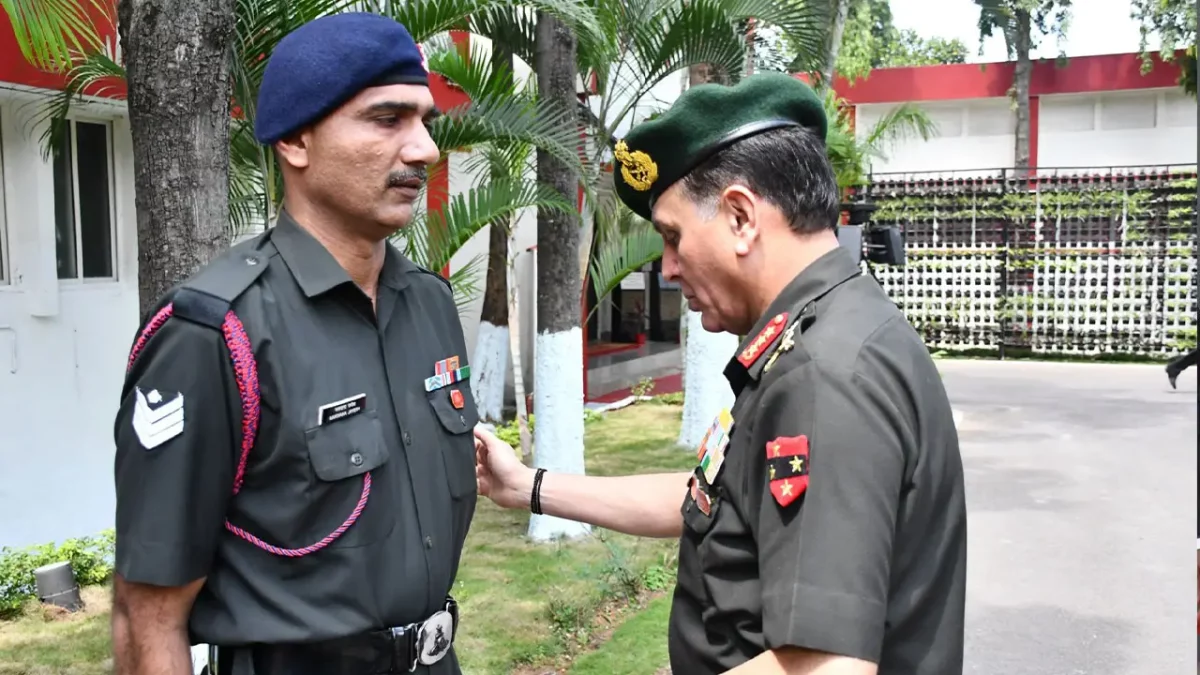
The salutation “Jai Hind,” uttered crisply alongside the military salute, has become an enduring symbol of discipline, unity, and national pride within the Indian Armed Forces. When personnel of the Indian Army, Navy, or Air Force render a salute—whether during parades, official ceremonies, or daily interactions—the accompanying phrase “Jai Hind” resonates as a collective affirmation of loyalty to the nation. This practice, now ubiquitous across all three services, represents more than a mere greeting; it embodies a deliberate post-independence evolution toward a secular, unified Indian military identity.





Historical Origins of ‘Jai Hind’
The phrase “Jai Hind,” literally translating to “Victory to India” or “Hail India,” traces its roots to the Indian independence movement. It was coined in 1907 by Chempakaraman Pillai, an Indian freedom fighter, but gained widespread prominence in the 1940s through the efforts of Netaji Subhas Chandra Bose and his associate Abid Hasan Safrani (also known as Zain-ul Abideen Hasan). Within the Indian National Army (INA), or Azad Hind Fauj, “Jai Hind” was adopted as an official slogan and greeting.
The INA, comprising soldiers from diverse religious, regional, and linguistic backgrounds who had defected from or been captured while serving in the British Indian Army, required a unifying form of address. Prior military customs often relied on faith-specific greetings such as “Ram Ram,” “Sat Sri Akal,” or “Salaam.” Abid Hasan Safrani proposed “Jai Hindustan Ki,” which was shortened to the concise and inclusive “Jai Hind.” Netaji Bose embraced it as the battle cry and standard salutation, fostering a sense of shared purpose and secular solidarity among troops. The slogan transcended religious divisions, allowing soldiers to greet one another—and their superiors—while standing erect with heads held high, in keeping with military dignity.
Following India’s independence in 1947, “Jai Hind” transitioned from a revolutionary rallying cry to a formal element of national identity. It was used prominently by leaders such as Jawaharlal Nehru and later Indira Gandhi, who frequently concluded public addresses with the phrase.
Adoption in the Indian Armed Forces
In the immediate aftermath of independence, the Indian Armed Forces retained certain colonial-era traditions inherited from the British Indian Army. Salutes were typically rendered in silence, or supplemented by regiment-specific or religious greetings that reflected the diverse composition of units. This fragmented approach occasionally underscored divisions rather than cohesion.
The shift toward “Jai Hind” as an integral part of the salute began with the Indian Air Force (IAF). Shortly after 1947, the IAF pioneered the practice of accompanying the salute with “Jai Hind,” establishing a unified, secular protocol that replaced earlier customs. The Indian Navy and Indian Army soon followed suit, recognizing the phrase’s potential to instill a common national ethos across the services.
This adoption was not accidental but aligned with the broader objective of Indianising the armed forces. By embracing a slogan born from the freedom struggle, the military distanced itself from British regimental traditions and reinforced a singular Indian identity. The practice spread organically at first, driven by the shared desire for unity in a newly sovereign nation.
Formalization and Institutional Recognition
The integration of “Jai Hind” received formal impetus in 2012 under the leadership of then-Chief of the Army Staff General Bikram Singh. As part of his “Back to Basics” initiative aimed at strengthening core military values and further Indianising traditions, General Singh issued a directive instructing Army officers to greet one another with a salute accompanied by “Jai Hind.” This replaced more casual time-of-day greetings such as “Good Morning” or “Good Afternoon.” The order explicitly noted that the IAF and Navy had already incorporated the practice, thereby standardizing it across the officer cadre. Jawans (enlisted personnel) continued to use regimental salutations when interacting with officers, preserving unit heritage while aligning with the overarching national greeting.
Former Army Chief General Manoj Mukund Naravane, in his book The Curious and the Classified: Unearthing Military Myths and Mysteries, highlighted this evolution. He observed that the IAF’s early adoption had paved the way for universal acceptance, underscoring how a seemingly simple change carried profound historical depth.
The Deeper Significance and Enduring Relevance
The incorporation of “Jai Hind” with the salute serves several strategic and symbolic purposes. Foremost, it promotes secularism and inclusivity in a force drawn from every corner of India’s diverse society. By providing a single, non-denominational greeting, it eliminates potential religious distinctions during formal interactions and reinforces the principle that service to the nation supersedes all other identities.
Secondly, the practice symbolizes victory and resilience—“Jai” (victory) for “Hind” (India)—echoing the sacrifices of the INA and the broader independence movement. It instills a sense of patriotism and morale, reminding personnel that their duty is ultimately to the motherland. In an era of modern warfare and joint operations, such shared rituals strengthen inter-service camaraderie and operational cohesion.
Today, “Jai Hind” remains a living tradition. It is heard on parade grounds, in training academies, during Republic Day and Independence Day ceremonies, and in everyday military life. Its use extends beyond the armed forces, appearing in civilian contexts as a mark of national pride. For soldiers, however, it retains a special sanctity: a concise yet powerful declaration that every salute is not merely an act of discipline but an affirmation of unwavering commitment to India’s sovereignty and unity.
In conclusion, the evolution of “Jai Hind” from an INA slogan to a cornerstone of military protocol reflects India’s journey from colonial subjugation to sovereign strength. It stands as a testament to the armed forces’ role as guardians not only of territorial integrity but also of the nation’s secular and patriotic ideals. When Indian soldiers salute and proclaim “Jai Hind,” they honour the past, affirm the present, and inspire the future—ensuring that the spirit of unity and victory endures for generations.