

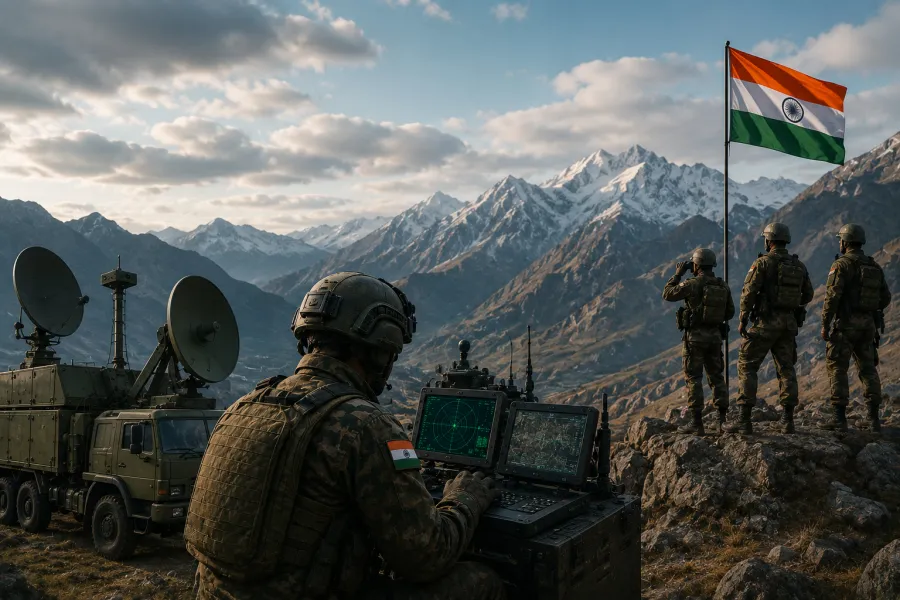
In a major step towards transforming its battlefield capabilities, the Indian Army is set to raise dedicated Electronic Warfare (EW) Brigades along the borders with Pakistan and China. The new formations will be tasked with intercepting, tracking and jamming enemy communications, radar networks and unmanned aerial vehicles (UAVs), significantly enhancing India’s ability to dominate the electromagnetic spectrum during future conflicts.





The specialised brigades will be assigned to specific sectors along the Line of Actual Control (LAC) with China and the Line of Control (LoC) and international border with Pakistan. Their primary mission will be to map, disrupt and blind enemy assets even before conventional military operations commence.
Major Shift in Army’s Operational Strategy
At present, electronic warfare operations within the Indian Army are conducted by specialised Signals units. Under the new structure, these capabilities will be consolidated into dedicated EW Brigades capable of conducting electronic attacks, signal intelligence operations and spectrum dominance missions across designated operational sectors.
The move is part of the Army’s broader technology-driven restructuring programme initiated after Operation Sindoor in May 2025. The modernization effort seeks to create agile, technology-enabled formations capable of operating effectively in future battlefields increasingly shaped by drones, network-centric warfare and electronic combat.
Military sources indicate that the new brigades will play a critical role in providing real-time intelligence inputs to artillery, air defence and strike formations, enabling rapid engagement of enemy UAVs, aircraft and other high-value targets.
Advanced Indigenous Systems to Power EW Brigades
The Ministry of Defence has been strengthening the Army’s electronic warfare capabilities through significant investments in indigenous technology.
In October 2025, the Defence Acquisition Council approved a ₹5,150 crore programme to upgrade the indigenous Dharashakti Electronic Warfare System, developed by the Defence Research and Development Organisation (DRDO) and manufactured by a consortium led by Bharat Electronics Limited (BEL) along with private sector partners including Larsen & Toubro.
The upgraded system demonstrated advanced capabilities during a joint Indian Army-Indian Air Force exercise in September 2025, successfully detecting, analysing and neutralising UAV threats at ranges of up to 150 kilometres while providing real-time threat assessment and electronic jamming support.
Additionally, the Ministry of Defence has signed a ₹1,476 crore contract with Bharat Electronics Limited for the procurement of five advanced mobile ground-based electronic warfare systems. These highly mobile platforms are designed to move alongside combat formations and provide electronic warfare support in challenging operational environments, including high-altitude regions along the LAC.
Lessons from Modern Warfare
The decision reflects the growing importance of electronic warfare in modern military operations. Recent conflicts around the world have demonstrated that dominance in the electromagnetic spectrum can often determine the outcome of battles on land, sea and air.
Electronic warfare systems can intercept radio communications, track radar emissions, disrupt enemy command-and-control networks and jam navigation and communication systems used by drones and guided weapons.
The proposed EW Brigades will continuously monitor radio, radar and digital emissions across operational sectors, building extensive databases of enemy electronic signatures. During conflict, this information can be used to locate, identify and target adversary military assets with greater precision.
Strengthening Multi-Domain Operations
The establishment of dedicated Electronic Warfare Brigades marks a significant evolution in the Indian Army’s approach to multi-domain operations, integrating cyber, electronic, information and conventional warfare capabilities into a unified operational framework.
With increasing reliance on drones, precision-guided weapons, networked sensors and digital communication systems, the Army views electronic warfare as a critical component of future combat readiness.
The new brigades are expected to enhance India’s ability to counter emerging threats while strengthening deterrence along both the northern and western fronts, ensuring that the Army remains prepared for the technology-intensive battlefields of the future.