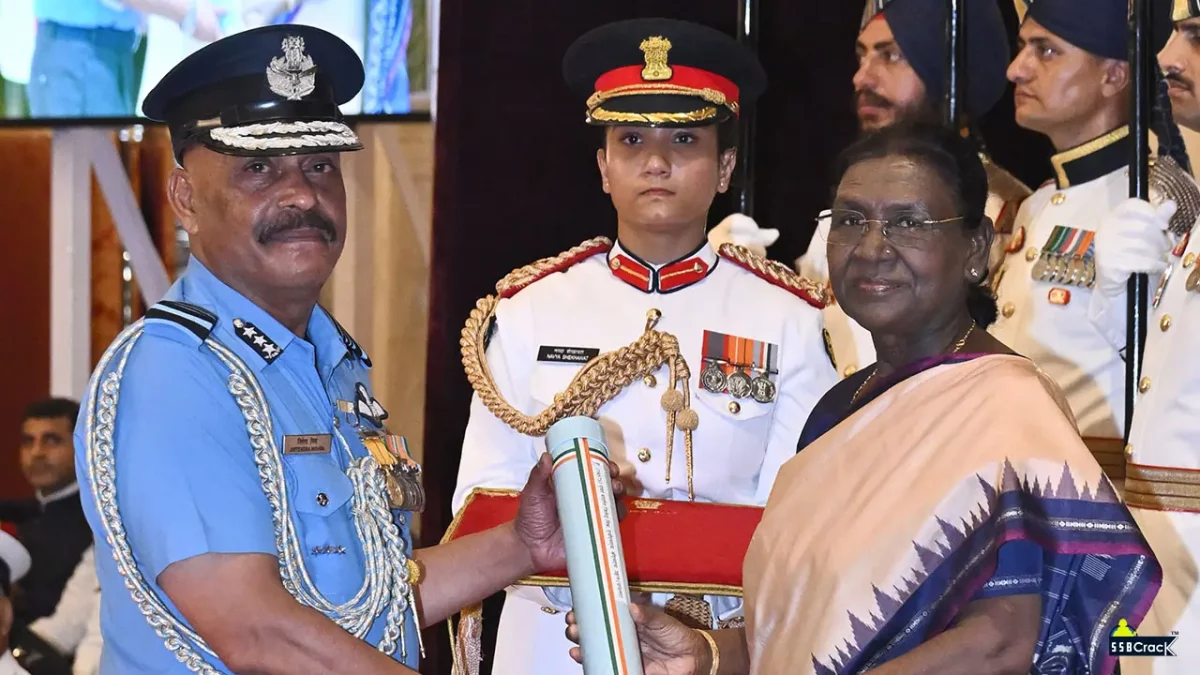
President Droupadi Murmu has conferred the Sarvottam Yudh Seva Medal (SYSM), India’s highest wartime distinguished service honour, on Air Marshal Jeetendra Mishra and six other senior commanders of the Indian Armed Forces for their leadership during Operation Sindoor.





Who is Air Marshal Jeetendra Mishra?
Air Marshal Jeetendra Mishra (Retd) served as the Air Officer Commanding-in-Chief of the Western Air Command (WAC), the Indian Air Force’s largest and most critical operational command, headquartered in New Delhi. Commissioned into the fighter stream of the IAF in December 1986, he is a graduate of the National Defence Academy, the Air Force Academy, and the Air Force Test Pilots School, and logged over 3,000 hours of flying across more than 18 aircraft types in a career spanning nearly four decades. Before taking over WAC, he served as Deputy Chief of Integrated Defence Staff. He had already been awarded the Ati Vishisht Seva Medal (2024) and the Vishisht Seva Medal (2013) prior to this honour.
His years commanding different air force bases, combined with his background as a fighter test pilot, shaped the way he led WAC through Operation Sindoor. That hands-on experience across various aircraft types and operational units gave him a granular understanding of both frontline squadron capability and the technical systems underpinning air defence.
WAC’s role in Operation Sindoor
Operation Sindoor was launched on 7 May 2025 in response to the Pahalgam terror attack of 22nd April 2025, in which 26 civilians were killed. As head of the Western Air Command, Air Marshal Mishra directed offensive air operations and air defence along the western sector, an area that bore the brunt of India’s response.
The IAF carried out precision strikes on terror camps and 11 Pakistani air bases, including Nur Khan and Rahim Yar Khan, while the Integrated Air Command and Control System (IACCS) enabled real-time co-ordination across units. WAC assets also helped defend Indian cities and religious sites against waves of drones and loitering munitions, using Akash surface-to-air missiles and other air defence systems. The IAF received four of the seven Sarvottam Yudh Seva Medals awarded this round — more than any other service — a reflection of how central air power was to the operation’s execution.
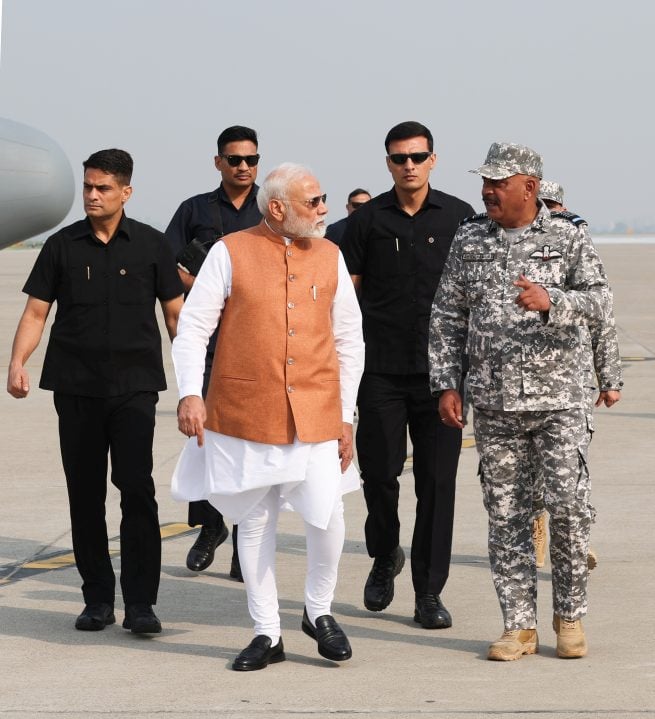
Following the operation, Prime Minister Narendra Modi had visited Air Force Station Adampur 13th May 2025 to interact with the Air Marshal along with the air warriors who played a role in the operation.
Alongside Mishra, the IAF’s other recipients were Air Marshal Narmdeshwar Tiwari (then Vice Chief of the Air Staff during), Air Marshal Nagesh Kapoor (then AOC-in-C, South Western Air Command), and Air Marshal Awadhesh Kumar Bharti (who served as Director General of Air Operations during the conflict). The Army’s Lieutenant General Rajiv Ghai and Lieutenant General Pratik Sharma, and the Navy’s Vice Admiral Sanjay Jasjit Singh (Retd) – the first Navy officer ever to receive the SYSM – completed the list of seven.
Why the SYSM matters
Instituted in 1980 as the wartime equivalent of the Param Vishisht Seva Medal (PVSM), the SYSM recognizes “distinguished service of the most exceptional order during war, conflict, or hostilities.” It is one of India’s rarest military honours. Before this round, it had been awarded only three times – to Lieutenant General Amarjit Singh Kalkat for Operation Pawan in Sri Lanka, and to Air Marshal Vinod Patney and Lieutenant General Hari Mohan Khanna for the Kargil War. The Operation Sindoor honours mark the first time it has been awarded since Kargil.
The awards were announced on 14th August 2025, on the eve of Independence Day, and formally presented to the recipients at a Defence Investiture Ceremony at Rashtrapati Bhavan on 29th June 2026.