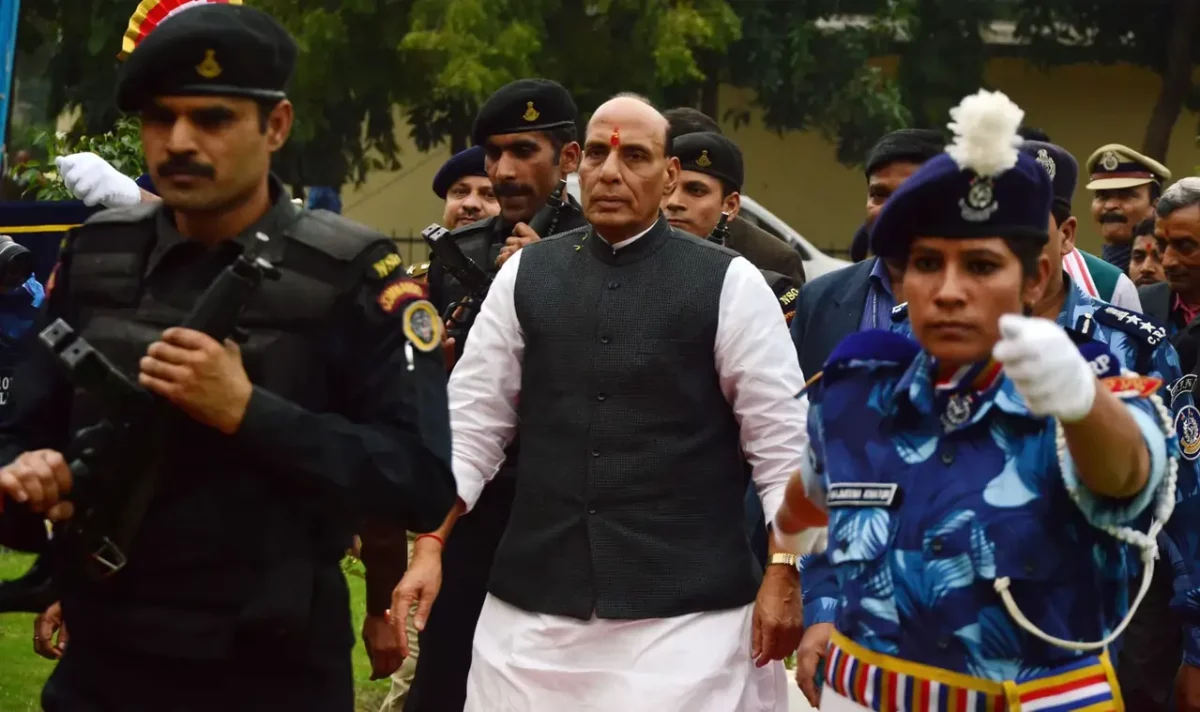
Raksha Mantri Shri Rajnath Singh has stated that Operation Sindoor stands as compelling testimony to India’s world-class defence preparedness, strengthened by the Prime Minister Narendra Modi-led Government’s unwavering commitment to the principles of “Nation First” and “Forces First”. Addressing an event in New Delhi on July 18, 2026, he described the successful military operation as a shining example of India’s transformed defence capabilities, technological prowess and growing self-reliance in defence manufacturing achieved through sustained reforms over the past twelve years.





Highlighting the Indian Armed Forces’ decisive response against terrorism and its patrons, the Raksha Mantri reiterated the Government’s uncompromising zero-tolerance policy towards terrorism. He emphasised that India’s resolve extends beyond rhetoric and reflects its demonstrated capability to strike against terrorism wherever necessary to safeguard national interests.
“Operation Sindoor is testimony to India’s up-to-date, up-to-the-mark and up-to-the-standard defence preparedness,” Shri Rajnath Singh remarked, adding that the operation showcased the unmatched valour and professionalism of the Indian Armed Forces while simultaneously validating the transformative changes undertaken within India’s defence sector.
The Raksha Mantri underlined that Operation Sindoor represented not only military success but also the successful integration of indigenous defence technologies into modern warfare. Advanced systems including the Akash Teer air defence system, the Akash missile system and the BrahMos supersonic cruise missile were effectively employed during the operation alongside several other state-of-the-art military platforms and technologies.
Describing the operation as a shining example of technological warfare, Shri Rajnath Singh observed that its successful execution reflected the Government’s growing confidence in Indian defence industries and indigenous military capabilities. He noted that these achievements have been made possible through the foundation laid over the last twelve years by prioritising domestic manufacturing and reducing dependence on imported defence equipment.
The Raksha Mantri highlighted the significant progress achieved under the Government’s Aatmanirbhar Bharat initiative in the defence sector. He stated that five Positive Indigenisation Lists issued by the Armed Forces now comprise 509 defence items, while five additional lists issued by Defence Public Sector Undertakings include 5,012 items earmarked for indigenous procurement. He announced that another Positive Indigenisation List will soon be notified to further accelerate India’s journey towards defence self-reliance.
Enumerating the remarkable transformation of India’s defence manufacturing ecosystem, Shri Rajnath Singh stated that annual defence production has reached an all-time high of approximately Rs 1.78 lakh crore during the Financial Year 2025-26, compared to around Rs 40,000 crore in 2014. Defence exports have similarly witnessed unprecedented growth, rising from Rs 686 crore in FY 2013-14 to over Rs 38,000 crore today.
The Government has set ambitious targets of surpassing Rs 2 lakh crore in defence production during the current financial year and achieving Rs 3 lakh crore by 2029. Defence exports are projected to reach Rs 50,000 crore by 2029, reflecting India’s growing emergence as a credible global supplier of advanced defence systems and technologies.
Shri Rajnath Singh emphasised that these accomplishments signify a fundamental shift in India’s strategic mindset—from dependence on foreign defence equipment to becoming a producer and exporter of advanced military technologies. He observed that genuine strategic autonomy can only be achieved when nations possess the capability to independently fulfil their defence requirements during times of crisis.
The Raksha Mantri highlighted that defence modernisation and self-reliance have been pursued simultaneously through comprehensive policy reforms aimed at strengthening India’s defence industrial ecosystem. Several initiatives have been introduced to simplify defence exports, including the Defence EXIM Portal, online approval mechanisms, the Open General Export Licence framework, streamlined quality certification procedures, the Green Channel policy and self-certification mechanisms.
He described the establishment of the Defence Industrial Corridors in Uttar Pradesh and Tamil Nadu as one of the Government’s most transformative initiatives for promoting indigenous defence manufacturing. Investments worth approximately Rs 70,000 crore have been proposed across these two corridors, with nearly Rs 10,000 crore already invested. These projects have generated substantial employment opportunities while integrating Indian industries into global defence supply chains.
The Uttar Pradesh Defence Industrial Corridor, in particular, has emerged as a successful example of the Government’s vision of Aatmanirbhar Bharat, facilitating advanced defence manufacturing and strengthening India’s indigenous industrial capabilities.
In the field of defence acquisitions, Shri Rajnath Singh revealed that seventy-five percent of the budget allocated for defence modernisation has been earmarked for procurement from Indian industries. The new Defence Acquisition Procedure (DAP), scheduled to be unveiled this year, will further strengthen domestic defence production by prioritising procurement mechanisms such as “Buy Indian-Indigenously Designed, Developed and Manufactured”.
The Raksha Mantri emphasised that innovation and technological advancement constitute the cornerstone of India’s defence transformation. Under initiatives such as Innovations for Defence Excellence (iDEX), iDEX Prime and the ADITI scheme, procurement approvals worth over Rs 2,400 crore have been granted to start-ups and MSMEs, while projects exceeding Rs 1,500 crore have been sanctioned for developing emerging defence technologies.
As of March 2026, 676 start-ups and innovators have actively engaged through the iDEX framework, resulting in the signing of 551 contracts. Today, more than 2,000 start-ups are contributing to India’s defence ecosystem across domains such as artificial intelligence, drones, cybersecurity, robotics, quantum technologies and other cutting-edge military applications.
Shri Rajnath Singh noted that India’s defence innovation ecosystem now encompasses Defence Public Sector Undertakings, private industries, over 17,000 MSMEs and thousands of supply units across the country. The Defence Research and Development Organisation has similarly evolved into a national innovation platform fostering meaningful collaboration among scientists, industry, academia and emerging technology enterprises.
Reflecting on India’s growing international stature, the Raksha Mantri observed that the country is no longer merely manufacturing defence equipment for domestic requirements but is steadily emerging as a reliable global security partner. India’s expanding role across the Indian Ocean and Indo-Pacific regions increasingly encompasses defence diplomacy, industrial collaboration and technological partnerships.
He highlighted Prime Minister Narendra Modi’s recent diplomatic engagements with Indonesia, Australia and New Zealand as examples of India’s expanding strategic footprint. These engagements have strengthened cooperation across diverse sectors, including the BrahMos missile system, uranium supplies, trade partnerships and cultural initiatives, further reinforcing India’s position as an influential regional and global partner.
Shri Rajnath Singh asserted that India’s defence diplomacy has undergone a fundamental transformation and now extends well beyond strategic cooperation to include technical collaboration, industrial partnerships and integration into global defence supply chains. This transformation, he noted, has been driven by the collective contributions of India’s soldiers, scientists, engineers, innovators, industries, MSMEs and, most importantly, the nation’s youth.
Concluding his address, the Raksha Mantri reaffirmed the Government’s resolve to build an Aatmanirbhar and Viksit Bharat that is both secure and technologically empowered. He stated that New India’s vision encompasses soldiers equipped with indigenous weapons and technologies, scientists empowered through new opportunities, youth driven by innovation and industries capable of competing successfully on the global stage.
“As we approach the centenary of India’s independence in 2047, the world will recognise India not merely as the largest democracy but also as a highly reliable, modern and self-reliant defence power,” Shri Rajnath Singh said, expressing confidence that India’s continued investments in innovation, indigenous capabilities and military modernisation will successfully realise the vision of Viksit Bharat by 2047.