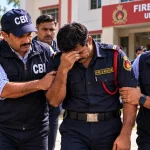

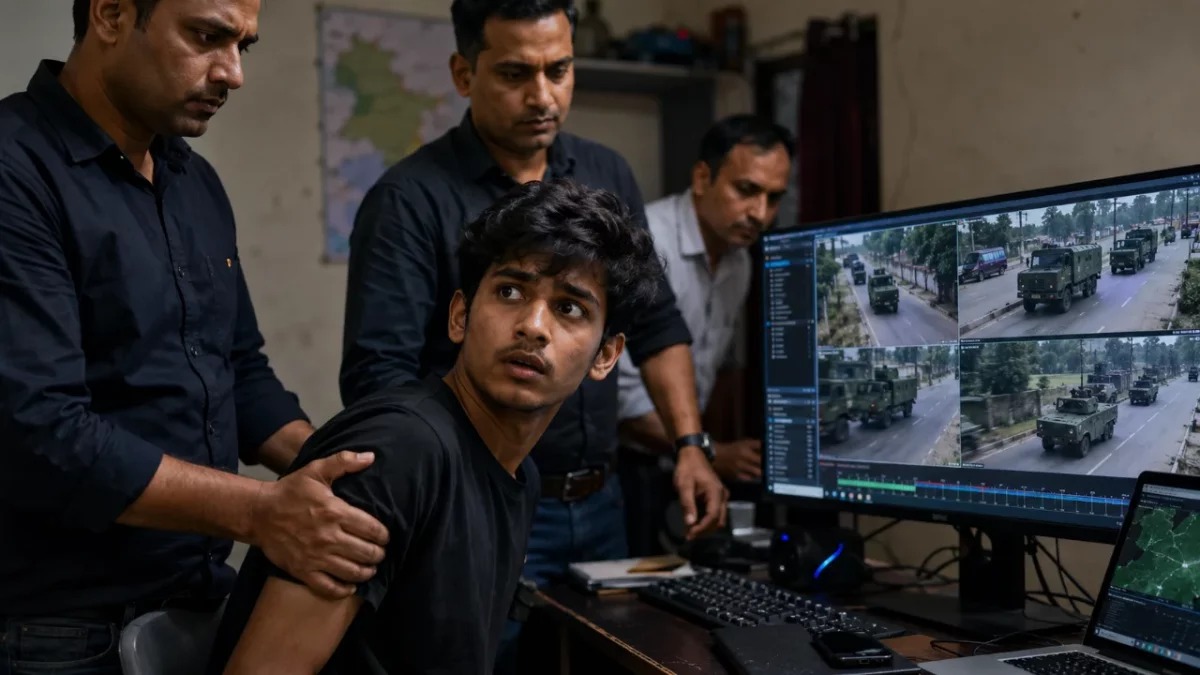
Ludhiana, August 29, 2026 — Punjab Police have arrested a 20-year-old man from Gurdaspur district for allegedly providing Pakistan-based handlers live, round-the-clock access to CCTV footage of Indian Army vehicle movements on the Ludhiana–Ferozepur Road, a stretch that leads toward the strategically important Baddowal Cantonment.





The accused has been identified as Rachhpal Singh (also reported as Rachpal Singh), a resident of Fatehgarh Churian in Gurdaspur. According to investigators, he rented a shop in New Sunder Nagar on the Ludhiana–Ferozepur Road — opposite a private hospital and about six kilometres from Baddowal Cantonment — and used a footwear store as a front. The shop was not opened regularly. Outside it, police say, he installed four banned Chinese CCTV cameras facing the main road. Every military vehicle travelling that corridor toward Ferozepur and the western frontier would pass the cameras’ field of view.
DCP (Investigation) Harpal Singh said the arrest followed a specific tip-off. “He ran a shoe store but would not open shop regularly. The CCTVs installed outside his shop faced in the direction of Ludhiana-Ferozepur road. All these raised suspicion,” an officer told reporters. Pakistan-based handlers allegedly had live access through mobile applications after Rachhpal shared user IDs and passwords. The feed, police say, was available 24 hours a day.
Money, handlers and the drug-smuggling trail
Interrogation has indicated that the operation ran for about two months. Rachhpal allegedly received between ₹2.5 lakh and ₹3 lakh in cash in instalments, plus ₹40,000 a month toward shop rent. Investigators suspect the payments were routed through cross-border drug smugglers. Police say they have identified the intermediary through whom he first made contact with the handlers and are examining how that relationship began — whether through social media, an existing criminal network, or another recruiter.
A case has been registered at Sarabha Nagar police station under Sections 3, 4, 5 and 9 of the Official Secrets Act, 1923, and Section 61(2) of the Bharatiya Nyaya Sanhita (criminal conspiracy). Four cameras with memory cards were recovered. Agencies are now analysing whether the footage was only streamed live or also recorded and stored, who else had access, and whether the module was part of a wider network.
Why the location matters
Baddowal Cantonment is not an ordinary roadside post. It houses the 17 Field Ammunition Depot and an Air Defence Unit that provides cover to the nearby Halwara Air Force Station and Ludhiana itself. The depot was established to support the Ferozepur frontier, which lies close to the Pakistan border. The Ludhiana–Ferozepur Road is a natural transit corridor for military convoys. Giving a foreign intelligence service a persistent, real-time view of that traffic — vehicle types, frequency, timing, and direction — is precisely the kind of tactical intelligence that can be used to map logistics patterns.
A repeating pattern in Punjab
This is not an isolated case. Police and national media have described it as part of a cluster of similar modules busted in Punjab in recent months:
- In Kapurthala, suspects were arrested after a SIM-based Chinese camera mounted on a pole transmitted live footage of military activity.
- In Pathankot, a resident was arrested for installing an internet-enabled camera on the Pathankot–Jammu stretch of NH-44, a major Army and paramilitary movement corridor, and sharing the feed with handlers (one report said he received ₹40,000 and instructions from a contact in Dubai).
- Earlier in 2026, Delhi Police Special Cell and Punjab units dismantled a larger ISI-linked module in which young men, some recruited on Instagram, installed solar-powered and 4G CCTV cameras near Army, Air Force and BSF sites across Punjab, Haryana, Rajasthan and Jammu.
The common features are striking: inexpensive, internet-connected Chinese cameras; a civilian cover (shop, rented premises, pole); remote access via an app after credentials are shared; cash payments often linked to the same smuggling networks that already move drugs and weapons across the border; and recruitment of young men from border districts who may have little ideological commitment but are vulnerable to money.
The banned-camera problem
The Indian government has banned the sale of certain internet-connected Chinese CCTV systems on security grounds. Officials say Indian agencies cannot easily access the overseas servers these devices use, while anyone with a username and password can watch the feed from abroad. Despite the ban, police say such cameras continue to be smuggled into cities like Ludhiana via Delhi and sold locally. That gap — cheap hardware, easy remote access, weak last-mile enforcement — is what modules of this type exploit.
What investigators are still trying to establish
Police have not publicly named the Pakistan-based handlers or confirmed an ISI command link in court papers, though several reports describe the case in those terms. The live questions are:
- How long the feed actually ran and what specific movements it captured.
- Whether Rachhpal acted alone or had local facilitators (landlord, electrician, someone who helped install or maintain the cameras).
- Whether the same handlers run parallel cameras at other points on the Ferozepur axis.
- How payments crossed the border and whether the drug-smuggling channel can be mapped further.
Ludhiana police and intelligence units are treating the case as both an Official Secrets Act prosecution and a counter-intelligence lead. Similar busts in Pathankot and Kapurthala suggest a systematic effort to place low-cost, deniable sensors on roads that Indian forces use to move toward the western theatre — not a one-off freelance job.
The accused remains in custody. Further arrests, if any, will depend on what the digital trail on the cameras, phones and money trail yields.