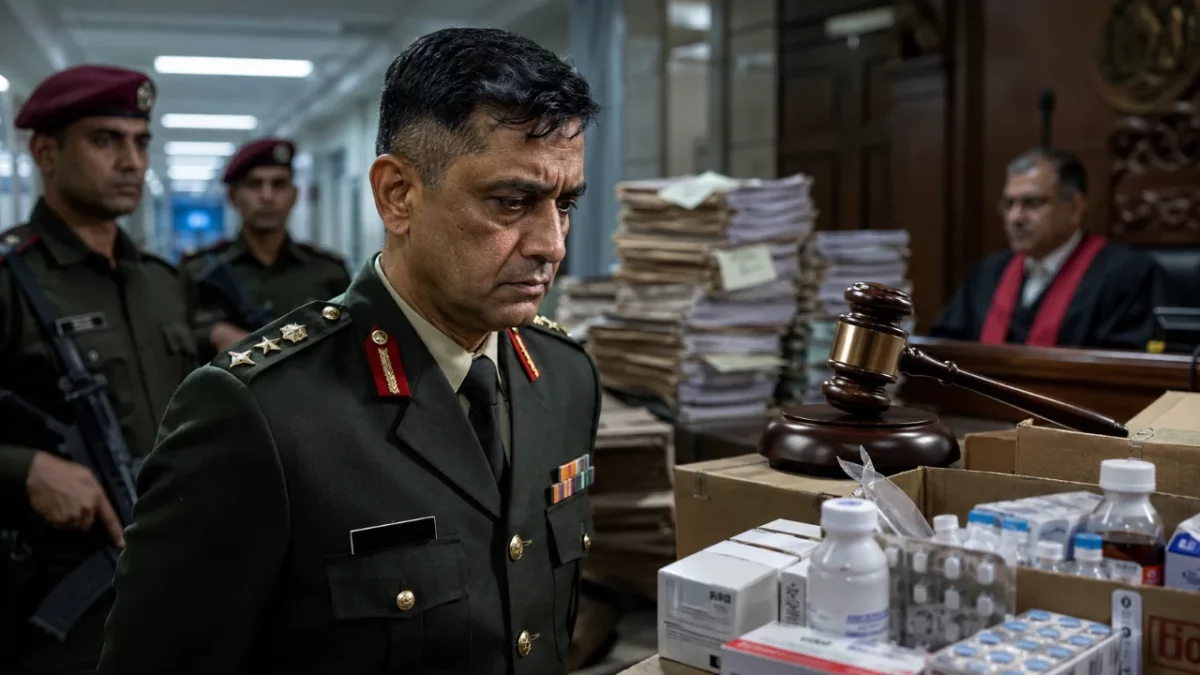
Jammu: A Summary General Court Martial (SGCM) has cashiered a Lieutenant Colonel of the Army Medical Corps (AMC) and sentenced him to one year of rigorous imprisonment after finding him guilty of financial misappropriation and administrative irregularities connected with the procurement of medical supplies for 166 Military Hospital in Jammu.





The officer faced 14 charges under Sections 52(a), 52(f) and 63 of the Army Act, involving allegations of false statements, intent to defraud and acts prejudicial to good order and military discipline. The military court found him guilty on five counts. The trial concluded on August 28, 2026, in the Nagrota area near Jammu.
The findings and sentence remain subject to confirmation by the competent confirming authority. Proceedings before the Armed Forces Tribunal (AFT) also mean that the punishment cannot be treated as finally implemented at this stage.
According to the chargesheet, the Lieutenant Colonel served as the indenting officer for medical supplies at 166 Military Hospital during 2018 and 2019. He was also involved in technical and financial board proceedings relating to procurement.
The prosecution alleged that while performing these responsibilities, the officer repeatedly projected urgent requirements for medical stores worth approximately Rs 3 crore in violation of provisions of the Defence Procurement Manual, 2009. He was also accused of improperly selecting and rejecting vendors, allegedly resulting in undue benefits to certain parties.
The hospital’s overall allocation for medical supplies during the two-year period covered by the chargesheet was reported to be approximately Rs 30 crore.
Another aspect of the prosecution’s case concerned the procurement of fixed-dose and multi-salt combination medicines in unusually large quantities. These medicines were allegedly purchased on a non-approved or special procurement basis instead of through the normal government medical supply chain.
The prosecution alleged that expensive medicines were recommended for purchase after two vendors were selected through a restricted tendering process. Questions were also raised over the officer’s participation in different stages of the procurement process, including technical evaluation and financial proceedings.
According to reports concerning the court-martial proceedings, 32 witnesses were examined during the trial. The Lieutenant Colonel was represented by multiple defence counsel during the course of the proceedings.
The chargesheet further alleged that the officer became aware that his signatures had been forged on certain technical board documents but failed to report the alleged forgery to his superior authorities.
The Lieutenant Colonel pleaded not guilty to the charges. His defence maintained that his actions had been bona fide and argued that some of the documents relied upon by the prosecution were forged and did not contain his genuine signatures.
The officer had also approached the Armed Forces Tribunal before the conclusion of the disciplinary proceedings. The AFT’s Principal Bench declined to stop the court-martial but directed that no final decision arising from the proceedings should be implemented until further orders.
That direction remains significant following the SGCM verdict. The punishment awarded by the military court must pass through the statutory confirmation process, while any applicable directions of the Armed Forces Tribunal will also have to be complied with before the sentence can be implemented.
The procurement controversy originated from complaints that surfaced in 2021-22. A subsequent Court of Inquiry, headed by a Major General with two Brigadiers as members, examined allegations of large-scale irregularities involving the local purchase of medicines using government funds.
Following the inquiry, three Army personnel — the Major General who had served as Commandant of the military hospital, the Lieutenant Colonel involved in procurement and a Junior Commissioned Officer — were reportedly attached for disciplinary proceedings.
The latest conviction is linked to the same procurement episode in which the hospital’s former Commandant, a Major General of the Army Medical Corps, was separately tried by an SGCM.
In July 2026, the Major General was found guilty on 16 of 18 charges concerning alleged irregularities and misappropriation associated with procurement of medical supplies worth approximately Rs 11 crore during his tenure as Commandant of 166 Military Hospital between August 2018 and January 2020.
The Major General was also awarded cashiering from service and one year’s rigorous imprisonment. His sentence similarly remains subject to the military confirmation process and applicable directions of the Armed Forces Tribunal.
The allegations in that case concerned purchases of medicines, including tablets, gels and ointments, along with dressings and medical equipment that were allegedly excessive in quantity or cost. The prosecution also alleged that incorrect information had been provided in procurement certification documents in violation of provisions of the Defence Procurement Manual.
Proceedings against a Junior Commissioned Officer linked to the procurement case have also reportedly been underway separately.
Cashiering is one of the most serious punishments that can be imposed upon a commissioned officer by a court martial. It amounts to punitive dismissal from military service and is distinct from normal retirement or administrative release from the Armed Forces.
The additional sentence of one year’s rigorous imprisonment would involve imprisonment following confirmation and subject to the outcome of any legal proceedings or tribunal orders affecting implementation of the punishment.
166 Military Hospital is an important Army medical establishment serving personnel in the Jammu region. Local procurement mechanisms allow military hospitals to purchase medicines and other essential medical stores when requirements cannot be met adequately or quickly through the central supply system.
Such expenditure is governed by prescribed procurement procedures intended to ensure that requirements are genuine, competitive processes are followed where applicable and government funds are properly accounted for.
The cases arising from the hospital’s 2018-20 procurement cycle are particularly significant because disciplinary proceedings have reached senior levels of the Army Medical Corps, including a Major General who commanded the hospital and a Lieutenant Colonel directly involved with procurement.
However, the punishments awarded by the respective courts martial should not yet be regarded as finally executed. Further action will depend upon confirmation by the competent military authorities and compliance with directions issued by the Armed Forces Tribunal.