

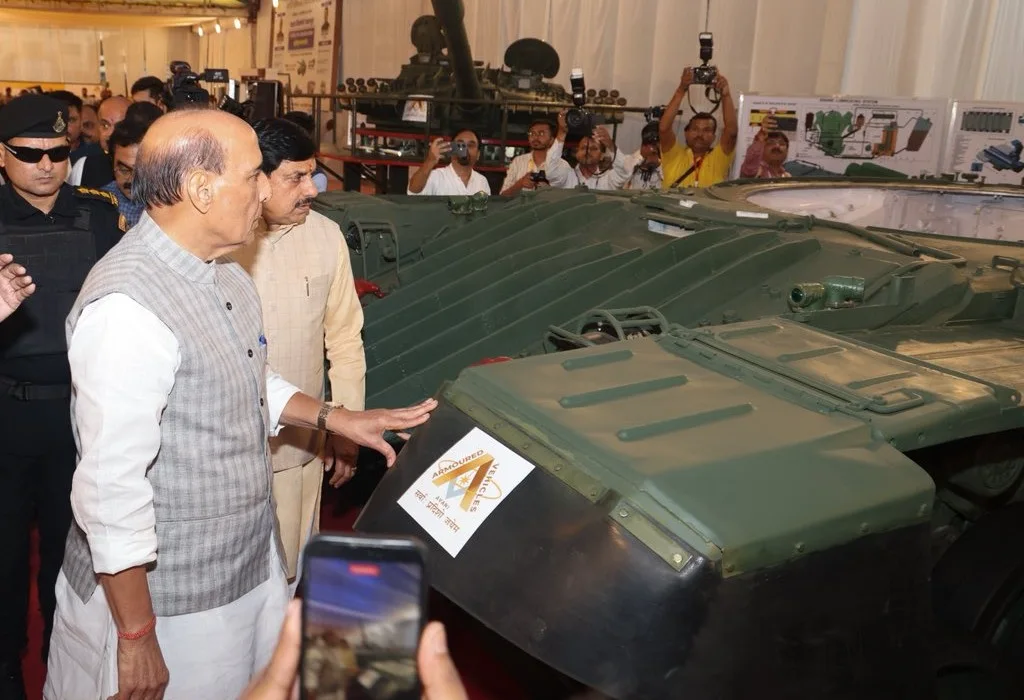
Jabalpur / New Delhi, August 27, 2026 — Defence Minister Rajnath Singh and Madhya Pradesh Chief Minister Mohan Yadav on Thursday performed the bhoomi pujan for a ₹472-crore T-series tank overhaul facility at Vehicle Factory Jabalpur (VFJ), a unit of Mini Ratna defence PSU Armoured Vehicles Nigam Limited (AVNL).





The plant is designed to overhaul 80 T-72 Ajeya and T-90 Bhishma main battle tanks every year. Combined with the Heavy Vehicles Factory (HVF) at Avadi in Tamil Nadu — which currently handles about 150 tanks annually — the new capacity is intended to close a long-standing shortfall against the Army’s requirement of roughly 230 tank overhauls a year.
Officials present at the ceremony included Secretary (Defence Production) Sanjeev Kumar and AVNL Chairman and Managing Director Satyabrata Mukherjee.
Why the gap mattered
A tank overhaul is not routine servicing. It is a deep, factory-level rebuild: inspection, repair and replacement of engines, transmissions, running gear, fire-control systems, armour fittings and other life-limited assemblies so that an ageing platform can return to units with a fresh operational cycle.
Until now that work has been concentrated at Avadi. HVF has supplied around 4,400 tanks to the Army over four decades, and AVNL as a group already has about 25 years of experience overhauling T-72 and T-90 variants. But a single-site bottleneck of 150 overhauls against a 230-tank annual need left a structural gap of about 80 tanks — exactly the capacity Jabalpur is being built to provide.
If that gap persisted, more tanks would sit in the maintenance pipeline instead of on the line of control or in strike formations. The Jabalpur project is therefore less a prestige plant than a readiness fix: more refurbished platforms, shorter queues, and a second node so that one factory’s disruption does not stall the entire fleet.
Jabalpur also sits closer to many Army field formations than Avadi. Singh said the location “will significantly reduce transportation time and logistical requirements for tank overhaul and maintenance,” cutting the cost and delay of moving 40-plus-tonne vehicles across the country.
The facility is planned with a modern plant and a dedicated testing track for inspection and operational trials after rebuild. Local reports put construction at roughly two years. In an initial phase before the full line is ready, VFJ is expected to complete complete overhaul and upgradation of about 12 T-72s a year.
Pilot already done
The foundation stone is not a standing start. AVNL authorised a pilot at VFJ in April–May 2025. The factory built the necessary technical setup, sent more than 30 employees for specialised training, and overhauled two T-72s in about nine months — inspection, repair and component replacement to Army specifications — before handing them back to the service.
That trial was the proof-of-concept for expanding VFJ from vehicles and engines into full T-series tank rebuilds. Established in 1969, the factory first produced Shaktiman 3-tonne trucks with Germany’s MAN and Nissan 1-tonne and Jonga vehicles with Japan’s Nissan. The complex covers about 330 acres, with an adjoining estate of around 600 acres. Over time VFJ has produced more than 1,000 T-72 engines and supported T-90 assembly — a base of mechanical and armour-vehicle skill the new line will draw on.
Part of a much larger fleet rebuild
The Jabalpur plant sits inside a wider five-year restoration and modernisation pipeline the Army has offered industry. About 790 T-72s are slated for restoration at a cost of more than ₹13,000 crore, with AVNL — including VFJ — expected to execute the work with support from a large MSME and startup ecosystem. Another 200 T-90s are planned for phased restoration at an estimated ₹56,000 crore. Separate work on BMP infantry combat vehicles is assigned to AVNL’s Ordnance Factory Medak.
Those numbers explain why a second overhaul factory is not optional. India still fields a large Soviet-origin armour inventory — on the order of 1,700 T-72s plus the T-90 Bhishma fleet — while it also inducts newer platforms and experiments with Future Ready Combat Vehicles. Until those replacements arrive in volume, the existing tanks remain the iron of the strike corps. Keeping them overhauled, and incrementally fitted with better sensors and battlefield systems, is how the Army stretches combat power without waiting for an all-new fleet.
Tanks in an age of drones
Singh used the ceremony to push back against the idea that tanks are obsolete because drones, missiles and precision munitions now dominate headlines.
“Our Army is one of the most powerful forces in the world. T-72 and T-90 tanks are extremely important for ground warfare. They stand like an iron wall on our borders,” he said, adding that they remain a “death knell for the enemy” and a morale factor for troops in forward areas.
He framed modern war as combined arms, not a single-platform contest: tanks, infantry, artillery, drones, air power, surveillance and precision weapons as one system — the logic of the Army’s Integrated Battle Groups. Tanks, he said, must be given better sensors and capabilities matched to that battlefield. The government’s focus, he added, is to give soldiers drones, missiles, artillery, electronic warfare, energy weapons and modernised tanks, and to make them work together. “This overhaul facility will advance this vision.”
The argument is practical. Overhaul is not only about keeping old steel running; it is the workshop through which upgrades — fire control, protection, communications, situational awareness — can be inserted without waiting for a new design.
Aatmanirbhar, MSMEs and Jabalpur as a hub
Singh presented the project as another step in making, repairing, maintaining and upgrading defence equipment inside India rather than depending on foreign depots and spare-part pipelines. He cited the jump in defence production to around ₹1.80 lakh crore in FY 2025-26 from ₹46,000 crore in 2014, and exports of about ₹39,000 crore from less than ₹1,000 crore a decade earlier.
For Jabalpur and the surrounding belt, the industrial effect is meant to be local. Overhauling T-72s and T-90s creates demand for mechanical, electrical, electronic and hydraulic components, assemblies and subsystems. The ministry says that sourcing will pull in MSMEs, thicken the supply chain, and create work for technicians, workers, youth and small entrepreneurs in and around the city. Singh said the aim is to make Jabalpur “a major hub for defence technology, maintenance, modernisation and manufacturing.”
He also pointed to Madhya Pradesh’s wider defence-industrial push: 3,073 hectares identified in the Gwalior–Chambal region and proposed investments of more than ₹16,960 crore, alongside the state’s investor-summit and single-window machinery. CM Yadav said the Jabalpur investment would strengthen the state’s defence ecosystem and MSME participation.
What “closing the gap” actually means
On paper, 150 tanks at Avadi plus 80 at Jabalpur equals the Army’s stated annual need of 230. In practice, readiness will depend on whether the new line is commissioned on time, whether quality matches Avadi’s four-decade standard, and whether the MSME supply chain can feed both factories without imported bottlenecks on critical assemblies.
If it works, the Army gets a geographically split overhaul system: Avadi in the south, Jabalpur in central India, closer to many operational holdings, with less time lost moving tanks by rail. The T-72 and T-90 fleets — still the mass of Indian armour — stay in a sustainable rebuild cycle while larger modernisation contracts run in parallel.
That is the maintenance gap the ₹472-crore plant is meant to close: not a shortage of tanks on paper, but a shortage of factory capacity to keep those tanks fighting.