
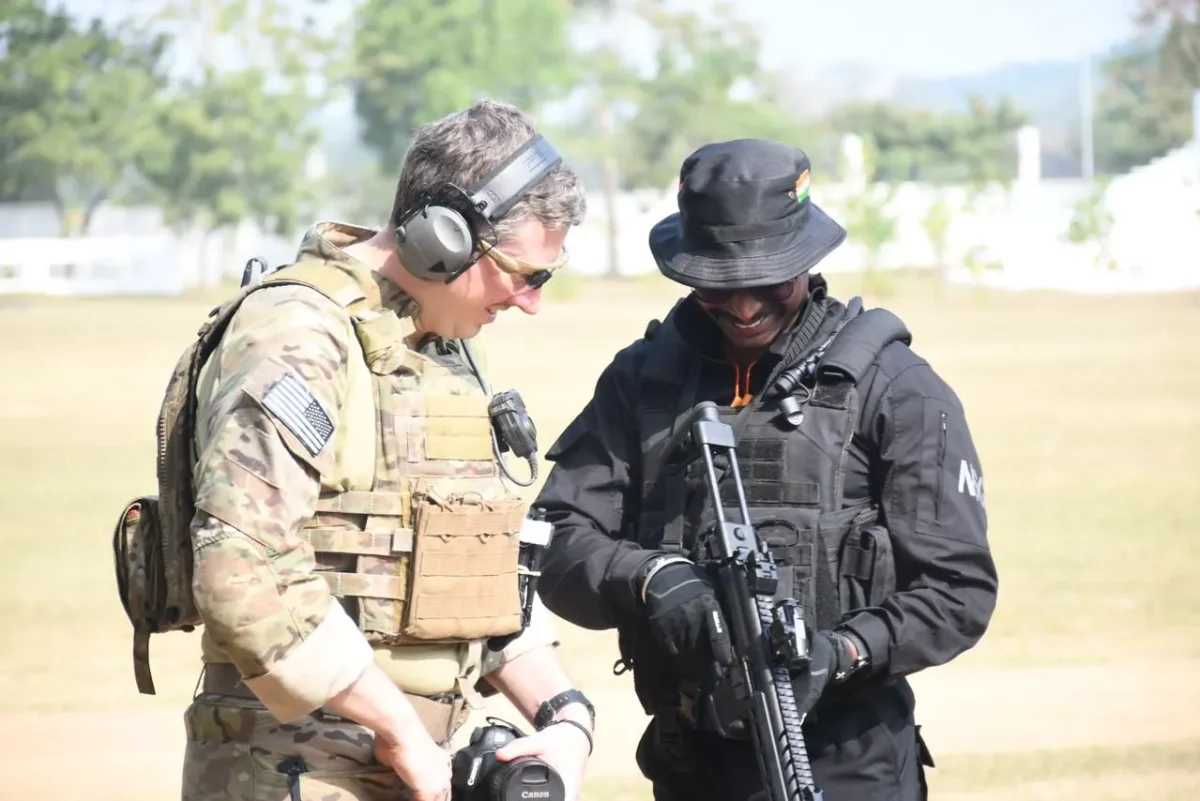
NSG and US Army personnel, along with Pimpri-Chinchwad Police and other agencies, conducted a high-intensity joint anti-terror mock drill at the Infosys Phase II campus in Hinjewadi, Pune, on Wednesday, 5 August 2026, to test emergency response and inter-agency coordination against potential terrorist threats.



The exercise ran for approximately five to six hours, from around 3 pm or 4 pm until 9 pm. It simulated a terrorist attack scenario at the high-value corporate facility in the Rajiv Gandhi Infotech Park, one of India’s major IT hubs that hosts numerous domestic and international companies and sees thousands of employees daily.
Commandos and officers from the NSG’s Mumbai-based 26 Special Composite Group took part. They were joined by 17 United States military commandos who are currently undergoing joint training exercises with the NSG. Local and state forces included Maharashtra Police’s elite Force One counter-terrorism unit, personnel from the Pimpri-Chinchwad Police’s Anti-Terrorism Branch, Quick Response Team (QRT), Riot Control Unit, Bomb Detection and Disposal Squad (BDDS), Hinjawadi Police Station, and Hinjawadi Traffic Division. Representatives from the Pimpri-Chinchwad Municipal Corporation’s Disaster Management Department, MIDC Hinjawadi Fire Service, ambulance services, senior Infosys officials, and the company’s security team also participated.
Senior officials from the NSG, the Pimpri-Chinchwad Police Commissionerate, and Infosys monitored the drill. The scenario tested multiple layers of response: the role of first responders, inter-agency coordination, crisis management, tactical intervention and neutralisation of attackers, bomb detection and disposal, cordon and search procedures, safe evacuation, crowd management, and the company’s internal security protocols.
DCP (Special Branch) Dheeraj Patil stated: “The objective of the mock drill was to strengthen coordination among all stakeholder agencies and enhance preparedness for responding swiftly and effectively to any terror-related emergency.” The exercise concluded successfully after meeting its operational objectives.
Hinjewadi’s status as a dense, high-visibility economic zone makes it a priority for such readiness drills. Sudden arrivals of armed personnel and security convoys initially caused curiosity and temporary unease among some local residents and employees, with reports of the area seeing heightened activity. Authorities clarified that it was a planned, controlled exercise, after which normalcy returned.
The involvement of US military personnel fits into the broader pattern of India-US special forces cooperation. The NSG (popularly known as the Black Cats) regularly conducts joint counter-terrorism training with US Army Special Forces units, including the long-running Tarkash series of exercises focused on urban warfare, hostage rescue, and related tactics. Regional hubs such as the 26 Special Composite Group in Mumbai were established after the 26/11 attacks to enable faster response; composite groups draw personnel from both the Army and Central Armed Police Forces and are designed for rapid deployment in their zones.
Such multi-agency drills serve practical purposes beyond publicity. They expose gaps in communication, logistics, medical support, and on-ground coordination between elite central forces, state police specialised units, civic emergency services, and private corporate security. For an IT campus, the exercise also validates internal lockdown, evacuation, and information-flow protocols under realistic pressure. Successful completion reinforces the message that security agencies treat soft targets of economic importance with the same seriousness as more traditional high-threat locations.
In summary, the five-hour joint mock drill at Infosys Phase II in Hinjewadi on 5 August 2026 brought together NSG commandos from the 26 Special Composite Group, 17 US military personnel, Force One, multiple Pimpri-Chinchwad Police units, civic emergency services, and Infosys teams. It simulated a terrorist attack to evaluate and improve rapid, coordinated response capabilities in one of India’s key technology and commercial hubs.