
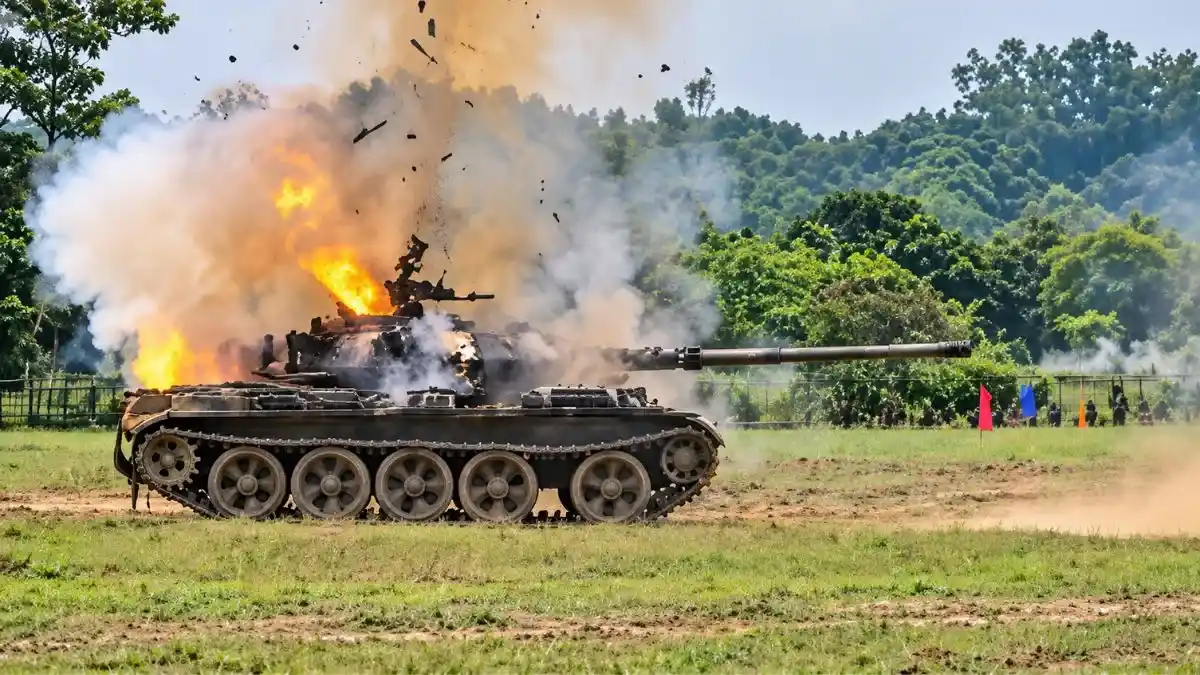
Two Bangladesh Army soldiers were killed and one officer was seriously injured on Wednesday after a tank exploded during a live-fire exercise at the Hathazari Field Firing Range in Chattogram. Bangladesh’s Inter-Services Public Relations Directorate (ISPR) confirmed the accident but did not officially identify the vehicle. Multiple media reports and circulating video footage indicate that the tank was a Chinese-origin Type 59 main battle tank.
According to an ISPR statement, the incident occurred while the crew was firing from the tank during a field-firing exercise. “Today, during a field-firing exercise at the Hathazari Field Firing Range in Chattogram, a sudden accident occurred while a tank was firing, killing two Bangladesh Army soldiers and seriously injuring an officer,” the Directorate said. The injured officer was airlifted to the Combined Military Hospital in Dhaka for advanced treatment. ISPR added that necessary steps were under way to determine the cause of the accident.
Local outlets, including The Daily Star and Prothom Alo, reported the same official account and did not immediately name the two soldiers who died. The identities of the deceased had not been released in initial statements. Reports citing The Daily Star said the two soldiers were inside the tank at the time of the blast.
Official confirmation and unofficial identification
The Bangladesh Army has not formally named the tank model involved. Indian and international coverage, drawing on social-media video from the range, has identified the vehicle as a Type 59, a Chinese-designed main battle tank derived from the Soviet T-54 and long used by Bangladesh’s armoured units. A video circulating online appears to show a violent blast during firing, with at least one soldier thrown into the air. The precise trigger—ammunition malfunction, mechanical failure, crew error, or another cause—had not been established.
Ageing Chinese-origin fleet
The Type 59 has formed part of Bangladesh’s armoured inventory for decades. Rather than retiring the platforms entirely, Dhaka has pursued life-extension and modernisation programmes. Defence procurement documents have previously referred to upgrades of Type 59 tanks and modernisation of Type 69IIG vehicles, intended to improve fire control, protection and combat systems and to keep the ageing fleet operational. Some Type 59 hulls have been rebuilt to a higher standard locally known as Type 59G Durjoy. Whether the tank involved at Hathazari was an original Type 59 or an upgraded variant has not been confirmed.
The accident has already prompted commentary on the reliability of older Chinese-origin armour still in service. Investigators will need to separate equipment age, maintenance, ammunition quality and training procedures before any conclusion can be drawn. No official finding had been issued at the time of reporting.
Investigation
ISPR said an inquiry had been initiated. No further technical details, range-safety findings, or comment from Chinese manufacturers or suppliers were available. The Army has not indicated whether firing at Hathazari was suspended after the explosion.
The Combined Military Hospital in Dhaka was treating the injured officer. Funeral arrangements for the two soldiers had not been announced in the initial official notice.