
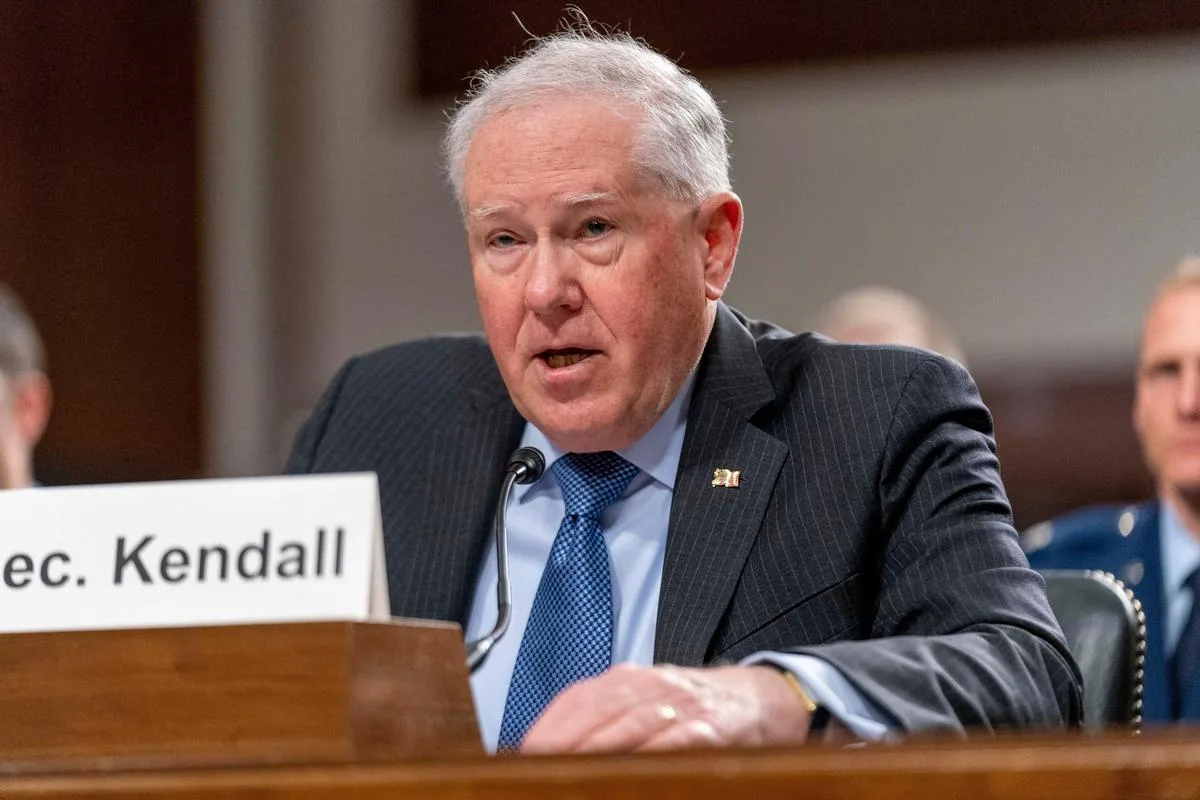
The United States Department of Defense has revoked the security clearance of former Secretary of the Air Force Frank Kendall, barring him from accessing classified information and from holding any position requiring security clearance, following allegations that he disclosed sensitive information relating to the capabilities of Air Force One to the media.



The decision was announced by Chief Pentagon Spokesman Sean Parnell, who stated that the revocation took effect immediately. According to the Pentagon, the action was taken over allegations that Kendall had shared classified details concerning the security features and operational capabilities of the presidential aircraft.
In a statement, Parnell emphasised that safeguarding classified information is a fundamental responsibility of all current and former government officials entrusted with access to sensitive material. He stated that individuals who violate that trust forfeit the privilege of accessing classified information and serving in positions involving national security responsibilities.
The Pentagon, however, did not identify the media organisation with which the alleged information was shared or specify the exact nature of the information that was considered classified. Officials also did not indicate whether the matter would be referred for criminal investigation or prosecution.
Frank Kendall denied any wrongdoing, saying he was “completely mystified” by the decision. He maintained that throughout his government service he had been extremely careful not to disclose classified information and stated that no government agency had informed him of what specific information he was alleged to have revealed.
The controversy follows media reports published last month regarding the capabilities of a Boeing 747 aircraft donated by Qatar for use as a temporary Air Force One platform. The aircraft reportedly underwent modifications valued at approximately 400 million US dollars before entering service and has already been used for domestic flights as well as President Donald Trump’s visit to Turkey.
Media reports had suggested that the aircraft lacked several advanced security, communications and defensive systems available on the existing Air Force One fleet. In comments reported by The New York Times, Kendall stated that time constraints had prevented the installation of all standard Air Force One modifications, resulting in certain security, communications and support capabilities not being incorporated into the aircraft.
Kendall reportedly questioned the decision to operate the aircraft outside the United States, particularly amid heightened tensions involving Iran, suggesting that the absence of some specialised capabilities could be a matter of concern. He had also previously stated that bringing the aircraft up to the full Air Force One standard would require an additional three to four years of engineering modifications.
President Trump travelled aboard the aircraft during his visit to Turkey for a NATO summit but later departed using one of the older Air Force One aircraft after the United States launched military strikes against Iran and Tehran responded with attacks on several Gulf Arab states. While reports indicated that the change was recommended by the US Secret Service due to security considerations, the President denied that the switch was prompted by concerns over the aircraft’s capabilities.
The US Air Force has defended the rapid conversion programme, stating that the aircraft was prepared without compromising security, safety or secure communications. At the same time, officials acknowledged that the aircraft does not possess every capability found on the traditional Air Force One fleet, with several complex engineering modifications intentionally omitted during the conversion process. These reportedly include certain structural features such as wider emergency exits and integrated boarding stair systems.
The dispute has also attracted attention because of the US Justice Department’s earlier attempts to identify the sources behind media reports concerning the aircraft. Prosecutors had issued subpoenas to journalists at The New York Times seeking disclosure of confidential sources, but those subpoenas were withdrawn after judicial criticism of the department’s legal approach.
The action against Kendall is the latest in a series of security clearance revocations undertaken by the Trump administration involving current and former national security officials. Although no criminal proceedings have been announced in Kendall’s case, alleged unauthorised disclosure of classified information in the United States can result in investigations under the Espionage Act if authorities determine that national security information has been improperly revealed.
The Pentagon has not released additional details regarding the evidence supporting its decision, and the matter is expected to remain under scrutiny as questions continue over the balance between classified information, public accountability and official commentary on national security issues.