
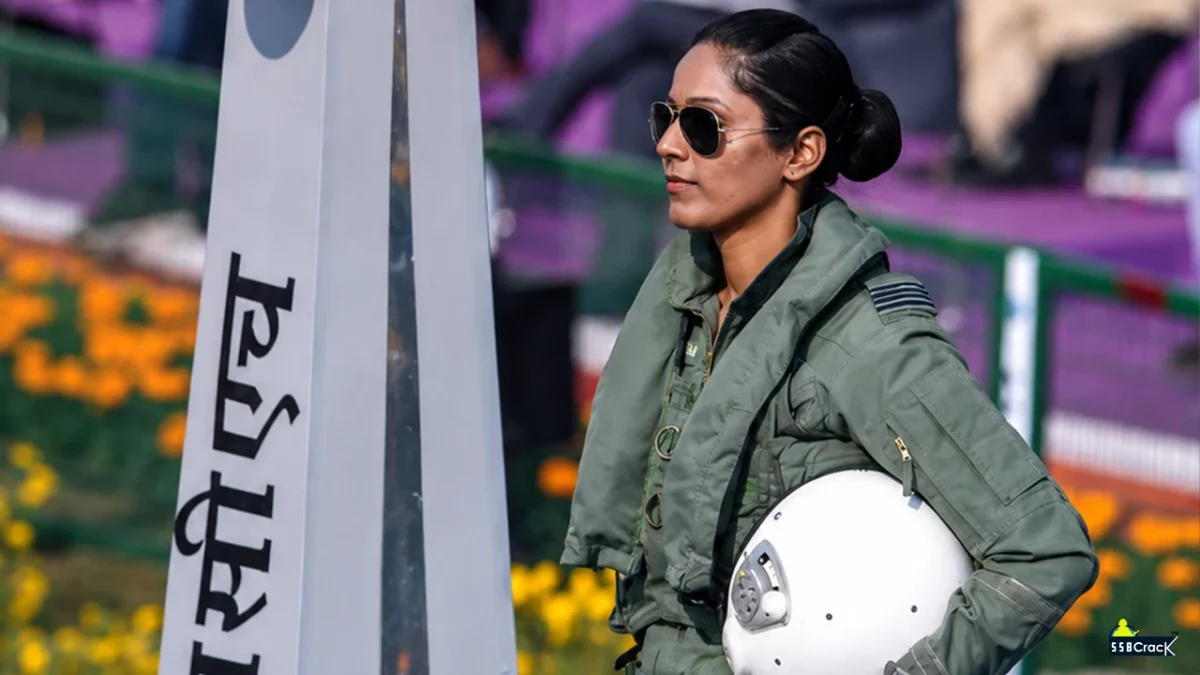
Squadron Leader Bhawana Kanth has become the first woman officer in the Indian Air Force to successfully complete the prestigious Fighter Combat Leader (FCL) course at the Tactics and Air Combat Development Establishment (TACDE) in Gwalior. The achievement, reported on 6 August 2026, marks another major breakthrough for women in combat aviation a decade after the fighter stream was opened to them.

The FCL course is widely regarded as the IAF’s equivalent of the US Navy’s Strike Fighter Tactics Instructor programme, popularly known as “Top Gun.” It is one of the most selective and demanding professional qualifications for fighter pilots. Only a handful of officers roughly one per cent of IAF pilots are chosen for the intensive 20-week (nearly five-month) programme. Graduates return to their squadrons as specialists responsible for refining combat tactics, operational planning, weapons employment, combat manoeuvring, and shaping frontline strategies.
The course curriculum covers advanced air combat tactics, operational doctrine, mission planning, electronic warfare, and emerging challenges such as unmanned systems, network-centric operations, and long-range precision-strike capabilities. TACDE itself functions as the IAF’s premier centre for developing air combat doctrine and tactical innovation. Beyond training elite pilots, it formulates tactical procedures and standard operating procedures, and validates newly inducted fighter aircraft, radars, and weapon systems before they enter operational service. It also runs the Helicopter Combat Leader and Master Fighter Controller courses.
A pioneering career
Bhawana Kanth was commissioned as a Flying Officer in June 2016 as one of the first three women fighter pilots in the IAF, alongside Avani Chaturvedi and Mohana Singh. The government had opened the fighter stream to women on an experimental basis in 2015; the trio completed Stage I and II training and were formally commissioned by then Defence Minister Manohar Parrikar at the Combined Graduation Parade at the Air Force Academy, Dundigal.
Born on 1 December 1992 in Darbhanga, Bihar, and raised in the Barauni Refinery Township in Begusarai, Kanth completed her schooling at Barauni Refinery DAV Public School and earned a Bachelor of Engineering in Medical Electronics from BMS College of Engineering, Bengaluru. She briefly worked at Tata Consultancy Services before clearing the Air Force Common Admission Test and opting for the fighter stream. Her father, Tej Narayan Kanth, an electrical engineer with Indian Oil Corporation, has spoken of her long-standing childhood ambition to fly.
Key milestones in her career include:
- Joining a fighter squadron in November 2017 after training on Pilatus, Kiran, and Hawk aircraft.
- First solo flight on the MiG-21 Bison in March 2018 (the second woman to do so after Avani Chaturvedi).
- Becoming the first woman fighter pilot to qualify for daytime combat missions on the MiG-21 Bison in May 2019 after completing the day operational syllabus.
- Later transitioning to the Su-30 MKI.
- Participating in the IAF tableau at the Republic Day parade in 2021 the first woman fighter pilot to do so.
- Receiving the Nari Shakti Puraskar from President Ram Nath Kovind in March 2020, along with her batchmates.
Broader context of women in the IAF
Kanth’s FCL qualification comes amid a series of recent firsts for women aviators. In May 2026, Squadron Leader Saanya became the first woman officer to earn the Category-A Qualified Flying Instructor (Cat-A QFI) rating the highest instructional qualification, awarded only to those authorised to train and assess other flying instructors. Earlier, Squadron Leader Shivangi Singh (India’s first woman Rafale pilot) earned the Qualified Flying Instructor badge and later piloted a sortie involving President Droupadi Murmu in a Rafale.
These achievements build on earlier barriers broken by the 2016 batch and subsequent women fighter pilots. Mohana Singh became the first woman to fly the indigenous Tejas in a frontline squadron, while others have moved into advanced platforms and instructional roles. Women officers have also distinguished themselves as fighter controllers and in operational briefings.
TACDE’s own history underscores the significance of the course. Established in 1971 as the Tactics and Combat Development and Training Squadron and redesignated TACDE in 1972, it has long served as the crucible for refining India’s aerial combat doctrine. Based in Gwalior, it trains the top tier of fighter pilots and has played a central role in preparing the force for complex operational environments.
Squadron Leader Bhawana Kanth’s graduation from the Fighter Combat Leader course places her among the IAF’s elite tactical leaders. It demonstrates that the experimental induction of women into the fighter stream has matured into full professional integration at the highest levels of combat flying and leadership training. Her journey from a Bihar village background and engineering degree to MiG-21 combat qualification, Su-30 operations, and now FCL status continues to expand the operational and inspirational horizon for women in the Indian Air Force.