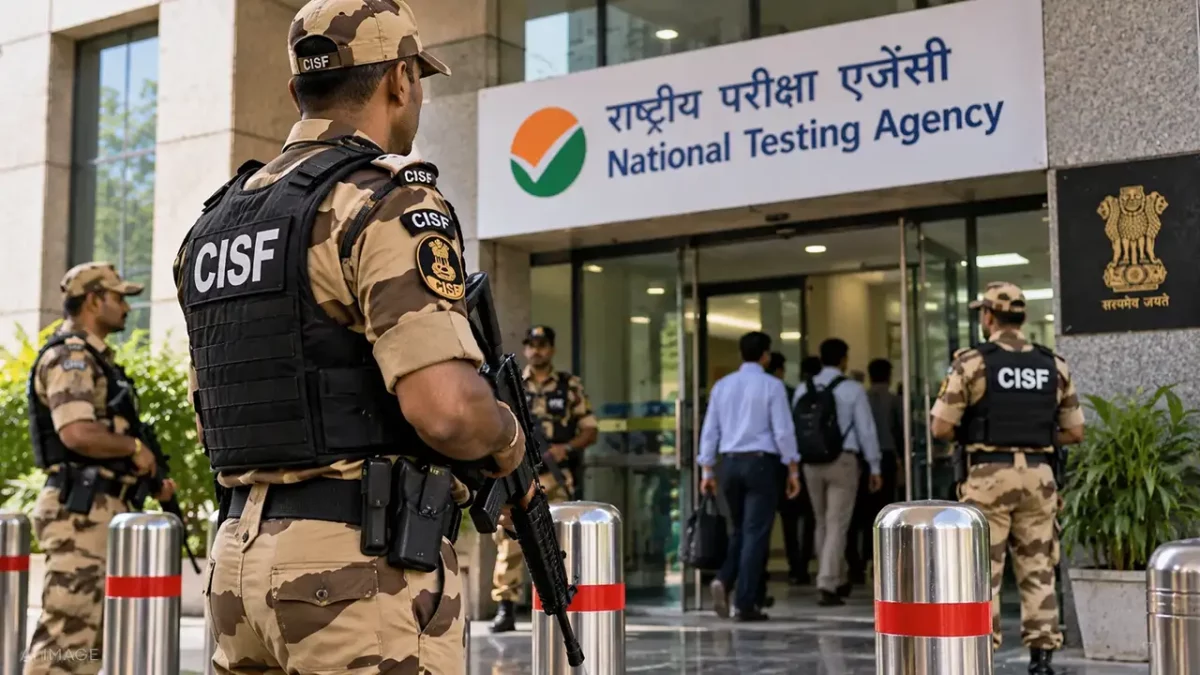
New Delhi, September 28, 2026 — The Union Home Ministry has approved CISF cover for the NTA’s relocated headquarters in the Government of India Press Building on Minto Road. Thirty-nine CISF personnel have been assigned to the premises. Their mandate is access control, screening of staff and visitors, and close monitoring of demarcated confidential areas where examination material is handled.





The force is stationed at entry and exit points leading to those restricted sections. Screening arrangements include frisking, X-ray baggage scanners and Door Frame Metal Detectors. Officials said movement and operations inside the confidential zones will be strictly regulated to prevent unauthorised access to sensitive material.
“Confidential areas have been demarcated in the building where the movement and operations will be strictly monitored to ensure that a foolproof system is in place,” a senior official said. The Home Ministry’s approval of CISF cover forms part of that arrangement.
The NTA has shifted confidential and sensitive work from its earlier office in Okhla to more than 55,000 square feet of space allotted in the Press Building. The fifth floor and portions of the fourth and sixth floors have been assigned to the agency. The relocation of those operations took place over the past month.
Some reports have noted that CRPF personnel were providing interim security at the new site and that the full CISF transition would be completed over two to three months. The bulk of coverage on 27 September stated that 39 CISF personnel have already been deployed under the approved cover.
Security gaps identified after the leak
The tightening of physical security follows the NEET-UG 2026 paper leak, which prompted nationwide student protests and the resignation of then Union Education Minister Dharmendra Pradhan. Prime Minister Narendra Modi subsequently announced a high-powered task force headed by Infosys co-founder Nandan Nilekani to recommend reforms intended to make the examination system leak-proof.
A CBI chargesheet identified three NTA subject experts as primary sources of the leaked paper. Investigators alleged that the experts took notes on small slips made from sheets supplied for rough work and translation, or memorised questions and reconstructed them later. The chargesheet stated that there was no checking or frisking of experts on entry to or exit from the confidential section at the earlier office, and that the premises lacked a dedicated control room for live CCTV monitoring.
Those findings have been cited by officials as the immediate reason for isolating confidential work in a government building and placing a central armed police force at its access points.
Wider overhaul
The CISF deployment is one element of a broader security and process overhaul at the NTA. The agency has been directed to strengthen protocols for confidential operations, including controlled access, closer surveillance and complementary cyber-security measures. Separate reports have referred to air-gapped systems for sensitive work, a designated Chief Information Security Officer, and plans to recruit specialists in cybersecurity and question-paper design.
The NTA was established in 2017 under the Ministry of Education to conduct standardised national examinations. The Minto Road relocation and CISF cover are intended to place its most sensitive functions in a government premises with regulated entry, continuous screening and force-level monitoring of the areas where examination material is prepared and handled.