Bijapur / Morena, September 2, 2026: After nearly three decades away from service, Girvar Singh Tomar has made an extraordinary return to the uniform of the Central Reserve Police Force (CRPF), bringing to an end a 27-year struggle that began with his dismissal from the force in 1999.





The 54-year-old native of Chhichhawali village in Madhya Pradesh’s Morena district recently reported for duty with the CRPF’s 85th Battalion in Bijapur, Chhattisgarh. His return is particularly remarkable because much of the period between his dismissal and reinstatement was spent living the life of a sadhu.
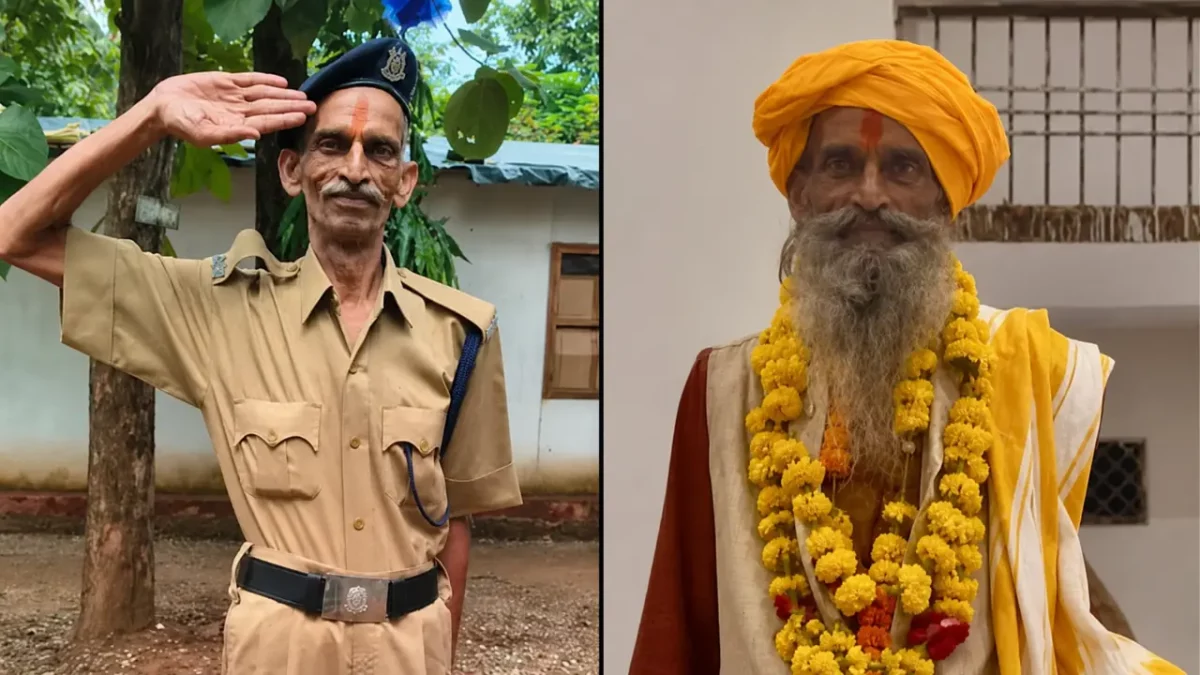
On the night of August 25, Tomar boarded a train from Morena for his new posting. After reaching Bijapur the following morning, one of his first stops was a barber shop. The long hair and flowing white beard he had maintained during his years as a sadhu were cut away. By afternoon, the mustard-coloured robes associated with his spiritual life had been replaced by a crisp CRPF khaki uniform, cap and polished boots.
“It is all by the grace of God. It feels as if I have returned home,” Tomar said after rejoining the force.
Tomar joined the CRPF in 1991 and served for around eight years before his career was abruptly interrupted. His service came to an end on October 21, 1999, following a departmental inquiry arising from a dispute involving a senior officer.
Tomar has maintained that the allegation at the centre of the dispute — that his bicycle had struck the officer’s vehicle — was false. According to him, his decision to contest the accusation ultimately made matters worse.
“I contested the allegation that my bicycle hit his vehicle. That made the situation worse,” he recalled.
Court records identify him as Constable Driver Girwar Singh Tomar, force number 913126828, and state that he was charge-sheeted in July 1999. Following his dismissal, his departmental appeal and subsequent revision were rejected in 2000.
Unwilling to accept the decision, Tomar approached the Allahabad High Court, beginning what would become a legal battle spanning more than two-and-a-half decades.
A significant breakthrough came on April 10, 2007, when a single judge of the Allahabad High Court concluded that even if the allegations against Tomar were accepted, the punishment of dismissal was harsh and disproportionate to the alleged misconduct. The court consequently granted him relief.
However, his return to service was still far away. The Union of India and the CRPF challenged the ruling through a special appeal and secured a stay. The litigation subsequently remained pending for years, leaving Tomar in an unusual state of uncertainty over his future.
As the legal proceedings dragged on, Tomar’s life took a dramatically different direction.
After returning to Morena, he joined the Nirmohi Akhara around 2001 and embraced the life of a sadhu. He became known as Baba Girvar Das and later as Girvardas Maharaj. He initially spent time at the Barahdwari temple near his village before spending around two decades at Morena’s Gufa Mandir.
His days were increasingly devoted to prayer and temple duties, but his fight to regain his CRPF service continued. Tomar reportedly travelled for court proceedings whenever required, moving between his spiritual responsibilities and a legal battle over a uniform he had once worn.
Despite becoming a sadhu, he remained connected with his family. Tomar is the son of Damodar Singh Tomar. His wife, Manju Devi, and their four children remained part of the household he continued to support. His daughters Shivani and Radha are married, while one of his sons, Abhishek, serves in the Indian Air Force. His other son is Krishna.
The decisive development finally came in August 2025, when a Division Bench of the Allahabad High Court disposed of the Union government’s appeal and directed that Tomar be taken back into service within three months.
Even then, his reinstatement was not immediate.
The CRPF reportedly faced difficulties retrieving records connected to a case dating back more than two decades. Further notices followed as Tomar waited for the High Court’s direction to be implemented.
Nearly a year later, the long wait finally ended. The CRPF issued orders for him to rejoin service around August 26, 2026, posting him with the 85th Battalion in Bijapur.
From his dismissal in October 1999 to his return to uniform in August 2026, Tomar had spent almost 27 years fighting to regain his place in the force.
His return also meant entering a CRPF very different from the one he had left behind. Most of the personnel with whom he had once served have long since retired or moved on. Tomar said only one or two people from his earlier period of service remain, but his new colleagues welcomed him warmly.
“Only one or two people from my time remain, but colleagues here are so welcoming and caring, it is as if I never left,” he said.
Despite exchanging his robes for the CRPF uniform, Tomar says his return to service does not represent an abandonment of his spiritual beliefs. The years spent as Baba Girvar Das remain an important part of his life, even as he resumes the duties of a uniformed member of the force.
He has also indicated that his battle may not be entirely over. Tomar intends to pursue the promotions and associated service benefits he believes he would have received had his career not been interrupted by the dismissal.
His story stands out even among India’s many prolonged service-related legal disputes. A CRPF personnel dismissed from service, a court battle lasting nearly three decades, approximately two decades spent living as a sadhu, and finally a return to active duty at the age of 54 make his case exceptionally unusual.
For years, Tomar lived between two worlds — performing worship at a temple while simultaneously fighting through the courts for the right to wear his uniform again.
Now, after 27 years of petitions, appeals, stays and waiting, the mustard robes of Baba Girvar Das have once again given way to CRPF khaki.
For Girvar Singh Tomar, returning to the 85th Battalion is more than simply resuming a government job. It marks the restoration of a career he had fought nearly half his life to reclaim — and an extraordinary homecoming to the uniform he first wore in 1991.