

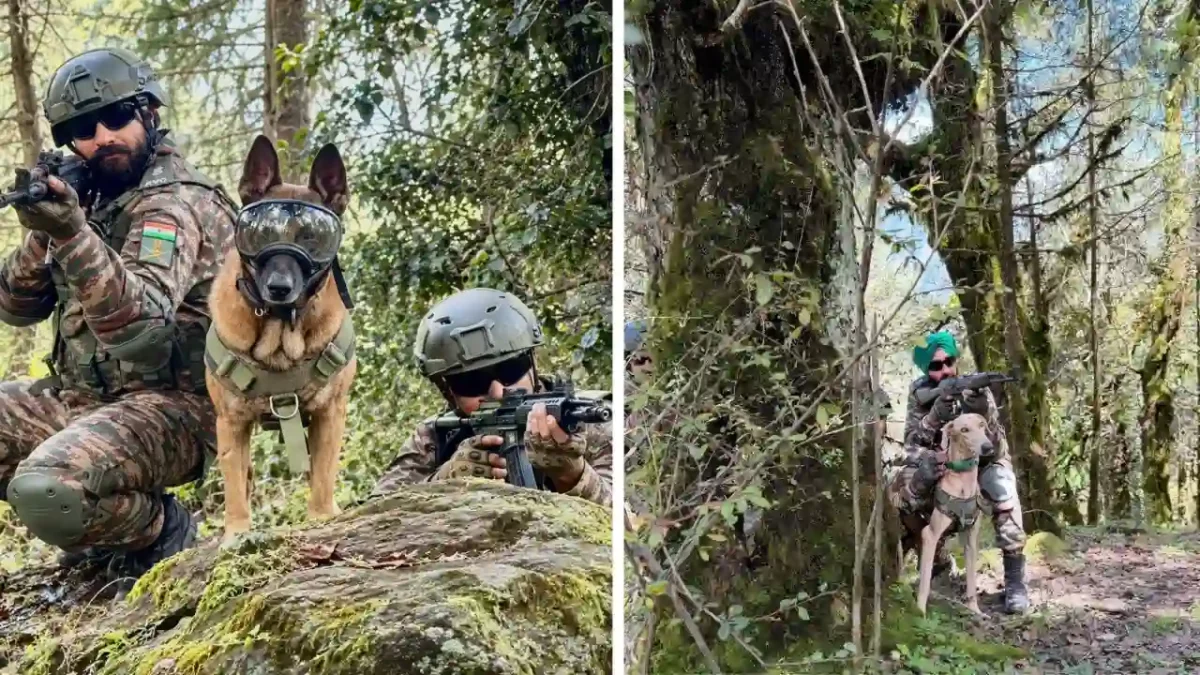
Indian Army canines Rice, Victor, Zac and Rowdy are participating in Exercise Yudh Abhyas 2026, demonstrating the specialised capabilities of trained military dogs in supporting troops during demanding tactical operations.




As part of the professional exchanges between the Indian Army and the US Army, the canines participated in drills involving room intervention and rappelling. The demonstrations provided US Army personnel an opportunity to observe the animals’ training, agility and employment alongside troops in challenging operational situations.
The participation of military dogs adds a specialised dimension to the exercise, highlighting the close coordination required between highly trained canines and their handlers during tactical missions.
Among the four canines participating in Yudh Abhyas 2026, Victor and Rowdy are Rampur Hounds, an indigenous Indian breed that is increasingly being employed by the Indian Army for military roles. Zac is a Belgian Malinois, while Rice is a Labrador Retriever.
The diverse composition of the canine team reflects the employment of different breeds for specialised military tasks. Their participation in the bilateral exercise also provides an opportunity to demonstrate the training standards and operational roles of Army Canines to personnel from a partner force.
The Rampur Hounds participating in the exercise bring operational experience from deployments in different parts of the country. They had earlier demonstrated their capabilities during an international multilateral exercise at Umroi in Meghalaya.
Following that engagement, the Rampur Hounds were deployed along the Manipur border, where they successfully detected Improvised Explosive Devices. Their operational employment demonstrated the potential of indigenous canine breeds in supporting troops during security operations in challenging environments.
The operational experience of this canine line extends to deployments in other sectors as well. Their siblings were deployed in the Jalandhar and Amritsar Sectors during Operation Sindoor, highlighting the use of trained military dogs across varied operational environments.
The experience gained through these deployments has added to the demonstrated utility of the Rampur Hounds in military roles. Their participation alongside other Army Canines at Yudh Abhyas 2026 further showcases the adaptability of trained dogs when employed with troops under demanding tactical conditions.
Military working dogs can provide specialised support during operations where their agility, mobility and training allow them to operate alongside soldiers. Their effectiveness depends not only on the capabilities of the animals but also on intensive training and close coordination with their handlers.
The room-intervention and rappelling demonstrations during Yudh Abhyas 2026 offered a practical display of this human-canine coordination. Such drills require the animals to respond to their handlers while negotiating complex environments and operating as part of a larger tactical team.
For the US Army personnel observing the demonstrations, the exchange provided insight into the training and employment practices of Indian Army Canines. At the same time, such professional engagements allow participating forces to share experiences and observe different approaches to specialised military capabilities.
The inclusion of Army Canines in Yudh Abhyas 2026 therefore extends the exercise beyond conventional soldier-to-soldier training. It highlights a specialised capability that supports troops in tactical situations and underscores the importance of trained animal teams within military operations.
The participation of indigenous Rampur Hounds is particularly significant in this context. Their deployment history, including operations along the Manipur border and participation in international exercises, demonstrates their use beyond ceremonial or demonstration roles.
Their involvement, alongside the Belgian Malinois and Labrador Retriever, also illustrates the varied canine capabilities available to the Indian Army. At Yudh Abhyas 2026, these highly trained animals are demonstrating how canine teams can complement soldiers during specialised operations while strengthening professional exchanges between the Indian and US armies.
The exercise thus provides another platform for showcasing the operational utility, adaptability and reliability of Army Canines, while highlighting the growing role of indigenous breeds such as the Rampur Hound in India’s military canine capabilities.